In January 1865, not long after his march had reached the sea, General William Tecumseh Sherman held a remarkable meeting in Savannah, Georgia. Along with Secretary of War Edwin M. Stanton, Sherman spoke with a group of 20 Black ministers about slavery, the Civil War, and the world that was to rise from the ashes of both. Of the sentiments the Baptist Garrison Frazier voiced on behalf of the group, one in particular was repeated: the desire, as Frazier put it, “to assist the Government in maintaining our freedom,” by which he meant serving in the military. Since the beginning of the conflict, Black Americans had invested their hopes for freedom in the Union cause, through both their support of the military and their service within its ranks. Expressing that devotion, Frazier told Sherman and Stanton that “if the prayers that have gone up for the Union army could be read out, you would not get through them these two weeks.”
On the eve of Juneteenth, a holiday celebrating the military order that affirmed emancipation in Texas, such connections are under strain. Pete Hegseth has taken up Edwin M. Stanton’s title as “secretary of war” but not quite his mantle. As my colleague Clint Smith writes in the July issue of The Atlantic, Hegseth has been at work supporting the administration’s project of “delegitimizing the accomplishments—and the very presence—of Black people in the military.” In addition to Hegseth blocking the advancement of Black senior officers and presiding over the restoration of Confederate memorials, the Department of Defense has removed tributes to Black heroes in the Pentagon and on department webpages.
Hegseth’s war on “wokeness” and diversity is also a war on history itself. Black military service has existed since the Revolution. The close bonds Frazier described were cemented with the Civil War, when Black Americans saw the Union army as an instrument of emancipation and full citizenship, as well as a way to serve the national cause. The Atlantic contributor Thomas Wentworth Higginson, a white officer in one of the first Black regiments to be recognized by Stanton, wrote in the magazine in 1864 that Black soldiers had remolded “the destinies of two races on this continent.”
What Garrison Frazier told Stanton and Sherman in 1865—that there were “thousands that are willing to make any sacrifice to assist the Government of the United States”—was true from the beginning of the war. In May 1861, a man named Harry Jarvis escaped his enslavement and presented himself to Union General Benjamin F. Butler at Fort Monroe, in Virginia, asking to enlist. But Army regulations, reflecting a federal military policy that had largely excluded Black men from service since the 1790s, barred him doing so. According to Jarvis, when Butler said that “it wasn’t a black man’s war,” Jarvis replied that “it would be a black man’s war before they got through.”
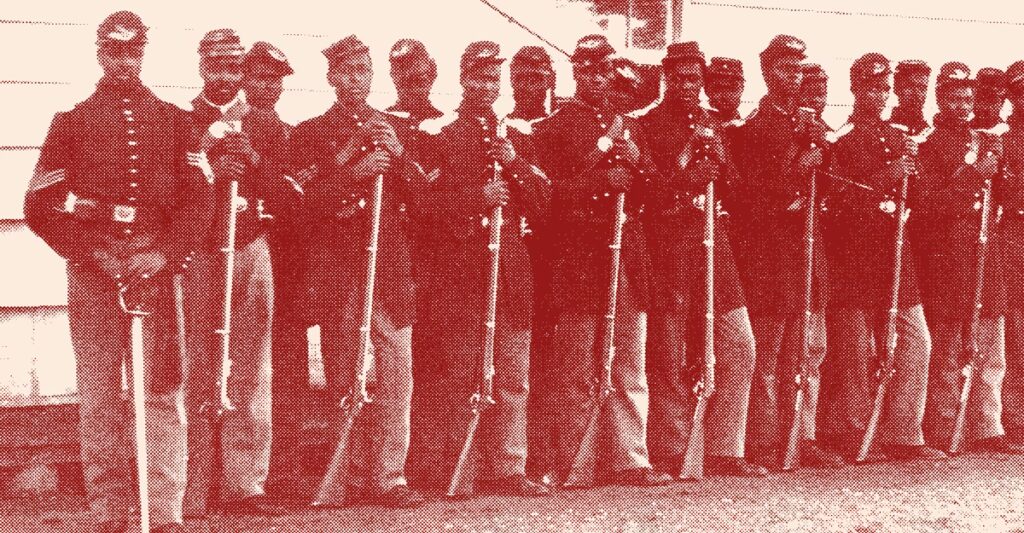
It was not long before Jarvis proved himself right: He and tens of thousands of other enslaved Americans would change the nature of the war, at first by escaping to Union armies and working in military camps, then by enlisting officially when legislation opened the ranks to them in the summer of 1862 “for any war service for which they may be found competent.” Opposition among white northerners was strong, and the Lincoln administration proceeded cautiously before more fully embracing such service with the Emancipation Proclamation. Even then, conditions were hardly ideal. Black soldiers were initially paid less, they served in segregated regiments under white commanders, and many of them received poorer-quality equipment and medical care. If they were captured by Confederate soldiers, they also faced the possibility of execution or re-enslavement.
Still, the implications for the war and the country at large were momentous. As Frederick Douglass said in an 1863 speech exhorting Black men to volunteer, “Events more mighty than men, eternal Providence, all-wise, and all-controlling, have placed us in new relations to the government, and the government to us.” The moment had come to not merely end slavery and claim freedom but to also fight for full belonging. “Once let the black man get upon his person the brass letters U.S.,” Douglass famously said, “let him get an eagle on his button, and a musket on his shoulder, and bullets in his pocket, and there is no power on the earth or under the earth which can deny that he has earned the right to citizenship in the United States.”
For those who served, the commitment to the Union cause ranged from the personal to the collective. A man named Spottswood Rice wrote from Missouri to the woman still enslaving his daughter in 1864, promising to come with his fellow soldiers and take his child: “I have no fears about getting mary out of your hands.” He added, “this whole Government gives chear to me and you cannot help your self.” But given the dangers and the stakes, Black soldiers’ resolve also extended to greater abstractions. One man, serving in the 55th Massachusetts volunteer infantry regiment, put it concisely before going into harm’s way: “If I fall in the battle anticipated, remember, I fall in defense of my race and country.”
The actions of those men helped transform a conflict fought initially to preserve the Union into one that destroyed slavery as well. Black Americans turned “one rebellion into two,” the historian Stephen Hahn wrote, by fleeing to Union lines and bringing slavery to the forefront of the war. Their eventual service did not erase discrimination within the ranks, nor did it guarantee freedom’s promises after the war. But the Union army in which about 180,000 Black men served was nevertheless the single most important national instrument in ending slavery and defining possibilities of freedom.
Lincoln himself recognized a particular kind of fortitude and resolve in these stories. Writing to an opponent of Black military service in 1863, he insisted, “There will be some black men who can remember that with silent tongue, and clenched teeth, and steady eye, and well-poised bayonet, they have helped mankind on to this great consummation.” Their efforts, he recognized, advanced not just their own interests but also the course of America. “On the spot, their part of the history was jotted down in black and white,” he said. “The job was a great national one; and let none be banned who bore an honorable part in it.”
The post The Black Soldiers Who Changed the Meaning of the Civil War appeared first on The Atlantic.