In mid-September 2004, James Conlon, a 54-year-old New Yorker who had just completed a nine-year appointment as music director of Paris Opera, got a surprising call from Plácido Domingo, the famous tenor and head of Los Angeles Opera. Conlon was itching to return home after having spent two decades in Europe, where he had headed the Rotterdam Symphony as well as the Cologne Opera and the German city’s Gürzenich Orchestra.
He seemed the most likely candidate to succeed another “Jimmy.” James Levine had become an operatic legend as music director of the Metropolitan Opera for nearly three decades and had been a mentor to and champion of Conlon. But Levine had no immediate plans to leave the Met.
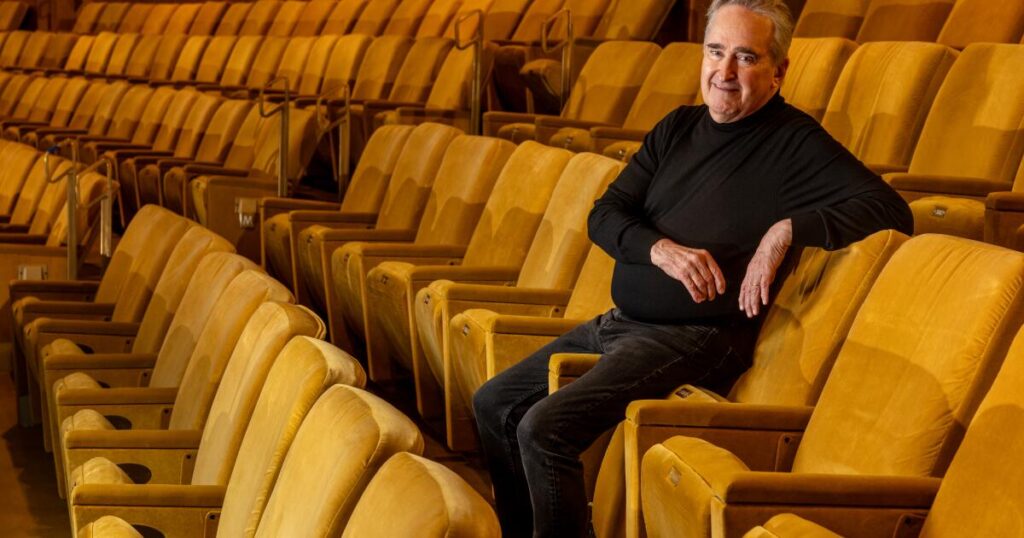
“I wasn’t expecting an offer or anything,” Conlon said recently in the Dorothy Chandler Pavilion office he has occupied for 20 years and laden with mementos soon to be boxed. When Conlon conducts the final performance of the company’s bewitching production of Mozart’s “The Magic Flute” Sunday afternoon that will also mark his last appearance as L.A. Opera music director.
“I left Paris thinking I’m going to goof off now,” Conlon explained, having for seven of his nine Paris years retained his positions in Cologne, shuttling between two exceptionally demanding jobs. But Plácido said to me, ‘If you just come to Los Angeles Opera for three or four years that would be great for the company. We’ll give you what you want,’ blah, blah, blah, blah.’
“Basically, I figured that would be it for a few years, but I felt right away at home. I liked it, and I wanted to stay.
“It is very hard to say why you like somebody,” he continued. “I mean, I got here, I started rehearsing and conducting and meeting everybody and felt welcomed on all levels. It was as simple as that.”
When L.A. Opera came calling, it was a wild, if exciting, adolescent company. Domingo told me at the time that he felt Conlon was the obvious choice to bring a firm hand to the company. Still, a dyed-in-the-wool New Yorker with an estimable European operatic pedigree could also appear an incongruous fit for L.A., which came to opera quite late in any kind of consistent or intrinsic way.
While L.A. had always had opera of one sort or another, most of it came by way of touring companies. L.A. Opera’s own founding in 1986 was a direct result of a visit by London’s Royal Opera to the Dorothy Chandler Pavilion in the 1984 Olympic Arts Festival. The company began without either an orchestra of its own or music director, and it was only in 2003 that it finally had both, with the appointment of Kent Nagano, who remained for three years.
Conlon’s West Coast experience had been but youthful appearances with the San Francisco Symphony and an ongoing relationship with the Los Angeles Philharmonic at the Hollywood Bowl. Since then he had become known not only for that sure hand in a wide range of repertory from Mozart to Shostakovich, but also for his persuasive passion in reviving forgotten works by neglected composers who had been victims of Nazi Germany, whereas in somewhat opera-free L.A., the bulk of the standard operatic repertory had been neglected. Yet it turned out that not only did L.A. hunger for the standard repertory in which Conlon thrives, but what became known as Conlon’s “Recovered Voices” efforts proved a natural for L.A. The German and Austrian symphonic and operatic music of the 1930s happens to be the root of the Hollywood soundtrack, created by composers such as Erich Korngold, who fled the Nazis.
The backstory of the works by the composers who perished is obviously compelling, but the lightning bolt that struck Conlon first was the music.
“I turned the radio on in the middle and I said, ‘Oh my god, what is this?’ I couldn’t identify it.” It was the “Lyric Symphony” by Alexander Zemlinsky and “I decided right then, I’m not going to record Beethoven or Brahms. Who needs another. Let’s do something that makes a difference. I picked out the Sinfonietta, which was his last work.”
Zemlinsky did manage to emigrate to New York but died of pneumonia in 1942 without having been able to revive his career. It was, however, Conlon’s attachment to the Austrian composer that led him to the many composers who could not flee. And in L.A. Conlon found an avid audience for mainstage productions of such little-known operas as Zemlinsky’s “The Dwarf,” Walter Braunfels’ “The Birds” and Franz Schreker’s “The Stigmatized.” This caught the attention of donors as well as the opera world at large with the release of DVDs. Conlon created a program at the Colburn School around the composers that has gained international significance.
What the success of “Recovered Voices” further demonstrated was that the newness of opera in L.A. could mean an openness, and one that allowed Conlon himself opportunities for other of his pursuits. He’s a talker, but there is not much room for that kind of thing, in an informal way, in Europe. L.A. audiences, on the other hand, can’t get enough.
Conlon’s pre-concert talks before every performance have become standing-room-only audience rituals on the second floor of the Dorothy Chandler Pavilion, where he shares his enthusiasm for, in particular, Mozart, Wagner and Verdi. Conlon got his Wagner big time, including a full “Ring” Cycle,in 2010. The production by Achim Freyer, though controversial, remains a milestone.
For those performances, not only did an excitedly tireless Conlon spend an hour before performances in the talks, but afterward, despite operas that lasted five hours or more, he could be found behind the bar at Kendell’s, the theater’s downstairs brasserie, serving drinks.
“Well, I have to tell you,” Conlon says, setting the record straight. “I did do the pre-talks. I did do the Wagner operas. You can believe what you saw. What you can’t believe, because it was a fraud, was I don’t have a clue as to how to mix drinks. It was a joke. I served them and pretended I mixed them. In all those years in Germany and France and Italy, I drank wine.”
Hand in hand with the talks came Conlon’s writing, in which, as in his talks, he goes inside the work in part to find philosophical and psychological meaning but mainly to share his love. He began this in Cologne as an attempt to counter a German prejudice against a lot of French music. Conlon became a regular contributor to the program book and the company’s website, along with Opera News and other publications.
“What was wonderful about L.A. was that I could do it here on a regular basis, and I started to understand that it is another form of expression. I liked what that did to me, the way it engaged my mind.”
Conlon may still consider himself a New Yorker. After 20 years as music director of L.A. Opera — half the company’s life — he brought it into adulthood. The way now we hear a great deal of operatic repertory is the way he had always heard it. He shared L.A. with longtime posts at the Ravinia Festival, the summer home of the Chicago Symphony, and Cincinnati May Festival of choral much, which he headed for a record 37 years. He also served between 2016 and 2020 as principal conductor of the RAI National Symphony Orchestra in Turin, Italy.
And when asked how he thinks L.A. has changed him, he has a New Yorker’s way of turning that back on the questioner. L.A. Opera has been a saga of triumphs and challenges. He got what he wanted at first, but opera companies everywhere are struggling, this being an outrageously expensive art form.
This is something that Conlon seems to take in stride. If the company can’t afford new productions as it once could (a problem for opera everywhere in America) or hire a plethora of star singers, he takes his delight and nourishment from the music. He’s made the orchestra great. He offers singers gracious support. I have yet to see an audience come away from one of his performances with anything less than rambunctious enthusiasm. It is not uncommon for Conlon to get the loudest applause at curtain call.
Conlon also took obvious pleasure in bringing opera to the community in other ways, conducting children’s opera at the Cathedral of the Angels, helping create city-wide festivals around composers who mean the most to him, Wagner and Benjamin Britten very much included.
During the COVID lockdown era, a fraught time for all performers and a frightful one for opera companies, Conlon shed his New York skin for L.A. He says he found great pleasure spending a year in his L.A. home with his family, dogs, scores and writing — a break from the rat race that would hardly have been the same had he remained in his New York apartment.
A change was readily noticeable when he returned to the podium, his lyrical and reflective sides more prominent, an organic quality to theater. But the main effect of spending 20 years in L.A. is that he has joined Los Angeles Philharmonic former music directors Zubin Mehta, Esa-Pekka Salonen and Gustavo Dudamel as incapable of cutting ties with the city.
“I love L.A. and I’m not going to leave,” Conlon insists, which doesn’t mean he’s giving up his New York residency either. “I am absolutely happy at this point in my life. You know my age is 76. It is not a secret. I wear it proudly. But I’ve been a music director for 47 years, and I don’t want to be a music director any longer.
“I will still conduct, and I will also be involved outside of the opera.”
While Conlon is not yet ready to announce what this will be, his relationship will continue with the Colburn School and its “Music Restored” project.
In the meantime, L.A. Opera has made Conlon conductor laureate. He is scheduled to conduct Mozart’s “Marriage of Figaro” next season. Asked whether that means he’ll return regularly, he replies, “That the theory.”
The post James Conlon remains hooked on L.A. as he reflects on his 20 years as music director of L.A. Opera appeared first on Los Angeles Times.