Paulo Alexandre Araujo, a physiotherapist, has worked with the world’s top soccer players. But nothing, he said, could prepare him for the conditions he faced assisting Iran’s national team at the World Cup.
The U.S. government imposed strict time limits for Iran, forcing the team to immediately leave the stadium, and United States territory, after playing its World Cup games there, Mr. Araujo, a member of the Iran delegation, said. After the team’s opener against New Zealand, Mr. Araujo bandaged players on the aircraft ride back to their home base in Mexico, a treatment, he said, that would normally be carried out in the locker room. No other teams at the World Cup face the same restrictions.
Under the United States government’s time limits, Iran’s delegation is allowed into the country a day before a game and, afterward, has just enough time to reach the airport to depart.
Iran’s captain, Mahdi Taremi, and its coach, Amir Ghalenoei, expressed frustration about their treatment both before and after their game against New Zealand, which carried far more significance than a typical match between two teams that rarely make a sporting impact on the tournament. The U.S.-Israeli war against Iran has placed its participation in the World Cup under severe scrutiny for months. Additionally, Los Angeles is home to a large Iranian diaspora community and a hotbed of opposition to the government in Tehran.
“There were so many unfair things, you know,” Mr. Araujo said in an interview in Tijuana, Mexico, where the Iranian squad stays between games. The difficulties, he said, started the moment the team touched down in the United States on Sunday. Several members of Iran’s delegation, including Mr. Araujo, faced detailed questions from U.S. border agents. The process, he said, took hours before another lengthy check was required outside the airport to enter the team bus.
The time spent clearing the team forced it to change plans. Instead of resting at their hotel, Iran’s players instead went straight to SoFi Stadium in the city of Inglewood, the site of their first contest, to fulfill media requirements and attend a prearranged stadium familiarization session.
At a news conference on Sunday, Mr. Taremi apologized for being late and described the team’s arrival into the United States as tense. That followed other trying episodes dating back months that include a lengthy wait for visas and a late change of the location of their training camp from Tucson, Ariz., to Tijuana.
The impact on players has been so disruptive that it is hard to fully estimate, Mr. Araujo said. Iran’s squad has had to make do without its media officers, analysts and other staff members required to carry out crucial tasks like managing mid-game substitutions.
“When you get players waiting in the airport, like two, three hours, and arriving and being surrounded by guys with machine guns and all this, they are not used to it,” Mr. Araujo said.
After the game, Mr. Ghalenoei described his team to reporters “as the most oppressed” at the tournament. Mr. Taremi added: “Everything is like a disaster for us.”
Iran has written to FIFA, a team official said, to ease the rules on its stay in the United States, including asking for more time to prepare before the game. Its next game kicks off at noon on Sunday against Belgium, a start time that coaches fear gives them even less time to acclimate.
“All 55 members of the Iranian National Football Team, including players and staff, who arrived at Los Angeles International Airport on Sunday, June 14, were inspected and processed into the country by CBP officers without incident,” a U.S. Customs and Border Protection spokesman said in a statement by email. The statement added that officials had balanced “robust security measures with efficient facilitation” across all host cities and ports of entry.
FIFA did not reply to a request for comment.
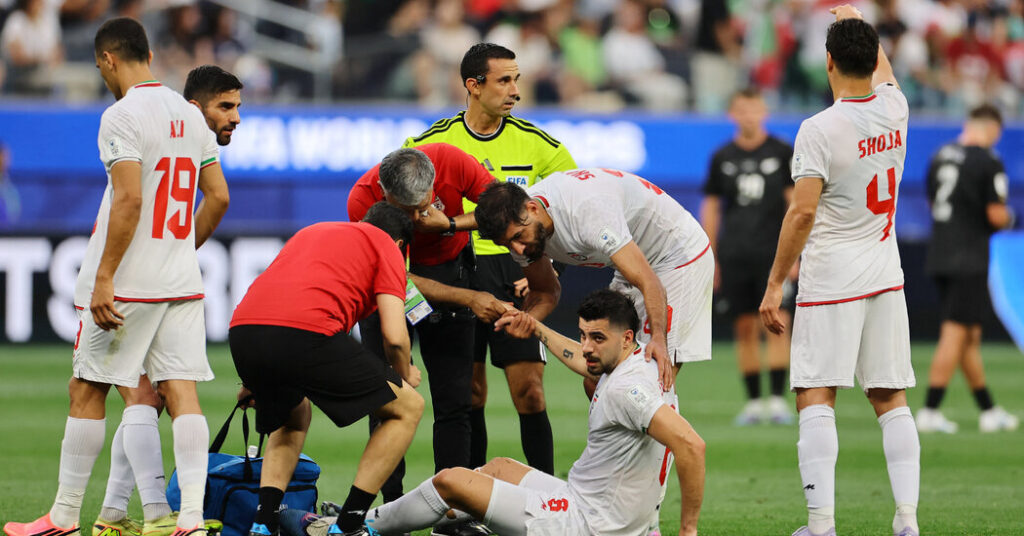
As the team’s bus idled on its way to the airport on Monday, Mr. Araujo tried as best as he could to speedily treat the players. He said he normally asks each player to spend about 12 minutes in an ice bath to recover from the strains of the game, but because time was short, each player entered the chilled water for about a minute. “It’s like throw them in, come out and take a shower, and go fast because the information was that we have to leave immediately,” he said.
Following Iran’s first game, its medical team was not able to fully debrief players about any injuries they may have sustained during the game, Mr. Araujo said.
Boarding the plane presented its own challenges. A checkpoint was set up yards from their airplane, where two at a time, Iran’s players and delegation underwent a second screening after already having cleared security checks and passport control inside the airport. “It took more than three hours to get inside the plane,” Mr. Araujo said.
The team eventually arrived back at their base in Tijuana after 2 a.m.
When the president of FIFA, Gianni Infantino, entered Iran’s locker room to offer words of encouragement after the game, Mr. Taremi said the team needed more support. Mr. Araujo said those appeals are unlikely improve its situation for the remaining games
“Nobody cares,” he said. “This is no way to treat sportsmen when you talk about fair competition.”
The post Team Medic Recounts Iran’s ‘Stressful’ World Cup Debut in L.A. appeared first on New York Times.