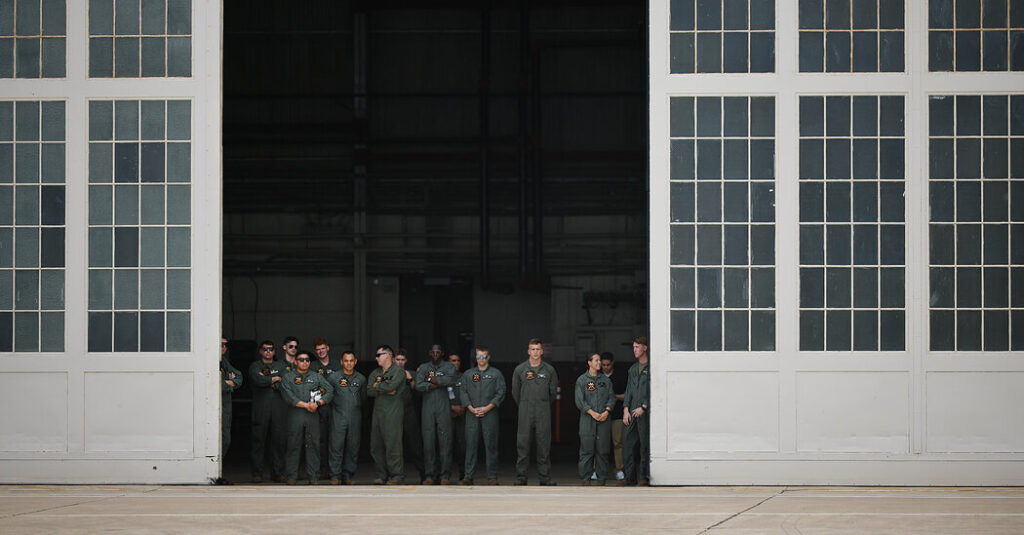
A major flu outbreak has sickened nearly 160 troops at Lackland Air Force Base in Texas less than two months after Defense Secretary Pete Hegseth announced that U.S. troops would no longer be required to be vaccinated for the flu, defense officials said.
The outbreak at the base in San Antonio raced through an Air Force Basic Military Training wing, where new recruits sleep on bunk beds in open bays and share meals at large communal tables.
A trainee in his sixth week of basic training died after falling ill on Friday and being taken to Brooke Army Medical Center, the Air Force said in a news release. It was not immediately clear whether the death of the trainee, Keon McDaniel, was related to the flu outbreak.
A comprehensive medical review into his death is underway to determine the cause, according to the Air Force.
In the weeks since Mr. Hegseth’s vaccine policy took effect on April 21, only about 40 percent of Air Force trainees have opted to take the vaccine, which had previously been mandatory, an Air Force official said.
In the aftermath of the outbreak, the Air Force issued an exception to the voluntary vaccine policy, requiring that all recruits at Lackland get flu shots — part of a broader effort to stem the virus’s spread.
Mr. Hegseth cast his decision to make the flu vaccine optional as a matter of religious freedom and medical autonomy.
“Under the disastrous Biden administration, this Pentagon waged an unrelenting war on our warriors on many fronts, including when it came to denying them simple medical autonomy and the freedom to express their religious convictions,” he said in a video announcing his decision in April.
He described the flu vaccine requirement as an “absurd, overreaching” mandate that had served to “weaken our warfighting capabilities.”
At the time, many lawmakers, including some prominent Republicans, expressed puzzlement and dismay at Mr. Hegseth’s decision.
“The reason it was mandatory was to enhance readiness,” Senator Roger Wicker of Mississippi, the chairman of the Armed Services Committee, said shortly after the new policy was announced.
“You know, you do give up certain rights when you take the oath,” said Mr. Wicker, who is an Air Force veteran. “It’s just part of it.”
Sean Parnell, the Pentagon’s chief spokesman, on Thursday defended Mr. Hegseth’s handling of the vaccine policy, saying the changes were “based upon thorough risk assessments” designed to maximize the readiness and lethality of the force.
Air Force officials described the recent flu outbreak as “localized” to the basic training wing and said that medical personnel were monitoring and offering antiviral medication to trainees who were in contact with those who were ill.
“Once they are cleared by medical professionals, they will return to training,” an Air Force statement said.
A White House spokesman did not immediately respond to a request for comment on the matter.
The flu outbreak highlights the risks of Mr. Hegseth’s and the Trump administration’s broader approach to vaccines and public health.
Some members of the administration, particularly those involved in public health agencies, have been critical of vaccinations broadly. While he has changed his tone since the spring, Health Secretary Robert F. Kennedy Jr. has a history of loudly questioning the safety and effectiveness of many standard vaccines.
Last summer he rescinded federal recommendations for all flu vaccines containing thimerosal, a mercury-based preservative that the anti-vaccine movement has falsely linked to autism.
President Trump once championed the Covid vaccine, during the initial months of the pandemic while he was still president in 2020. But he soon grew resistant to the mandates related to that vaccine, particularly as his base of supporters questioned its safety.
Despite his administration’s actions on both the Covid and flu vaccines, Mr. Trump received the two shots in October 2025 at Walter Reed Military Medical Center.
Since taking office, Mr. Hegseth has fought to ensure that troops who were forced to leave the military for refusing to take the Covid vaccine are able to return to service at their former rank with back pay and benefits.
Roughly 8,700 active duty and reserve troops voluntarily or involuntarily left the military after refusing to get vaccinated before that mandate was rescinded in 2023. As of last summer, 13 had been reinstated.
In March, Mr. Hegseth extended the deadline to apply for reinstatement to April 1, 2027.
U.S. military personnel are still required to get vaccinations for diseases including measles, mumps and polio. Others, such as the anthrax vaccine, may be required depending on risk and military occupation.
In April Mr. Hegseth encouraged troops to get the flu vaccine even as he was announcing the policy change to make it optional. “We will not force you because your body, your faith and your convictions are not negotiable,” he said.
The post Scores Fall Ill at Air Force Base After Hegseth Makes Flu Vaccine Optional appeared first on New York Times.