When Peter Freeman moved to New York from Hawaii almost two decades ago, he was possessed by a singular dream: to make the greatest egg cream in the city.
So, in 2009, he opened Brooklyn Farmacy, a soda fountain in Carroll Gardens that was once a 100-year-old apothecary, where he and his sister offer ice cream treats, desserts and, of course, egg creams.
In the time since, Mr. Freeman, 49, has wrangled with many of the same challenges all small businesses face — dealing with credit card fees and trying to keep prices down while battling inflation and supply-chain issues, all while meeting payroll and paying taxes. And the cherry on top? Having to procure a specific permit to sell ice cream. But to him, it’s worth it.
“All the economic data supports why small businesses are important, but we are also the heart of New York City,” Mr. Freeman said. “We have the coolest little niches, and you come and you really feel like you are a part of something amazing.”
Mayor Zohran Mamdani made improving the experience of small business owners a central promise of his campaign last year, memorably promising to reduce “Halalflation” in a viral video.
Now the mayor has laid out a package of roughly 50 proposals to help small businesses as part of his OPEN plan, which stands for “Overhauling Procedures & Expanding Navigation.” The mayor described the initiative as “reforms that cut red tape, eliminate redundant fees and streamline the permitting process.”
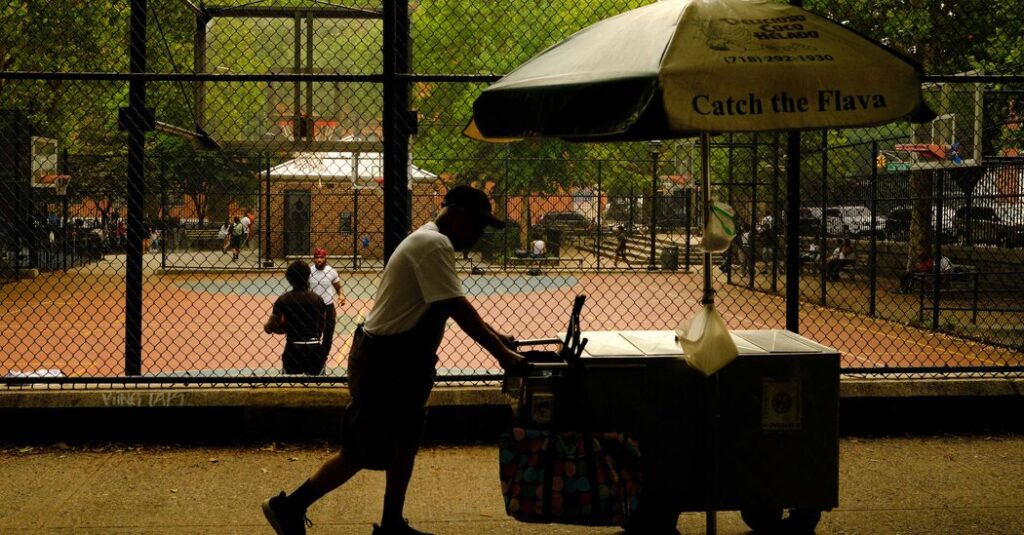
He had coined another word to describe the perilous ice cream requirement: “treatsploitation.” He said he planned to work with New York State to get rid of its frozen dessert permit, which is required on top of a general food service establishment permit for any store, restaurant or cart to sell ice cream.
Other initiatives including streamlining the permit system for barbershops and increasing winnings from bingo games — proving, the mayor said, that he was “in the pocket of Big Abuela.”
Under the mayor’s proposal, the city’s Department of Consumer and Worker Protection would “remove unnecessary regulations” for those holding bingo and games-of-chance licenses, including removing prize limits. As it stands, the current prize limit imposed by the city is $250 per game and $1,000 per occasion. The reform would remove that, but state limits of $5,000 and $15,000 would still apply.
Outside 231st Bingo in the Bronx last week,
Schenell Taylor, 37, said the prize limit move suggested that the mayor cared about her community.
“He’s a person that’s very open to everything, and his opinion really does matter,” Ms. Taylor said. “He’s seeing a different picture of how to make the place a little bit better than what it was.”
The proposals run the gamut of small business, with half geared toward food service and food retail and the rest split among child care, transportation, personal care and other businesses.
Some of the mayor’s proposals, such as helping business owners open storefronts by assigning each owner a client manager in the city government, can be implemented through executive order. But changes like the frozen dessert permit will require partnership with the state, while others, such as reforming the Truth in Pricing Law to simplify rules around listing prices of goods in stores, need City Council approval.
“When I was inaugurated as mayor, I said the era of small expectations and even smaller ambitions was coming to an end in City Hall,” Mr. Mamdani said in a news conference last week introducing OPEN. “Today’s announcement represents that promise made material.”
According to a report from the mayor’s office, there are around 180,000 small businesses that have fewer than 50 employees operating around the city. Small businesses employ about one million people — roughly a quarter of the city’s work force.
Mr. Freeman said that the most challenging part of running a small business was finding someone from the city to speak with face-to-face. Instead, he languishes in a purgatory of automated answering machines and city portals.
“Oftentimes the solution to the bureaucratic challenges lies behind an information wall, so you can’t find the person you need to talk to,” he said.
The mayor appeared dedicated to improving that system. In his report, the words “streamline” and “reduce” appear repeatedly. But the main proposal that would affect Mr. Freeman’s business is the elimination of the frozen dessert permit — even if it didn’t amount to much monetarily.
“It’s a big splash for a small ripple,” Mr. Freeman said, noting that he pays around $25 a year for that permit on top of the $280 annual restaurant permit. “Financially, I just spent more on a new mop bucket.”
But he added that he was grateful to the mayor for making small businesses feel seen, and opening the conversation on what they need to succeed. He said the continued effects of the pandemic are more pressing, with many small businesses paying off loans and unable to pay their workers enough.
The mayor’s report also took a small step on the contentious issue of outdoor dining. The city has proposed to streamline that application process, too.
Baby steps aside, Mr. Freeman said he hoped the Mamdani administration would continue to cater more to small business owners.
“There’s a beauty in the small business, and it’s the beauty and the beast,” he said. “If it wasn’t so beautiful, nobody would do it. And if it wasn’t so hard, everybody would do it.”
The post Mamdani Offers 50 Ways to Aid Small Business, From Barbershops to Bingo appeared first on New York Times.