A skating ramp with walls scrawled and sprayed on by local graffiti artists is not what visitors ordinarily see when they step inside Kunstmuseum Basel, Gegenwart, the contemporary art branch of the city’s main museum.
Yet from now to Oct. 11, all four floors of the museum, which is housed in a converted paper mill, have been taken over by the Chinese contemporary artist Cao Fei for a survey of her nearly 30-year career. And that entrance space with the skating ramp leads to 10 immersive installations and environments — depicting street culture, factories, cities and the metaverse — that represent the artist’s singular vision of the world.
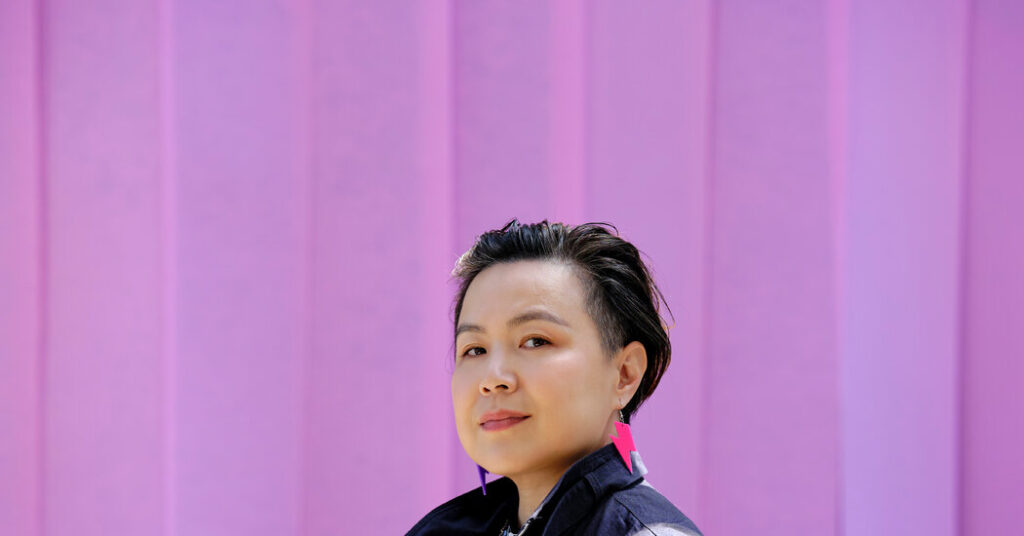
Cao Fei, 48, works with film, video, virtual reality and installation to create real and surreal environments that evoke the rapid shifts that have transformed her native China and the world as a whole during her lifetime. Born in the vast southern city of Guangzhou (sometimes referred to as the “factory of the world”), she explores the human consequences of globalization, new technologies and the internet age.
Her breakout work — “Whose Utopia?” (2006) — was set in a real-life lightbulb factory, where workers took a break from their assembly lines to practice ballet and hip-hop moves and play the guitar. In “RMB City” (2007-2011), she created a virtual metropolis on the Second Life platform that was inhabited by an avatar of herself called China Tracy whom users openly interacted with. On the platform, the avatar participated in talk shows, led feng shui sessions and had an active love life.
Both works are in the Basel show. So is Cao Fei’s new avatar — a shiny humanoid creature called Oz that exists in the digital, virtual and gaming world. At the same time, in another contemporary-art venue, the Prada Foundation in Milan, a multimedia project by Cao Fei called “Dash” examines the impact that technology has had on farming in China and across Southeast Asia.
In a video interview from Basel, Cao Fei spoke about her avatars, her irritation with artificial intelligence and her friendship with the fashion designer Miuccia Prada (president and director of the Prada Foundation, who decides upon and oversees the programming there). The conversation, parts of which were translated from Chinese by a translator during the video interview, has been edited and condensed.
Nearly a decade ago, you created an avatar of yourself on Second Life called China Tracy. Now, you have a new avatar, Oz. Can you talk about that?
In 2007 and 2008, tech was booming: it was the first wave, a virtual reality wave, and the era of Second Life. There was more optimism about technology and the future world. My work “RMB City” was like a tech utopia: let’s share education, new concepts.
After 2020, when the world went into quarantine, a new era of technology started, and for me, the feeling totally changed. Technology became more commercial. Everybody wanted to invest in it.
Now, it’s too much about money. There are so many robotic, automatic things. The world is full of A.I. Technology has become more widespread. It has lost its original utopian motivation. It has nothing to say.
In the last 20 years, we have been growing so fast. As an artist, I want time to observe. I don’t feel I need to give a strong reaction to the times we are living in and to technology. So my new avatar, Oz, is floating in the sky, observing the changing times.
Are you pessimistic about the world of new technology that we live in?
I’m not pessimistic. I just want balance. We need technology management, because everything is developing too fast, much too fast.
If everyone knows about something, and everyone invests in it, I feel, as an artist, that I have to escape a little bit — keep a distance. That’s why I have a project in Milan, at the Prada Foundation: a project on smart agriculture.
Can you describe the project?
In the beginning, it was a focus on technology and how it can change agriculture. What I discovered along the way is that we have lost our respect for nature. Human beings have cut their connection with the land — a connection that we have had for thousands of years — and that concerns me. Everything is going too fast. We have to do something.
I’m not suggesting that we start going back to the way things were, but we need to find an in-between, to balance the two sides. That is the role of the artist: to make a contribution, to make a statement, to look for balance.
Would you say that your work is about the human condition — about what happens when humans and machines interact?
Yes. Even in the Second Life project, I had a human being behind the avatar, China Tracy. The hate, the love, the romance: everything was about the human. So yes, I always think about technology, the machine, the value of the human being.
You seem concerned that technology will overtake humankind.
I’m not the only one. In my show in Milan, I show the impact of technology on China.
On the one hand, technology has helped a lot. The speed is so fast: We order something online, and we receive the goods the next day. Even when it comes to agriculture, if you look at the positive side, technology is helping improve food a lot. It is helping food production become more modern, because there are fewer farmers and young generations don’t want to do hard work on the farm.
Technology is not a black-and-white issue. My point is not to stop it, but to achieve a balance. I love technology. But I also see the problems. So I always think about how we can have a win-win — not sacrificing too much of the human.
What do you think of Artificial Intelligence?
We are currently living through an A.I. boom. I want to keep a distance. Training A.I. to produce a video and a moving image is not my style. Everyone is doing that. I’m not interested.
What about the threat of A.I. replacing us?
Going back to the concept of balance, in China, we have the yin and the yang. If there’s too much yang, we go back to yin. If there’s too much yin, we go back to yang. If A.I. takes over too much, something has to come up to stop it.
In the beginning, human beings welcome technologies such as A.I. But at some point, you will see something happen. We human beings are still there. This is a time when we can do something to preserve life, our human life.
Are there artists that you admire and find interesting?
I like master film directors like Andrei Tarkovsky and Federico Fellini, because I work with video and visual media. I don’t understand painting — for me, it’s a difficult language. I am more like a film director.
What was it like working with Miuccia Prada on the show in Milan?
We met in 2007, when I showed at the Chinese pavilion in the Venice Art Biennale. She loves new things. She came all the way to meet me in person. I was so surprised. The two of us stood under the big tree, and we talked. She was very curious about my Second Life project at the time.
Both of us are very curious about the world of today. So we have something in common.
The post Decades Ago, She Built a Virtual City. Now the Artist Cao Fei Looks Ahead, Again. appeared first on New York Times.