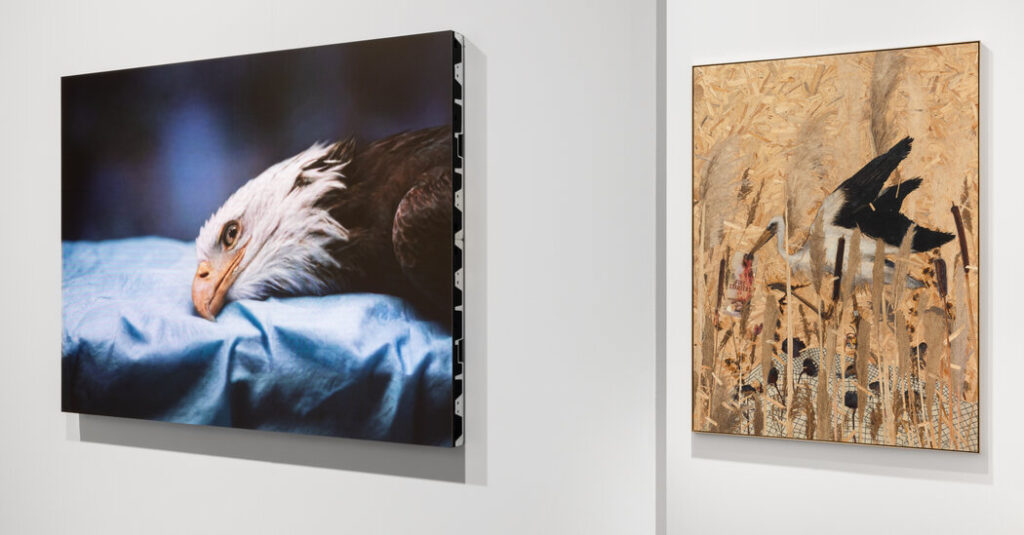
A seven-hour video of an American eagle lying immobilized but awake on an operating table. A 13-foot-wide Henry Moore bronze sculpture that looks like it’s made out of solid gold. A philosophizing animatronic mouse.
These were just some of the highlights of the 56th annual edition of the Art Basel fair in Switzerland, the world’s largest fair for modern and contemporary art, which opened Thursday after two preview days for V.I.P. visitors.
For decades, the Art Basel group’s flagship home event in its international fair portfolio, which this year featured 290 galleries from 43 countries and territories, has been a must-attend fixture for the world’s most serious collectors. But this year’s Art Basel was held in challenging conditions for dealers. It had a nervy, make-or-break feel.
Earlier this month, Pace Gallery, one of the international art world’s four biggest dealerships, announced it was shedding 50 employees and 50 artists from its roster. Also this month, Tiwani Contemporary in London and Dépendance in Brussels shuttered, adding to the lengthening list of reputable contemporary galleries that have closed in the last couple of years. Auctions of major-name modern and contemporary art have been buoyant — last month’s modern and contemporary sales in New York grossed $2.5 billion — but business for dealers has been slower. And the costs of running galleries continues to rise.
“People are buying more cautiously and spending less,” said Alison Jacques, a London-based exhibitor at the fair. “The prices for young artists just got too high,” she added: “A correction was needed.” She was referring to the speculative frenzy for new paintings by emerging talent that created a very different atmosphere at Art Basel in the early 2020s. In 2022, auction resales of works by artists aged under 40 soared to $306 million. In 2025, equivalent sales collapsed to $48 million, according to the French database Artprice.
Like many Art Basel exhibitors, Jacques was showing older pieces by reputable 20th-century names alongside new works by living artists. On the first V.I.P. day, she said, her gallery sold a 1977 Robert Mapplethorpe gelatin silver print of a tattered American flag, priced at $500,000, as well as less expensive items like a painting by the young British artist Sophie Barber, for about $40,000.
Most sales at Art Basel are, in fact, organized in advance. Dealers email photographs of works to potential clients before the fair, and a buyer confirms a reservation once they see the work in person. This year, to freshen things up, the organizers introduced Basel Exclusive, an initiative that encouraged exhibitors to wait until the V.I.P. preview before unveiling some pieces, and 195 exhibitors agreed to participate.
Magnus Resch, a New York entrepreneur who has developed an art-pricing app, said that dealers were “bringing their best works,” adding that his research showed that the “median artwork price at Art Basel is higher than at either Art Basel Paris or Art Basel Miami Beach.”
“It’s not as glamorous as Paris or as festive as Miami,” he added, “but the collectors who come to Basel tend to be traditional buyers focused on art rather than the social scene.”
The problem, however, is that the focus is the other way around for many market players, particularly from the United States. The allure of Art Basel’s ultrachic fair in Paris in October prompted several U.S.-based exhibitors to drop out of this year’s Swiss fair. There were conspicuously fewer Americans browsing the booths, too.
“The main American collectors are holding fire until October,” said Wendy Goldsmith, an art adviser based in Palm Beach, Fla. “Paris has a better selection of hotels, restaurants and shops than Basel, so if they’re going to make a choice, it will now be Paris.”
Dealers brought some exceptional works to Basel — although they didn’t quite compare to the pieces by Constantin Brancusi and Jackson Pollock that made more than $100 million each at May auctions in New York.
The front of Gagosian’s booth was taken up by Henry Moore’s monumental 1984 bronze, “Large Four Piece Reclining Figure,” one of an edition of seven, priced at about $25 million. It didn’t find a buyer at the preview, but Gagosian said it had sold a large Willem de Kooning abstract.
The fellow mega-gallerist Hauser & Wirth said it had sold a seven-foot-wide 1963 Picasso canvas, “The Painter and His Model in a Landscape,” for $35 million.
“It was an extremely successful first day; it needed to go well, and it did,” said Iwan Wirth, a co-founder of the gallery, referring to the pressure that overhead-burdened galleries are under to make sales. Hauser & Wirth reported more than 30 on the first preview day.
Maike Cruse, Art Basel’s director, said that because galleries were working in a “challenging market,” the fair “didn’t increase booth prices this year,” and even offered discounts to first- and second-time exhibitors.
That seemed to have allowed exhibitors to show less obviously commercial pieces at unintimidating prices. The up-and-coming London gallerist Ginny on Frederick, for instance, brought a sculpture of a lemon in three stages of decomposition by the young British artist Hamish Pearch, which sold for about $6,700, the gallery said.
After viewing the emerging galleries on the fair’s first floor, Ann Webb, a collector based in Vancouver and Berlin, said the quality was “very strong this year.” She, like many others, was particularly impressed by “Eagle Eye,” a mesmerizing seven-hour A.I.-animated film by the Belgian artist David Claerbout showing a paralyzed American bald eagle. Esther Schipper of Berlin offered the work in an edition of seven, priced at 60,000 euros, or about $70,000, each, and sold one, the gallery said.
Another technology-generated animal that seemed to capture the strangeness of our times was an animatronic mouse that was poking its head through a wall. The latest in an ongoing series of conceptual animal sculptures by the British artist Ryan Gander, the mouse declared, “I don’t think I’ve got anything to say,” between yawns, before repeating, “I’m not here to make a statement.”
This was offered by the London-based Lisson Gallery in an edition of five, priced at €200,000 each. All have sold. “It keeps on swinging back and forth,” said Alex Logsdail, Lisson’s chief executive, summing up the current state of the market for gallerists. “Everything takes longer and you have to work harder. But sales are happening. There’s no shortage of money.”
The post At Art Basel, a Nervy, Make-or-Break Mood appeared first on New York Times.