At a small cafe in Quito, Ecuador’s capital, a young woman stirred her tea, her eyes puffy from crying. Across from her, a man sobbed quietly. I sat at a nearby table, so close it was impossible not to overhear their exchange.
She took his hands and asked softly in Spanish, “¿Qué quieres hacer?” — What do you want to do?
He looked into her eyes and said, “Wawita, solo vamos a changarnos.”
The phrase, roughly translated, means: “Babe, let’s just go hug with our legs.” But most Spanish speakers — even many Ecuadoreans — wouldn’t fully understand it. For translators, it’s a puzzle, if not a nightmare.
The phrase was spoken in the distinctive Spanish of Ecuador’s Andes region, a language interwoven with Kichwa, an Indigenous tongue spoken since the Inca settled the slopes of the Pichincha volcano — 60 years before the conquistadors arrived in 1534.
I moved to Quito from Guayaquil, on Ecuador’s Pacific Coast, years ago and began collecting snippets of overheard exchanges, at parties, dinners, in offices, fascinated by this particular form of Spanish.
In Kichwa, “changa” means “leg.” And in this hybrid Indigenous Spanish tongue, “changar” means to intertwine one’s legs with another — an act of intimacy, shared between lovers, siblings, parents or close friends. It’s not something you would do with someone you’re at odds with.
Kichwa is Ecuador’s most common Indigenous language, spoken by roughly half a million of the country’s 18 million people, according to official records. It is part of the same linguistic family as Quechua, which is spoken in other parts of South America.
During the colonial and post-independence eras in the early 1800s, a Spanish filled with Kichwa words developed as a language of daily contact in Ecuador.
“The foreman spoke to the peasants in both Kichwa and Spanish,’’ said Gonzalo Ortiz, a historian and member of the Ecuadorean Language Academy. “The ‘wasikama’ — the Indigenous nursemaids who raised the estate lords’ children — did, too. That’s how this language was born.”
Five centuries later, that same language — evolved, but still rooted in that fusion — was spoken at the lovers’ table, softening the aftermath of a fight.
A Grammar of Its Own
“Kichwa is a very kind, very sweet language,’’ said Silvana Cárate, a linguist at York University in England. “In fact, it’s called ‘Mishki Shimi’: sweet tongue.”
This unique form of Spanish is melodic and gentle, leaning on the diminutives “-ito” and “-ita,” both directly inherited from Kichwa, for tenderness and politeness.
It also bends grammar through what scholars call “loan translation.” “It’s copying the grammatical structure of one language and transposing it onto another,” Ms. Cárate said.
In this type of regional Spanish, commands are also softened by Kichwa phrasing. Instead of demanding, for example, that someone pass the salt — as in “dame la sal” — Ecuadoreans in the Andes will say “dame pasando la sal.” This translates roughly to, “Could you be passing me the salt?”
“Colonial Spanish arrived with a harsh tone, like the commandments: ‘Thou shalt not kill,’” said Marleen Haboud, a linguistics scholar and member of the Ecuadorean Language Academy. Kichwa takes that Spanish structure but infuses it with its own layer of kindness and courtesy.
Countless conversations in this mixed tongue are inescapable in Quito.
“Mi abuela tenía unas changotas,” Karen Menéndez, a 34-year-old publicist said at a dinner party I had been invited to, referring affectionately to her grandmother’s shapely legs.
“A mí no me gusta andar a pata llucha,” Bárbara Bravo, a 32-year-old political scientist said at a different party. “Llucha” is Kichwa for naked and the entire sentence means that Ms. Bravo doesn’t like to walk barefoot.
A feminist cycling collective in Quito is called “Karishinas en bici” “Kari” means “male,” “shina” means “like.” “Karishina” is a woman who defies traditional gender roles. Once used pejoratively, the cyclists have reclaimed it.
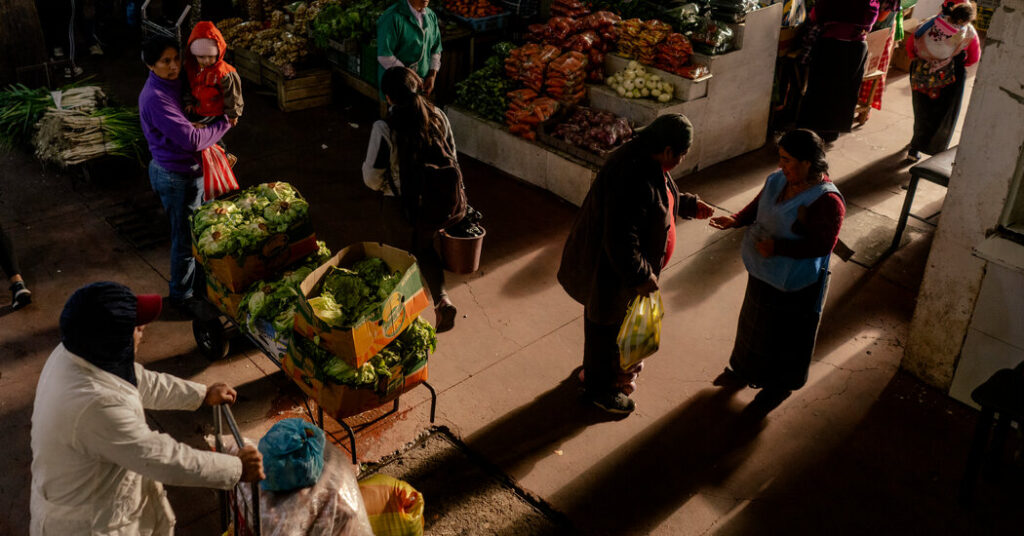
On the steep streets of San Roque, a neighborhood in Quito near a hill known as El Panecillo — where an Inca city once stood — two children darted through traffic. “¡Wawas irki, los van a atropellar!” I heard a woman shout on a Sunday morning. “Wawas” means “children.” “Irki” means “rebellious.” The rest is standard Spanish, becoming: “Wild children, you’re going to get run over!”
A Mystery Language, Even to Its Users
Though ubiquitous, Kichwa is often unfamiliar even to those who use its words. “So muchar is not a Spanish word?” asked Doménica Escalante, a 24-year-old project manager, during a chat with co-workers I overheard in an office building elevator. “Mucha” is Kichwa for “kiss.” In this blended language, muchar means “to kiss.”
Gonzalo García-Saardá, a 41-year-old executive from the coastal city of Guayaquil, said, “I think it’s a kind of potato’’ after I asked him if he knew the meaning of the word “chaucha.”
“I actually don’t have the slightest idea what it means,” he admitted.
“Chaucha,” from the Kichwa “chawcha” (bean pod), became slang for coins of little value in the early 1800s, according to Mr. Ortiz, the historian.
Later, the term came to mean a freelance gig. “No puedo vernos, me salió una chaucha,” Vanessa Terán Collantes, a 33-year-old visual artist, told me — “I can’t make it today, I just got a freelance job.”
Mr. García-Saardá wasn’t entirely wrong. There is a potato called “chaucha,” small, round, pale brown, and it does look like a bean pod.
Many Kichwa words used in everyday speech have sounds that seem to evoke their definitions. In the Ecuadorean Andes, people say “achachay” to mean “it’s cold,” and “arraray” when something is hot.
There are also distinctive phrases that would puzzle a grammar professor in Madrid or Mexico City like “Se fue a volver” — he left to return, a way of explaining a brief absence in Ecuador’s highlands.
Verb conjugations that Spanish purists would call incorrect are “identity markers,” said Lucía Durán, director of the Casa del Alabado, a museum of pre-Columbian art in Quito.
Ms. Haboud, the linguistics scholar, added: “Our Andean Spanish allows us to draw closer to our own history. It shows us how languages can truly break down social, cultural and political borders.”
The post The Sweet Tongue: How Ecuador’s Andes Created a Language of Its Own appeared first on New York Times.