May was a great month for L.A. Metro. And then came the World Cup, with droves of fans making their way to local stadiums and watch parties.
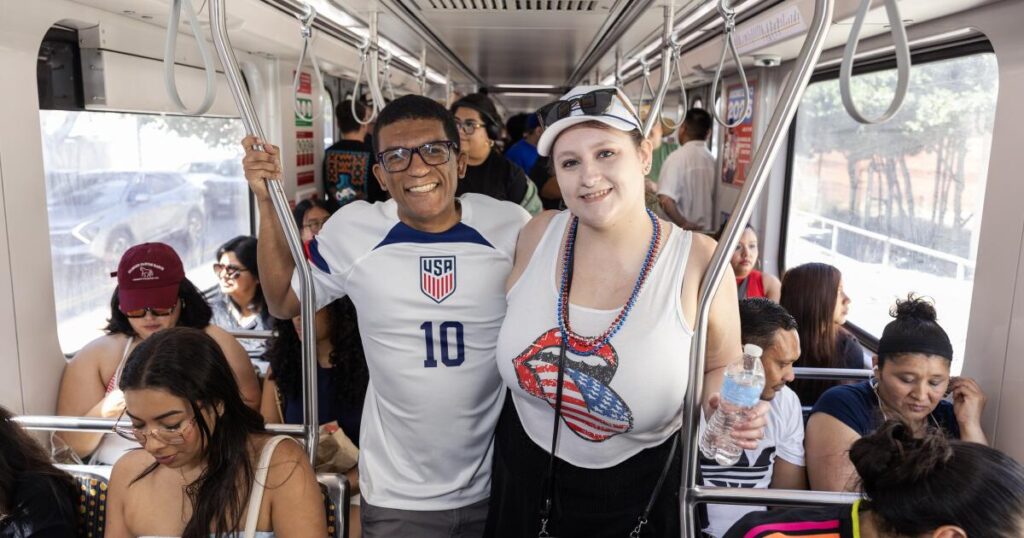
After the leap in ridership last month, early numbers in June show that game-day ridership is high for Metro. As for the experience of taking public transit in L.A. amid the crush, the reviews are mixed.
“The transit is impossible,” said Ignacio Santa Cruz, who had traveled to Los Angeles from Asuncion, Paraguay, to see his country’s national team play the U.S. on Friday.
“I mean, to go everywhere, you can expect at least 45 minutes of rides.”
Gary Mackenzie, on the other hand, told The Times on Saturday during the FIFA Fan Festival at L.A. Memorial Coliseum that “the roads here compared to back home are pretty crazy, man.” Mackenzie is from Scotland, where you drive on the left side of the road.
He had thought about “hiring a car” but decided against it, and “I’m pretty glad I did. … I’m really using public transport, which has been fine.”
Last month, the opening of the long-awaited D Line extension along Wilshire Boulevard combined with the L.A. County Fair, Kia Forum concerts and events at the L.A. County Museum of Art to send ridership numbers shooting to the highest Metro had seen in six years. The D Line extension added about 8,000 to 10,000 additional riders per day. Year-over-year, ridership was up 9.5%, Metro said.
It’s not clear what the effect of the World Cup will be for the transportation agency, an official partner of FIFA. But the agency shared positive news.
Metro has seen an increase in total ridership for the World Cup and near certain watch parties for the U.S.-Paraguay match last week. At the Exposition Park, USC Metro E line stop, there was a 598% increase in total rider taps on Friday, compared to a typical day. At the A line, Memorial Park stop in Pasadena, near the Pasadena Civic Center watch party Friday, there was a 7% increase in fare gate taps.
Metro also touted the lack of “safety issues” amid the World Cup, helped along, it said, by an increased number of law enforcement and security personnel.
Metro has deployed “an engaged and visible presence of uniformed personnel from Metro’s Department of Public Safety Ecosystem,” L.A. Metro spokesperson Maya Pogoda said by email. L.A. police, Sheriffs Department and security officers as well as transit agency ambassadors are deployed across the system, Pogoda said.
“We are pleased that there have been no safety issues with our World Cup Enhanced Services, and there has not been an increase in safety issues with our regular system since the World Cup began,” Pogoda said.
With L.A. set to host the Olympics in two years, there have been widespread concerns about the city’s ability to efficiently move people on public transit during a sporting event on that scale.
For the World Cup games, Conan Cheung, the chief operations officer for L.A. Metro, told The Times earlier this year that the goal was to “keep our system accessible. The way we’re planning the entire program is to ensure that we support people from the minute they decide to come to L.A. for the World Cup.”
For many whom The Times spoke with who had traveled to the region for the games, avoiding L.A. traffic and cars was important to them.
At SoFi Stadium, the parking cost up to $300 per car during the World Cup, on top of already sky-high ticket prices. For many, gas prices were also a concern.
On Monday at Union Station in downtown Los Angeles, many of those in line told The Times that they’d used Metrolink to connect with the gameday bus to SoFi Stadium at Union Station.
For the U.S. vs. Paraguay match on Friday, 18,541 people used the bus services set up by Metro and its partners to get from 15 locations across Southern California to the stadium. On Monday, for the Iran-New Zealand match, 26,206 did so, according to the agency, a 41.3% jump over the previous game.
“With the Olympics and Paralympics Games coming to our region in two years, the World Cup service has been a good chance to prepare for moving a lot of fans at once,” Metro said.
But not everyone was using Metro transit options to get to the games.
Andrew Rori Moore of Palmerston North, a town on New Zealand’s North Island, told The Times, he and his friend had decided to walk and take rideshare everywhere.
“We’ve just done a bit of Uber so far and a bit of walking everywhere,” Moore said. “It’s just been super easy, which has been nice.”
The post Passengers ‘Ride the D’ — and other Metro lines — in droves as World Cup mania sweeps SoCal appeared first on Los Angeles Times.