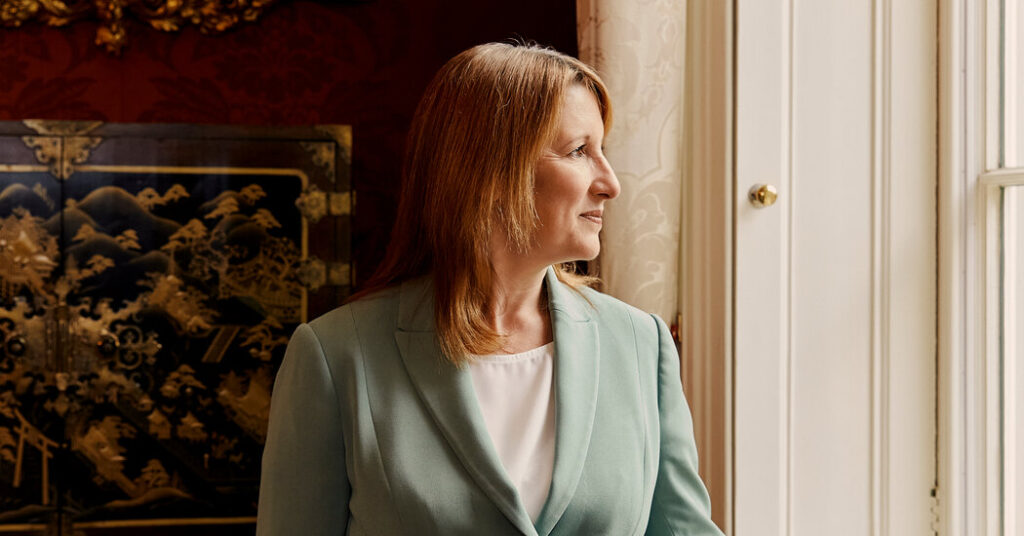
Rachel Reeves, Britain’s top financial official, has spent the past few months imploring voters and markets with a consistent message: Trust me, I have the right plan for the economy.
There are signs that she has been able to convince some bond traders, Silicon Valley and other international investors. The problem is that her pitch has fallen on deaf ears at home.
In Britain, there was hope that her political party would “not just be a safe pair of hands but do things that were radically moving in the right direction,” said David Aikman, the director of the National Institute of Economic and Social Research, an independent think tank. “Relative to those expectations, people feel it hasn’t worked.”
Ms. Reeves’s position as chancellor of the Exchequer is deeply entwined with that of Keir Starmer, the prime minister. But their leadership of the governing Labour Party, and by extension the country, is under threat. After dire results in local and regional elections last month, many have called on Mr. Starmer to step aside. An election on Thursday could return Andy Burnham, who is vying to be the next leader of the Labour Party, to Parliament. If he wins, he could challenge Mr. Starmer for the top job.
Whether Ms. Reeves would survive Mr. Starmer’s ouster is unclear. Bond investors appear to back her, and many superstar companies, including Anthropic and OpenAI, are expanding in London.
Yet Ms. Reeves’s popularity in Britain is low, partly because she is seen as holding the country’s purse strings too tightly.
Last week, the defense secretary, John Healey, resigned abruptly and blamed the Treasury, and Mr. Starmer, for not directing enough money to the British military.
The job of chancellor today is a difficult one. After years of government underinvestment, Britain needs to spend vastly more on everything from the energy grid to public transport. Public services, especially for taxpayer-funded health care, need more money and more efficient running. Welfare spending is costly and the government has vowed to give more for defense. All the while, public debt is high, at about 94 percent of the economy’s size. Interest payments amounted to about 8 percent of all public spending in the last financial year.
Ms. Reeves took office in July 2024 after a general election that restored Labour to office following 14 years of Conservative Party-led rule. She argues that she has had no choice but to prioritize fiscal stability. The country was still encountering market skepticism after the bond market rout in 2022, when a previous prime minister, Liz Truss, pushed for tax cuts without an adequate plan for funding them. Borrowing costs on government debt spiked.
Labour was very clear “that we were going to return stability to the economy, and that stability was the rock on which economic growth is built,” Ms. Reeves said in an interview last week with The New York Times.
“Obviously, stability on its own is not enough,” she added.
The British economy also needs more investment and reform, she said. But Britons have shown their frustration with the pace of change and remain worried about the cost of living. In April, inflation fell below 3 percent for the first time in more than a year, partly because of policy changes the Treasury made to lower household energy bills.
The inflation rate held steady at 2.8 percent in May, data published on Wednesday showed. But it’s expected to stay elevated throughout this year because of the impact of the war in the Middle East. That has also ended hopes of interest rate cuts by the Bank of England this year. Even once the Strait of Hormuz reopens, analysts say it will take months, maybe years, for the energy sector to recover.
In an effort to soften the impact on the British economy, which is dependent on energy imports, Ms. Reeves directed the government to slash the value-added tax, a sales tax, on children’s leisure activities and restaurant meals until the start of September.
“I recognize that with everything that’s happening in the world, people are worried about the cost of living and the cost of basics,” she said.
In response to the energy shock, the government has given more money to households that use heating oil, and cut taxes on some fuels to help farmers, the rail industry and people who need to drive for their jobs, such as at-home care aides.
The interventions were tailored narrowly, in keeping with Ms. Reeves’s approach to budgeting. As she and Mr. Starmer promised during their campaign, Ms. Reeves changed the government’s rules to require that day-to-day spending be paid for by tax revenue, and to force debt levels lower. The point was to free up more money for investment. Lowering the nation’s deficit, a difficult task, was made harder by the government’s own pre-election promise not to increase any of the taxes that could raise the most revenue, such as income tax.
Ms. Reeves has stuck to these rules ferociously, even as members of her own party suggested she was allowing the threat of global bond investors to dictate government policy.
“One of the issues is she probably hasn’t seen any clear tangible benefits to point to for the stance she’s taken,” Mr. Aikman said. Yields on British bonds remain relatively high.
Still, he added, Ms. Reeves is to be applauded for sticking to her rules in the face of political pressure. “That has allowed the fiscal position to stabilize, but it’s stabilizing at such an uncomfortable level,” where debt levels are still high.
Bond investors have recently expressed concerns about whether new government leadership would be as committed to reducing the deficit. Mr. Burnham’s decision to run for Parliament was met with a sharp sell-off in Britain’s bonds. He has tried to reassure investors that he would stick to the existing fiscal rules set by Ms. Reeves.
Credibility, Ms. Reeves said, “is hard won but easily lost.”
“I’ve managed to build that up over the last two years,” she continued, “by proving that I can live within the fiscal rules that I’ve set.”
The post Britain’s Finance Chief Confronts the Political Challenges of Fiscal Stability appeared first on New York Times.