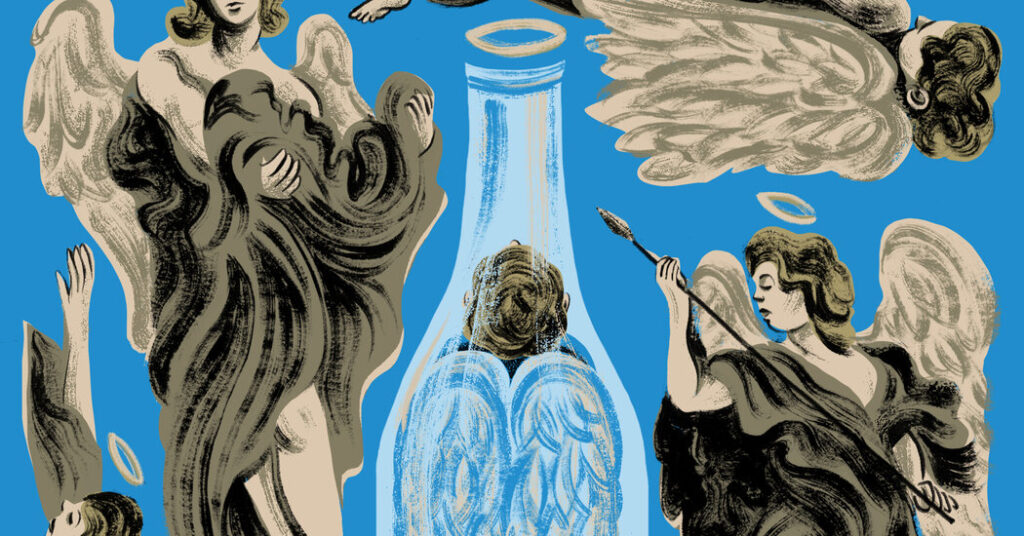
This personal reflection is part of a series called The Big Ideas, in which writers respond to a single question: What drives us? You can read more by visiting The Big Ideas series page.
It was August, and I was in Rome, sick and hung over among the ruins of imperial strength. The heat that month was colossal. I woke each morning in a panic of alcohol withdrawal, limbs covered in sweat, and spent the afternoons wandering aimlessly through the city center, dwarfed by the battlements of ancient fortresses, seeking shade beneath the statues of war heroes.
Earlier that year, I’d started drinking again after 11 years of sobriety. There was no good reason for the return, no major tragedy or life crisis; I should have known better. Drugs and alcohol had nearly killed me in my twenties, and during the subsequent decade of abstinence, life had gotten very good. I went back to school, married, published two books. But whatever survival instinct propelled me into that new life had abruptly reversed course and turned reckless. I hid the relapse from everyone, including my husband. We’d come to Rome for his work, but when I came down with Covid, he got his own hotel room to avoid getting sick. Within an hour of him leaving our rented apartment, I was at the corner store, handing over 20 euros for a bottle of vodka.
Accounts of human motivation tend to focus on survival and self-actualization — the striving for power, autonomy and recognition — or incentives that maximize pleasure and reduce pain. We are a species that has been fine-tuned by evolution for success. So why do we often choose failure? Why do we poison ourselves? Walking one day down the slope of the Oppian Hill, I passed the Colosseum, brazen and brutal in the midday sun. There is a story in Augustine’s “Confessions” about his student Alypius, who is so obsessed with watching the gladiatorial games that Augustine calls it a “reckless addiction.” Alypius sees himself as an intellectual, capable of rationally mastering his passions. When Augustine convinces him that the games are evil, Alypius renounces the entertainment as loathsome and promptly stops attending them. One afternoon, though, Alypius is walking through Rome when he runs into some friends who invite him to the Colosseum. He initially begs off, but when they insist, Alypius gives in and agrees to go, boasting that he will keep his eyes closed the whole time. He does this successfully until a great roar takes over the stadium and his curiosity gets the better of him. He opens his eyes and becomes “intoxicated” with blood lust.
A strain of Greek philosophy holds that vice and self-destructive behavior stem from ignorance. “No one who knows or believes there is something else better than what he is doing, something possible, will go on doing what he had been doing when he could be doing what is better,” says Socrates in Plato’s “Protagoras.”
Augustine, however, did not put much stock in self-knowledge. The problem was the human will, which was by nature weak. The literary scholar Erich Auerbach argued that the story of Alypius marks a discernible shift in theories of human motivation. In place of the self-controlled Hellenic intellectual, who cannot do what he knows is wrong, came the fallen soul of Christianity, who is corrupted by original sin and inclined by default toward evil.
Unlike many Eastern traditions, which tend to accept suffering as an unavoidable fact of life, the monotheistic religions, which center on an omnipotent, benevolent God, have been haunted for centuries by the problem of evil. And nowhere is this problem more baffling than when the pain is self-inflicted. It’s a puzzle that eventually found its way from theology into Western philosophy. The German philosopher Arthur Schopenhauer believed that harmful urges came from the will, a transpersonal force of creative destruction that seeks “strife” and possesses people with motives that often run contrary to their rational self-interest. Sigmund Freud spoke of the “death drive.” When aggressive tendencies are repressed, he argued, the violence turns inward, spurring compulsions, addictions and other pathological habits. Contemporary therapeutic frameworks often attribute unhealthy drives to maladaptive patterns, or else to faulty impulse control and glitches in the brain’s reward systems. But for me, the destructive urge has never felt like a glitch. Instead, it feels like what Schopenhauer describes: being possessed by some cosmic force that cares little about your higher aims and ultimately wants you dead.
It’s impossible to spend any amount of time in Rome without sensing the futility of human striving. All the ruins of grand palaces, all the statues of dead emperors, stand as reminders that the great swell of aspiration, even at its most triumphant, is subject to attrition and decline. In the Basilica of Santa Maria del Popolo, where I’d gone one morning to escape the heat, I saw a woman cover her mouth with her hand and silently weep as she looked at Caravaggio’s “The Conversion of Saint Paul.” In his second letter to the Corinthians, Paul describes how God declined to remove a “thorn” in his flesh (some unnamed fault or temptation), assuring Paul that “My strength is made perfect in weakness.” This is the Christian solution to bad will, one I still find compelling: Give up. Surrender. Accept that there is some inscrutable force calling the shots (God, fate, the unconscious), and you’ll open yourself up to the possibility of grace. This idea had gotten me sober a decade earlier in the rooms of 12-step fellowships. And it was a moment of utter failure and desperation that would later lead me to confess my relapse to my husband and return to the recovery community that has been foundational to my sobriety these past four years.
Thinking back on that summer now, I see grace everywhere: The mother who baptized her child’s sweaty head with handfuls of cold water from the public fountain. The couple who covered the bill of a tourist who didn’t realize the cafe accepted only cash. The stranger who gave me the rest of his water bottle when I nearly fainted on the marble steps of the Pincian Hill.
I don’t pretend to know why we are driven to darkness. But I believe that life is more beautiful when this tendency is acknowledged. If you think human motivation seeks only goodness, you will be outraged every time someone falls short. If you believe, on the other hand, that we are inclined toward vice and failure, then every act of virtue is a miracle, one of those unmerited gifts that is all the more wondrous because it is so rare.
Human nature, like history, is more circular than linear. Civilizations rise and fall. We err, convert, transcend ourselves and inevitably return to sin. But we do, sometimes, get better.
Meghan O’Gieblyn is the author of “God, Human, Animal, Machine: Technology, Metaphor, and the Search for Meaning.” Her memoir “Will and Attention” will be published in October.
The post Why Do We Poison Ourselves? appeared first on New York Times.