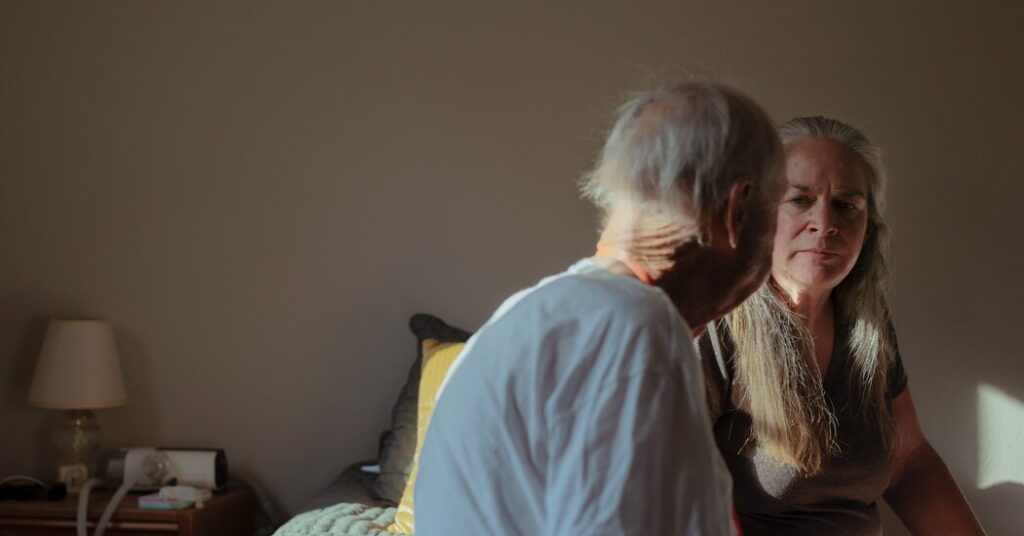
It started in January 2024, with a call from her father’s eye doctor. Did Carole know that Andre was still driving, even though his vision was so poor? Even though it was illegal to drive with eyesight so bad?
Well, no, she didn’t; she made a point not to know this sort of thing about her father. Also, she didn’t really care.
Still, Carole drove to his house, on the outskirts of Santa Rosa, Calif., down long dirt roads surrounded by vineyards. The house had beige carpets and beige curtains and beige walls with wood paneling — and Carole, who visited infrequently, was startled at “the squalor he was living in.” Everything was in disrepair. The food was expired. There were rats in the ceilings, but Andre, who was partly deaf, couldn’t hear the ceaseless patter of their feet above him.
And there was her father, 93, standing by the front door, on that filthy rug, next to the maroon-colored walker that he hated to use. Looking small, looking weathered. Carole didn’t want to stay, but she stayed, and later she would think that she never really had a choice to do otherwise. Her sister would have nothing to do with Andre — they had been estranged for years — and by then his siblings were all either dead or too old to help him. Maybe she could have just walked away, left her father to become a ward of the state, but she couldn’t bring herself to do it. “I have enough integrity,” Carole, who is 58, told me. “And I have to be able to live with myself after that [expletive] is dead.”
The visit led to hours of help a week, and later hours each day. Carole brought Andre to his appointments. She managed his finances and his medications. She ran his errands. She answered his endless calls and text messages. Andre had some savings from his decades of working as a newspaper typesetter, but he refused to spend anything on his care. He said he didn’t need it. And while his doctor agreed with Carole that her father clearly had some dementia, he told her that she couldn’t force him to pay for caregivers or cleaners or anything else. So that was that.
That spring, Carole installed a security camera outside his front door that sent alerts to her phone whenever he went outside. Once, at work, she opened the app to see her father, who was gardening, fall straight backward, deadweight, slamming his head on the concrete before sitting up, seeming to have a seizure and falling back down again. She brought him to the E.R. that time, and every time he fell after that.
But there were things she wouldn’t do: embrace her father, for instance. Whenever Carole drove Andre anywhere, she would make him sit in the passenger’s seat until she could get his walker from the trunk and position it by the door, and she would put a hand on his back or his arm to steady him, but she wouldn’t take him into her arms.
Sometimes, for a moment, Carole could see Andre as others saw him, as a sweet old thing. A French Canadian man with pale blue eyes and a bad knee, who said “merci beaucoup” with the remnants of an accent. An older person with dementia who was losing the thread.
But usually, she saw him as he was when she was a little girl, when he used to kick her — hard, “like you would kick a dog that you were abusing.” She remembered being 4 and playing with her toys in the family room and her father yelling at her to pick them up — and then, when she didn’t, him grabbing her by both hands, so that she couldn’t get away. “He’s holding my right hand. He’s holding my left hand. And he’s kicking me in the crotch. It’s hurting really bad. I pissed my pants, and I was humiliated, because I was potty-trained, you know?” She remembered that after it was over, she cleaned up her toys and went upstairs to change her clothes.
When Carole first became a caregiver for her father, she joined Parenting Aging Parents, a Facebook group with nearly 40,000 members, most of them women. Carole read the message board, but she didn’t see her situation reflected in many of the comments. The other people in the group seemed to have had good parents, or at least good-enough parents, who in turn earned their children’s support in old age. Carole felt like a lone caregiver whose sense of obligation came without all the cozy feelings.
Soon enough, though, she began to see that there were others like her. They tended to be quieter, but they occasionally revealed themselves in the comments. They were all across the country, too, people caring for mothers and fathers who had themselves been poor caregivers. (The caregivers I spoke to asked to be identified only by their first names to protect their privacy.)
Some had parents who never said “I love you”; who never tried very hard; who never took an interest. Others had parents who hurt them. Many were harmed in the usual, derivative ways — with belts and closed fists and neglect and humiliation — but some had parents who were more inventive in their infliction of pain. A woman whose father would swing her sister around by her ponytail. A man whose drunken mother used to wake him up at night to tell him that he was a “piece of shit” for hours on end, so he couldn’t sleep.
They all had their reasons for looking after parents who seemed so undeserving. They said they had to because there was nobody else. Because they couldn’t afford paid nursing aides, or because they couldn’t find any in their small town. Some did it because of Catholic guilt, because of other kinds of guilt. Because the sight of a once-robust parent, now degraded and infirm, had unmoored them. In Florida, a woman agreed to care for her father because he had apologized for everything. In Delaware, another women did the same because even though her father used to beat her, he later defended her, to her mother, when she came out as gay.
They did it because they wanted the inheritance. Because they believed that a child’s duty to a parent was unconditional. Because “two wrongs don’t make a right.” Because they hadn’t realized how hard it would be; how expensive it would be; how long their parents would hold on. Some did it because their fathers were too weak to hurt them now. Because they wanted to be good people. Because one thing led to another, and now there was nothing to do but endure it.
In the early 2010s, a social-work researcher named Jooyoung Kong, now a professor at the University of Wisconsin-Madison, looked at the proportion of American adults who were caring for older parents (currently around 10 percent) and those who said they were physically or sexually abused as children (more than 20 percent). She theorized that some adults were caring for parents who once harmed them, and she wanted to study them. Her colleagues assumed she would find very few.
Instead, in a 2015 study called “Caring for My Abuser,” which analyzed caregiver data, Kong and her co-author, Sara Moorman, found that of 1,001 adults providing care for aging parents, 18.6 percent reported having experienced verbal, physical or sexual abuse during childhood at the hands of a parent, and that 9.4 percent reported neglect. If the numbers played out at scale, this could be mean millions of Americans.
Kong found that, sometimes, culture explained the existence of these caregivers. There were people in certain communities and certain families who never questioned their obligations. They understood that they were meant to be caregivers, whatever happened before.
But there were structural causes too. When it comes to funding long-term care, we are “one of the worst” countries in the world, says Howard Gleckman, a fellow at the Urban Institute, a nonpartisan economic and policy research institute. Many Americans are startled to learn that Medicare doesn’t cover long-term caregiving at all, that it mostly pays for acute medical care — hospitalization after a broken hip or an infection, say — and a short period of rehabilitation afterward.
Medicaid does cover caregiving — professional aides to help with things like showering and using the toilet — but only for people with very limited assets, around $2,000. Even then, it often covers very little: perhaps a few hours a day, which may not be enough. Anybody else is left to embark on what policy analysts obliquely call the “spend-down pathway.” On average $35 an hour on at-home caregiving and $115,000 a year on a nursing home, but more for a private room.
And so the American system is reliant on unpaid family caregivers, and adult children in particular. Older people who are left to fend for themselves can meet dire fates: regular trips to the E.R. — for dehydration, malnourishment, pneumonia, urinary tract infections, fractures, falls — followed by hurried hospital discharges and brief stretches back at home, before the next emergency. The “doom loop” ends, Gleckman says, only when people die in their hospital rooms or at home. “And nobody knows it until, you know, the mail carrier or somebody smells something bad.”
Just the thought of it can force the hand of a reluctant caregiver. “I think that here, in the United States, it’s often perceived that caregiving is a choice, though more than 50 percent of U.S. caregivers feel like they don’t have a choice in becoming one,” says Allison Applebaum, a clinical psychologist who works with family caregivers. In these cases, the pretense of choice “almost begets a greater sense of burden and resentment.” The reluctant adult child suffers through it and then is told that she chose to.
A woman named Asia, who lives in Washington, told me she became her father’s caregiver by mistake — though later, everyone said that she must have seen it coming. He was getting older and poorer, and he couldn’t afford his rent anymore. Asia and her husband at the time decided to build him a small house on their property. It would increase the value of the place, she reasoned, and her father could live there in the meantime. Only after he moved in did the extent of his dementia become clear.
Asia thought: Oh my gosh, no. I don’t have it in me to be a caretaker. Then she felt angry “and kind of stupid.” That was around 10 years ago.
When she was growing up, her father was very religious and very strict, and he often beat his children with a belt for their various infractions. Afterward, he would cry and promise to do better, and invariably the child he had beaten would end up consoling him and telling him that it was all OK. He was awful in other ways, too. He hated noise, for instance, and in his presence, his children were not allowed to laugh.
But now he had nobody else. Two of his four children wouldn’t speak to him, and another lived out of state. Asia decided that even though she had a bad childhood, this wasn’t an excuse to be a bad person now. Also, what was she going to do — evict a broke, demented man from her home?
Over the years, though, Asia’s father became “more demanding than every other aspect of my life” — more exhausting than her own children. She grew afraid to leave the house, afraid to water the flowers on the front porch, even, because every time her father saw her, he needed something else from her. As his dementia, later diagnosed as Alzheimer’s disease, worsened, he became more selfish and more self-righteous. He told her that he was “extremely disappointed” in her for the way she was living, outside of the church. “It sounds very dramatic, but it was literally killing me,” Asia told me. “I wasn’t able to have a life, in any way, outside of caring for him.” At some point, she told her husband that she was going to kill herself. She didn’t entirely mean it, but she did feel desperate.
Then he grew sicker. Earlier this year, Asia moved her father into a facility, and then another facility, and then into hospice. Sometimes, he would cry and beg to leave. Other times, he would ask when his other children were coming to visit. At first, Asia would say, “They’re not really happy with you because of how they were raised.” She didn’t want to console him. To let him eventually die believing that he was a good father. But later, she felt as if she was punishing him for something that he probably didn’t remember. She would say that they were busy.
Kong’s research into abused caregivers identified a dynamic that clinicians often missed. “We never asked about the relationship,” says Pat Berry, a retired hospice nurse who has studied family caregiving. Through her early years of nursing, Berry says, she always assumed that her elderly patients would be cared for by their children, whenever possible, and that their children would want to do it. And that, in the end, those children would be sad to see their parents die. Nurses were forever saying things like, “Oh, your mother is so sweet.” Or calling a daughter who hadn’t visited in a while: “Your mom’s been asking about you. I bet you’re busy, but boy it would be nice if you could come.” It never occurred to them that an adult child might be staying away because of the awful things that had been done to her.
Berry found herself thinking about language, about how everyone in health care uses “loved one” as a shorthand for “family member,” and how this reinforces a larger myth about how people in a family always love one another.
In therapists’ offices, though, these caregivers were presenting themselves. Many came to talk about setting boundaries. Given that they had to be caregivers, how could they bear it? What should and shouldn’t they do for the parents in their charge? Others came just to talk about the trials of caregiving — and sometimes, they said nothing at all about their abusive pasts, for weeks and weeks.
“Oftentimes, caregivers do have this dissociation,” says Stephanie Muskat, a Toronto-based social worker and founder of the Compassion in Caregiving therapy group. “It is very hard for someone to acknowledge, ‘This person really wronged me, and I’m very hurt deep down, but yet I am expending so much of myself, to give to that person.’ So they try to separate it, even subconsciously.” They tell their therapists only that they aren’t sleeping or that they’re angry all the time; that they’re overeating or undereating or drinking a lot. Muskat has had a few patients who, in some act of psychic self-preservation, managed to forget that they had ever been mistreated — at least, for a while.
Debora moved in with her parents five years ago, when her 87-year-old mother could no longer handle her 90-year-old father alone. “She’s real little, and he’s real big,” she says. Debora was the second of their 10 children and the oldest daughter, and her own husband had already died. Everyone assumed she would be the one to help. “I think it was just pretty much expected of me.” Even as a child, she was always a caregiver, always tending to her siblings on the family farm, always working in the kitchen, never allowed to go outside and play.
At her parents’ condo, Debora cleaned and organized and ran errands. She cooked meals that her father would push away, like a petulant child. As her father grew more frail, Debora also started helping him with other things: the toilet, the shower. “I didn’t wash his private parts,” she told me. “I gave him a rag to do his private parts. I was not going to do it, you know what I mean? But the rest of him, I scrubbed and scrubbed.”
Debora knew that when she was a child, her father sometimes hurt her, though her memories were blurred and incomplete. And so she had never told anybody — not her mother, not even her husband. But back with her parents, she started remembering things. Sometimes a smell — car oil (her father was a mechanic), lumber (he was always woodworking) — could resurrect a whole childhood scene. Debora came to see that her father had sexually abused her for years. That he had used her body over and over and also brought her to other men — the farm help, usually — and let them use her, too, in exchange for booze or cigarettes or whatever.
She trained her mind to go numb while she was caregiving. “I did it without feeling,” she says. “I was a robot.” But that worked only for a time; after that, she was angry. She started drinking — at first a little, and then a lot, in the hours after she put her parents to bed.
It was only when a few of her siblings confronted her about the drinking that “I finally came clean,” Debora says. “And they went nuts. They couldn’t believe it. Because we were the perfect family of 12 Catholics.” Everyone was so sorry. And after that, some of the siblings did start to hug her more, to call her more, to help with things.
But apart from her oldest brother, who wanted to know the details of what happened, nobody talked about the abuse again, and Debora continued to live there, in the condo. She wanted to prevent her mother from learning what her siblings now knew. Her mother was “a saint,” she says, and she deserved some peace in her final years.
It went on like that until one day in January 2026, when Debora’s mother went to lift something from the coffee table and fell — and then Debora’s father tried to help her, and he fell too. He ended up in the hospital and then a nursing home. And maybe this new distance opened up something in Debora, because she allowed herself to not visit him. To not care how he was doing.
He had been in the nursing home for several weeks before Debora’s mother remarked on her absence — and Debora decided that, to avoid her suspicion, she would visit. When she entered her father’s room, she found that “he was in an awful state. He had food all over his face, his clothes. He couldn’t reach the drink on his tray.”
Did she feel sorry for him?
“I did,” she says. “I did, and I don’t know why.”
Carole was angry all the time, host to a raw, indigestible fury. She would yell at Andre sometimes, and afterward, she would not feel bad about it.
What enraged her most was how he never seemed grateful for any of her help, or even, often, to notice it. Carole thought that a better parent would try to spare his daughter the burden. But Andre thought he deserved it all, and for someone else to pay. He never even offered to cover her gas.
“You know what, Dad,” she told him one day, after he refused to use his walker again, “when you fall, you better make sure you kill yourself, because if you break your leg or break your pelvis, and you end up in a diaper in a skilled nursing facility, you’re going to be miserable.”
In an email, her therapist wrote: “I feel concerned for you, Carole, and the level of retraumatization you are facing. Please protect yourself.”
At some point, Carole met with social workers at the Redwood Caregiver Resource Center to ask what she could do about the fact that her father was refusing all kinds of professional help. Alexis Glidewell, the program director, said that this was often how things happened; the older adult was legally free to make his own choices, and he made imprudent ones. In elder care, scholars speak of an older person’s “right to folly.” Unfortunately, sometimes the only way to resolve things was to “precipitate a crisis.” Carole could wait for something bad to happen to Andre: a fall, a broken bone, something serious enough to get him admitted to a hospital. That would place him inside the system, at which point it would be the hospital’s responsibility to treat him and ensure his “safe discharge.”
If Carole refused to take him in, then Andre might be sent for rehabilitation at a nursing home that, at his age, he was unlikely to ever leave. Things played out like this all the time, Glidewell said. In other instances, people abandoned elderly relatives, many with dementia, at the doors to an emergency room, sometimes with letters pinned to their jackets. Something like, “Please take care of my dad.”
Social workers also understand that people who experience abuse as children can go on to become physically abusive caregivers. Hurt people, as they say, hurt people. But usually, Glidewell told me, when elder abuse occurs, it takes the form of “this kind of insidious neglect.” A daughter might give up on getting her father to take his medications, for instance, because he always puts up a fight about it. She might say, “Fine, Dad, do it yourself,” when she knows that he won’t.
In August 2025, nearly two years after the call from Andre’s eye doctor, Carole finally got her father an appointment with a neuropsychologist, who did a three-hour evaluation and diagnosed him as having major vascular neurocognitive disorder. The exam found that Andre’s language skills were still “average to high average” — he could speak fluidly and even be charming — but that his executive functioning was “low average to exceptionally low.” On one memory test, he scored in the less-than-first-percentile range. The neuropsychologist concluded that Andre lacked the capacity to make even basic medical decisions. From now on, Carole would make them for him.
“I guess I’m being punished by God,” Andre said.
“Everyone gets old and dies, Dad,” Carole said. “You aren’t being singled out.”
From all her time in therapy, and from all the psychology books she had read, Carole knew better than to expect anything meaningful to come from her caregiving efforts. Like healing, for instance. “There is going to be no redemption before he dies,” she said. The final years of Andre’s life would not be one of moral transformation or awakening: the flawed old man being brought to his knees in shame before his selfless child.
Still, she did sometimes reach for closure. Carole had gone a lifetime without ever asking Andre about the ways he had hurt her. She never thought there was a point; he was probably too much of a narcissist to even recognize himself as an abuser. But the experience of caregiving — her proximity to him, his proximity to death — made her want to ask. “Dad, you have the choice,” she said. “You could choose to take responsibility for your behavior before you die and apologize.”
But he just denied it all. He said that Carole was making it all up. That he had always been a decent father. That he hadn’t been like his own father, an awful man. “I did the best I could,” he said. It was hard to know, now, how much was dementia and how much was willful denial.
In January 2026, Andre finally agreed to move into a retirement home — and Carole set up an appointment with a placement agency. Andre was agitated at the meeting, and he yelled a lot, but he managed to ask for a balcony with a view of the mountains.
After the appointment, Carole turned to leave. When she did, she saw that her father had started to cry.
“He was wanting to hug me,” Carole said, later, “and he was crying, yeah. And I just … I didn’t want to hug him back.”
The question of what, exactly, children owe their parents has always shadowed the family unit. Common sense seems to say that we owe them something, even if it is hard to translate that intuition into a coherent account of how much precisely is due. Then again, common sense might also say that this debt is limited and, maybe, that it is contingent on how we were raised. “Each generation,” wrote the philosopher Daniel Callahan, “has had to make its own sense of the biblical injunction that we should honor our fathers and mothers.”
The question seemed to acquire a new urgency in the 1970s, when the proportion of Americans over 65 reached 10 percent and people started to speak of “the graying of America” — and when increased life expectancy meant that, in some families, elder care was now a decades-long undertaking.
With the creation of Medicare and Medicaid in 1965 and the subsequent expansion of Social Security, “filial obligation” became a growing preoccupation of the state. In the lead-up to the passage of the programs in Congress, there had been a political debate about whether adult children should be required to exhaust their financial resources, to help “indigent” parents, before the state stepped in. But controversially, when Medicaid eligibility regulations were published, they limited financial responsibility to applicants and their spouses. In other words, they expressly forbade states from treating a child’s income as if it were available to her parents.
Supporters of Medicare and Medicaid, says Hendrik Hartog, an emeritus professor of history at Princeton University, imagined that in addition to offering social assistance, the programs could promote family togetherness and even affection, by taking the straining obligations of elder care away from children and placing them on the government. “It sort of got parents and children out of the impossible situation.”
But as many as 40 states had old “filial responsibility” laws on the books: legislation that dated back to the colonies and that required adult children to financially support their impoverished parents. The laws, which were enforced only haphazardly, had been an attempt to codify filial obligation, less out of any moral imperative and more because filial duty kept government expenditures down. Now these old laws stood in tension with the new public welfare programs.
Nevertheless, many states refused to abolish them. In the early 1970s, Gov. Ronald Reagan vetoed two measures that would have repealed part of California’s law. Adult children who were financially able “should contribute,” Reagan argued, in a news release. “The integrity of our welfare program demands that responsible relatives help support their parents.”
These critics worried that public funding would weaken the American family as a moral category. “At one time, fathers that neglected to pay for their children were not punished,” read a 2002 article in Family Law Quarterly. “Today those same fathers would be considered ‘deadbeats’ subject to wage garnishment and a host of punishments.” It went on, “Until there is regular enforcement of filial-responsibility statutes, Americans will continue to believe that the government will take care of their parents.”
Fewer than two dozen states retain filial-responsibility laws today, and they are very rarely enforced. Pennsylvania is an exception. In a notable case in 2012, a man was held liable for his mother’s $93,000 nursing-home bill, after she moved to Greece without paying.
Katherine C. Pearson, a law professor at Pennsylvania State University, gives lectures about the legislation around the state. “And whenever I describe the law, I always see one person’s face get very frightened. And I know that they will come up and meet with me, and they will tell me a story about how their parent had been a bad parent.” In these instances, Pearson tells the person that having been abused is not, itself, a statutory defense but that judges consider it to be a mitigating factor — and that, in general, “if the parent didn’t hold up what we think of as a parent’s end of the bargain, then the court would prefer not to find that child liable.” She tells the person, “Hold on to that story.”
But some adult children have trouble knowing whether the word “abused” applies to them. They ask themselves, Didn’t everyone get hit back then? Were bad parents bad by some objective measure, or did they need to be judged against the standards of the time? And what about those parents who weren’t abusers themselves but who seemed to let their spouses get away with it?
It was only when Susan was in her late 40s that it occurred to her that her mother hadn’t been so great. Growing up, Susan told herself that everything was her father’s fault. It was her father, after all, who screamed all the time — all 210 pounds of him, stomping so hard that the walls would shake. “Everyone in the neighborhood could hear it,” she told me. When she was still very young, Susan “got this idea in my head that it was my sacred contract to take care of my mother. That it was my duty.”
Only years later did she think about how her mother had been “complicit” in things. How, yes, it was her father who raged, but it was her mother who didn’t do anything about it. Susan acknowledged that her mother was born in the 1930s and “was not, like, a woman’s libber” — but she had her own money and a good job, and ultimately, Susan thought, she could have left and taken her children with her. This is what a good mother would have done.
There were other things that Susan thought of, too. The way her mother had always been distracted or absent. Those years when she would come home from work and not make dinner and just silently watch TV all evening long — or else talk too much, about her husband and her marriage, as if Susan weren’t her daughter and just a little girl. How her mother used to snort or sneer or condescend when Susan said something sincere.
Susan’s father died first. Then, in July 2019, her mother had a stroke. Susan started traveling from Denver, where she lived, to Portland, Ore., where her mother lived, staying for longer stretches at a time before relocating in 2022. Susan had no kids or pets or job — she was on disability payments, because of multiple sclerosis — and so she thought it only made sense for her to go. In Portland, Susan took her mother to appointments and did her laundry and handled her banking. “I could do all of that administrative crap,” she said, “but I could not cook for my mother.” She couldn’t brush her mother’s hair, either. Those things felt too maternal, too caring.
Also, in her old age, her mother could be nasty — almost as if she was trying to provoke her daughter. In the early days, Susan would just lose control. “And guess what I would do? I would go straight into what my dad used to do. I’d scream at her, which is awful.”
But over time, as her dementia deepened, her mother started to change. She became “less defiant, more compliant,” Susan said. Nicer. Less selfish. She started saying “thank you” all the time. Susan was able to imagine, now, that she was caring for a different woman, a woman other than her mother.
For some caregivers, dementia can be a complicating factor; it can make an adult child wonder if she owes anything at all to a person who doesn’t resemble the parent who raised her — and who might not even remember having raised her. But for Susan, the disease made things easier; it let her keep going. “Oh, thank you, God,” she told herself, “for changing the circumstance so that I can actually serve my mother.”
In February, a local retirement facility accepted Andre’s application for residence. Carole had insisted, per her father’s request, that he receive a room with a view. His balcony would face westward. “He likes to see the sunset,” she said.
She would still have to visit on occasion, to refill his pill dispenser and to check up on him, but she hoped that the visits would be infrequent: once every three or four weeks, at most, until it was over.
In the days after Andre’s move, Carole’s sense of resentment toward him seemed to grow, expanding outward to fill the new physical distance between them — acres of grievance, enveloping everything. She thought constantly about how he had no appreciation of her sacrifice or any interest in it either. Once again, he was refusing to accept that he was hurting her, so that he could keep taking from her.
Experts in caregiving observe, in many families, a tendency to over-attribute agency to people with dementia. To see malice where there is only a symptomatic “combativeness”; to see gaslighting and prevarication where there is only memory impairment. This is particularly true if someone has always been this way: mean and manipulative. In these cases, family members might be unable to comprehend that the disease has taken over — that the same bad behavior must now be understood to have a different, disease-driven cause.
“The way dementia presents itself is particularly triggering for people who have had historically abusive relationships,” says Glidewell, the clinical social worker. But someone with dementia, she says, isn’t capable of elaborate manipulation, and all the layers of thought and action that it requires. “If a person can do that,” Glidewell says, “they likely don’t meet the criteria for dementia.”
Carole had considered the idea that she might be overestimating her father’s abilities. Still, most of the time, she thought that Andre was actively manipulating her and that his instinct to do it was strong enough to override his impairments. “Absolutely, 100 percent absolutely.”
She had started to clean out Andre’s old farmhouse. Within weeks, she had thrown out decades’ worth of plastic bags and paper napkins, many of them used. On the porch, Carole found canisters of paint that were half a century old, and in the back office, what seemed to be every pair of eyeglasses her father had ever owned. Sometimes, in the midst of it all, Carole would feel sorry for her father, for the way he had been living. But when she felt this way she would reread her mother’s old journal. In the journal, her mother had recorded insults that Andre had yelled at her, in front of their daughters — “[expletive] blockhead,” “[expletive] idiot,” “dumb, ignorant and gullible” — and described him threatening to kick Carole’s sister.
When Carole read the notes, “it was like my mother was validating me from beyond her grave.”
Carole said she didn’t care what happened to him, but she did keep visiting, not every few weeks, as she had hoped, but every few days. There was just so much to do to get him settled, she said. Carole spent hours digitizing old photographs and uploading them onto a digital picture frame, so that Andre could have something to look at when he was sitting in his armchair. She made appointments and spoke to his doctors. She reminded him to use cream on the itchy parts of his back. On days when she didn’t visit, Carole would monitor her father on her phone, with the Find My iPhone app, checking to make sure that he moved from his apartment to the restaurant around lunchtime and dinnertime.
On a recent Monday morning, Carole carried a few plastic bags down the hallway of the retirement facility, toward Andre’s apartment. The bags were filled with items that Andre had requested from the house — his mail, a knife sharpener — and some honey, for his coffee. “That’s very kind of you,” Andre said, when he answered the door. “Merci beaucoup.”
As Carole moved around the apartment, rearranging things, Andre told her that he had slipped the day before, in the bathroom, and hit his rib on the counter. Carole frowned. “How badly does it hurt?” He said it didn’t hurt so badly. Carole said that she would buy him a bath mat. Then she brought him a glass of water. “You were coughing,” she said, when he looked confused.
“Carole has been extremely helpful. I thank God every day for my daughter,” Andre told me, sitting at the edge of his brown recliner. “Without my daughter, I’d be a dead man.”
He said he liked his new place. He liked the balcony. Still, it was awful being so old — 95, as of a few months earlier. “I used to climb mountains,” he said. He wiped his eyes. “It’s my punishment. For being what I am.”
“What do you think you’re being punished for?” I asked.
“I don’t know.”
Around lunchtime, Andre and I walked down the long hallway, past a digital sign advertising bingo, yoga and “Mocktail Monday” and into the facility’s restaurant, where he ordered a lentil soup and a coffee with three sugars. “I don’t want her to hear this,” Andre told me, “but Carole tends to be authoritarian.” She was bossy; she yelled. “I cannot fight back because I need her,” he said. “She knows that.”
Later, he said: “If Carole asks what I said about her, say that I said good things.”
Back in Andre’s apartment, Carole handed her father a pair of slippers. She said she wanted him to wear them, so that he wouldn’t slip again. Then she said that it was time for her to leave. “Give me your cheek, I want to kiss you,” Andre beckoned. “Love you.”
Carole flinched, then leaned in. “Love you, too.”
Andre died on June 3 following a heart attack. Carole is deciding what to do with his ashes.
Katie Engelhart is a contributing writer for the magazine focused on medicine and ethics. She won a Pulitzer Prize for her article about a woman with Alzheimer’s disease and the fight within her family over what was best for her.
The post The Pain of Caring for a Parent Who Abused You appeared first on New York Times.