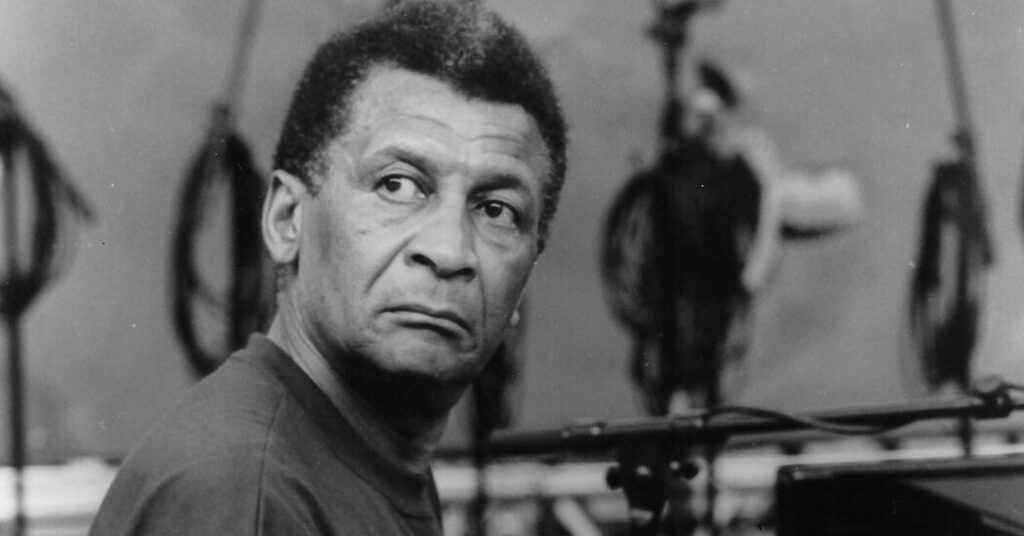
Abdullah Ibrahim, a jazz pianist and composer whose elegant, meditative style mingled the sounds of his native Cape Town with musical traditions from around the world, making him an admired ambassador of the anti-apartheid movement, died on Monday in Prien am Chiemsee, a town south of Munich. He was 91.
His death, at hospital, was confirmed by Jonas Herbsman, his lawyer. He lived in nearby Aschau im Chiemgau.
Mr. Ibrahim — who was known as Dollar Brand before converting to Islam in the late 1960s — folded the music of his South African hometown into an ongoing conversation with the latest evolutions in American and European jazz. For years, he was embraced by the standard-bearers of the avant-garde musical scene, including the saxophonist Ornette Coleman.
For all its disparate components, Mr. Ibrahim’s music never sounded like a crude synthesis — perhaps by dint of the unhurried grace of his playing and the deep spirituality of his approach. In his frequent solo concerts, he often performed lengthy, unbroken sets, fluidly folding together different themes and compositions as inspiration dictated.
“Improvisation is really becoming one with nature,” he told Tidal in a 2024 interview. “Becoming one with our real self.”
Mr. Ibrahim’s compositions, sometimes drawn from hymns of the African Methodist Episcopal Church that he sang as a child, tended to have a timeless air about them. “Mannenberg,” “The Mountain” and “The Wedding,” among others, became renowned in South Africa for their stirring evocation of musical liberation.
Mr. Ibrahim was a leading figure on Cape Town’s jazz scene by the time he fled South Africa in 1962 and landed in Zurich. Duke Ellington, the American jazz-band leader, who was touring Europe at the time, saw him perform at the Africana Club and was impressed. He subsequently supervised the recording of an album by Mr. Ibrahim.
“Duke Ellington Presents the Dollar Brand Trio,” released in 1964, touched off what would be a prolific and, at turns, transcendent recording career. Among the more than 70 albums Mr. Ibrahim released, a number are considered jazz classics, including “African Space Program” (1973), featuring a 12-piece orchestra; “Banyana” (1976), an expressionist trio recording; “African Marketplace” (1980), celebrating the goema rhythms of Cape Town carnivals; and “Water From an Ancient Well” (1986), an achingly beautiful sextet recording.
As the apartheid regime crumbled, Mr. Ibrahim regained the right to enter South Africa. In 1994, he performed at the presidential inauguration of Nelson Mandela, who hailed Mr. Ibrahim as “our Mozart.” For the rest of his life, Mr. Ibrahim split his time among residences in Cape Town, New York and Germany. In 2019, he was named a Jazz Master by the National Endowment for the Arts.
A Learned ‘Bitterness’
Adolph Johannes Brand was born on Oct. 9, 1934, to a Sotho man named Sentso, whom he never knew, and Rachel Brand, who was of mixed race and classed as “colored” under the apartheid system.
When Adolph was 4, his father, a house painter, was shot dead under murky circumstances. It was a tragedy kept from him until adulthood, when he also discovered that the woman who had raised him was his grandmother, not his mother; he had been told Rachel was his sister.
“My grandparents gave me their name so I’d be classified as colored,” a label that afforded them a higher social status than if they had been deemed Black, he told The Guardian in 2001.
He added: “That code of silence was created by the system. I was saddled with a lot of bitterness at an early age.”
Another thing the apartheid system had taken, he said, was the right to spiritual self-determination. “We were robbed of our traditional belief system,” he said in an interview with the N.E.A., adding, “The A.M.E. Church served as a home for our vision, for our perspective of freeing ourselves and expressing our spirituality in our own tradition.”
His grandmother had helped found the local A.M.E. Church in Kensington, the hardscrabble suburb where he grew up. She and his mother served as pianists and singers at church; his mother also played piano at movie houses, accompanying silent films. They both encouraged young Adolph’s interest in the instrument, and he started taking lessons at age 7. He immediately started composing his own music.
In Cape Town, a port city that included large populations of Indian, Chinese, Malaysian and other backgrounds, he was at the center of a cultural mix that naturally disrupted the apartheid system’s ethic of division — especially in District Six, the cosmopolitan inner-city neighborhood where his family moved during his childhood.
“Where I grew up, there is every kind of music,” he told the N.E.A. He studied Indian ragas and talas, Chinese folk song, the Zulu music sung in work camps and the rhythmic songs of street celebrations.
He listened to Voice of America broadcasts that carried the sounds of jazz, and he earned the nickname Dollar from the American soldiers stationed on Cape Town’s docks during World War II, because he was constantly coming around to see if he could buy the latest jazz records that they’d brought from the United States.
By 15, he was performing publicly, first as a vocalist and then as a pianist with big bands. In 1958, he formed the Dollar Brand Trio with Johnny Gertze on bass and Makaya Ntshoko on drums, endeavoring to fuse the sounds of Cape Town with American bebop. Soon after, the trio joined up with a group of horn players from Johannesburg who were on a similar creative mission.
Their brief union was called the Jazz Epistles, and it resulted in a series of now-legendary performances in both cities, as well as the first bebop recording in South African history, “Jazz Epistle Verse 1” (1960).
Mr. Ibrahim heard in bebop — especially the quasi-cubist pianism of Thelonious Monk — an African taproot. “For us, what Monk did was so natural,” he told The Guardian. “The rhythmic approach people found weird was totally in the African tradition. When I met him, I said thank you for all the inspiration. He was so surprised; he said, you’re the first piano player to tell me that.”
‘Mannenberg’
He had hoped to become a doctor but was barred from medical school because of apartheid. Instead, he read books and practiced piano for much of the day.
In 1962, he and his girlfriend, the singer Sathima Bea Benjamin, left South Africa amid the escalating violence of apartheid and a crackdown on the District Six jazz scene. That same year, Mr. Mandela was imprisoned and the African National Congress was banned.
His former bandmates from Cape Town, Mr. Gertze and Mr. Ntshoko, followed him to Zurich, where they continued performing together, including on the album he recorded under Mr. Ellington’s supervision.
Mr. Ibrahim and Ms. Benjamin married in London in 1965 and that year he released “Anatomy of a South African Village,” the first of a series of well-received recordings for the British label Black Lion.
That July, he made his U.S. debut at the Newport Jazz Festival, followed by performances at Carnegie Hall and the Village Vanguard in New York City. The next year, he performed five concerts with the Duke Ellington Orchestra, and soon after that, he spent six months in the band of Elvin Jones, the drummer, who had recently left John Coltrane’s quartet.
A multi-instrumentalist, Mr. Ibrahim also sometimes played wood flute, saxophone and cello. In New York, he began collaborating with musicians on the cutting edge of jazz’s “new thing,” including Mr. Coleman, Don Cherry and Archie Shepp. Suffering from ill health, he gave up drinking and smoking, took up martial arts and, after a return to Cape Town in 1968, converted to Islam, taking the name Abdullah Ibrahim. Two years later, he made the hajj to Mecca.
He lived for a time in Swaziland, then returned to live in Cape Town in 1973. That emotional homecoming gave way to his best-known composition, “Mannenberg,” named for the Cape Flats township where many Capetonians displaced from District Six had moved.
Guided by a cantering, wistful piano pattern and a gentle undercurrent of goema rhythm, the nearly 14-minute “Mannenberg” recording became a foundational work in the history of so-called Cape jazz.
“We’re on a break, and I look: There in the corner was a little upright piano,” he told the N.E.A. He started fiddling with a riff that the musicians quickly picked up on. “‘OK, let’s play it!’ And we played it for about 15 minutes,” he recalled. “But the engineer kept rolling. He didn’t even tell us that he was recording. We thought we were practicing the song. Then we realized that we had captured the mood of the people and the mood of the country.”
The tune quickly became the unofficial anthem of the country’s freedom struggle. “We had created something which was tradition, but it was affirmation of a new dawn coming,” Mr. Ibrahim told NPR in 2007.
After the Soweto uprising in 1976, Mr. Ibrahim fled the country, publicly declared his support for the African National Congress and began participating in benefit concerts, vowing not to return until democratic rule was established. The apartheid government revoked his South African citizenship. He settled again in New York with Ms. Benjamin and their two children, living for many years at the Chelsea Hotel.
Even many U.S. record companies shied away from him, he later said, in part because of his outspoken politics. Instead, he recorded most often for Enja, a German label, which remained his most consistent conduit well into the 21st century.
Starting in 1981, he briefly ran his own label, Ekapa (the Xhosa term for Cape Town). Two years later, he formed Ekaya, a midsize group of New York-based musicians that would remain his flagship ensemble for decades. He composed and performed the soundtracks for the films “Chocolat” (1988) and “No Fear, No Die” (1990), both by the French director Claire Denis, and for “Tilaï” (“The Law,” 1990), by the Burkina Faso director Idrissa Ouédraogo.
In 1990, he met the newly freed Mr. Mandela, who encouraged him to move back to Cape Town, which he eventually did.
His marriage to Ms. Benjamin ended in divorce. Mr. Ibrahim is survived by his partner, Marina Umari; his son, Tsakwe, a pianist and guitarist; and his daughter, Tsidi, a rapper who goes by Jean Grae.
In 1999, Mr. Ibrahim opened an education center in Cape Town called M7. He said he believed that music should be understood as a means of accessing ancient wisdom.
“The concept is not that the sound belongs to an individual,” he told NPR. “There is only one sound, and all the rest is echo.”
Ash Wu contributed reporting.
The post Abdullah Ibrahim, Eminent South African Jazz Pianist, Dies at 91 appeared first on New York Times.