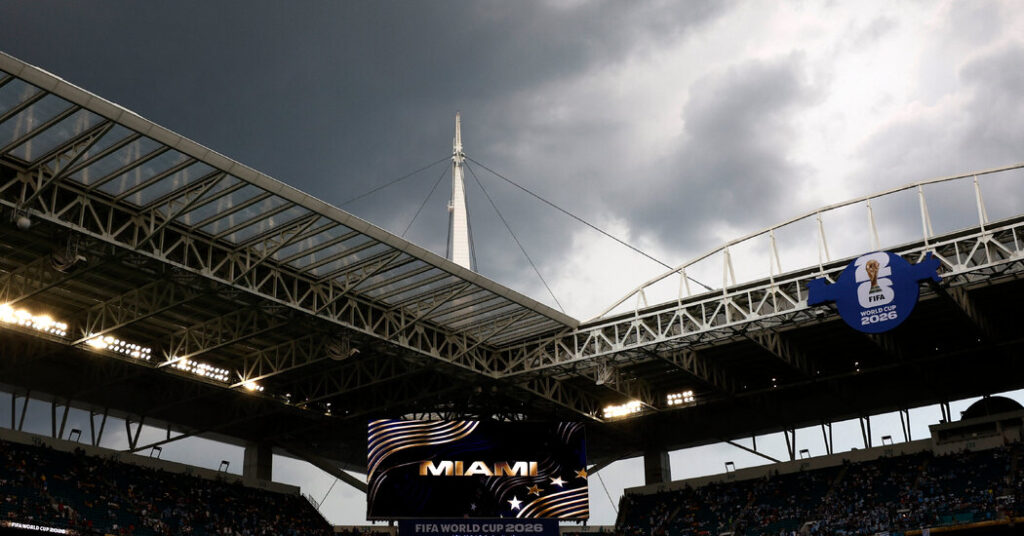
Excited throngs of people streamed into Hard Rock Stadium in Miami Gardens, Fla., on Monday afternoon for the region’s first World Cup game — some carrying portable fans, others with raincoats.
This is June in South Florida.
The National Weather Service issued a severe heat advisory for the region on Monday morning, warning that the heat index — a measure of how the air actually feels because of combined heat and humidity — could reach a high of 107 degrees Fahrenheit. (It was 102 degrees at kickoff.)
The Weather Service also predicted possible thunderstorms right around the 6 p.m. start between Saudi Arabia and Uruguay.
But the bipolar weather forecast did little to, well, dampen the spirits of the soccer faithful, most of them Uruguayan fans in a city that sees itself as the capital of Latin America.
“This heat is difficult,” said Sebastián Schwartz, 35, who had traveled to Miami from Montevideo, the Uruguayan capital. But, he added in Spanish, “There are so many Uruguayans!”
Mohammed Alotabi, 20, was in town from Jeddah, Saudi Arabia. “I came from the heat,” he noted, but added that the big crowds in Miami Beach over the weekend had made South Florida feel sweltering, even to him.
The severe heat advisory on Monday appeared to be the tournament’s first. Saturday’s match between Qatar and Switzerland in Santa Clara, Calif., was played under a more moderate heat advisory; the temperatures in Monterrey, Mexico, another host city, are forecast to rise dangerously over the coming days.
Just how hot it might get across North America during the tournament has been a crucial concern for FIFA, the World Cup organizer. The world has warmed about 1.3 degrees Fahrenheit since the last World Cup on the continent, held in 1994, which infamously featured some of the hottest World Cup matches on record, held in the middle of the day in open stadiums.
Since then, many new stadiums have been built, and others have added roofs or partial shade coverings, as is now the case at the Miami Gardens stadium, where fans’ seats are out of the sun. FIFA has also instated mandatory three-minute hydration breaks for players, one in each half of every match, even in covered and air-conditioned stadiums.
The breaks have also allowed FIFA’s broadcasting partners to run commercials during each match, anathema to soccer traditionalists.
No South Florida match is scheduled to take place at midday, avoiding the worst of the summer heat — on the field, at least.
Outside the stadium before game time, some fans huddled under limited shade. Others looked eagerly for paper fans handed out by one of the tournament’s corporate sponsors. Some people clutched bottles of water and Gatorade — or water and beer. Overhead, the clouds turned menacingly gray. (Should lightning strike anywhere in an eight-mile radius around the stadium, play would have to pause for half an hour until the lightning clears.)
Javier Hervith, 48, of La Plata, Argentina, ripped his shirt off nearly two hours before kickoff. “It’s so hot — 100/100,” he said in Spanish. But he said he was thoroughly enjoying it.
“I come from Argentina where it’s 5 degrees” Celsius (41 Fahrenheit), he added, referring to the winter season in the Southern Hemisphere. “I’m thrilled.”
The post Scorching Heat or Scorching Lightning? Miami’s Match Could Have Both. appeared first on New York Times.