Fox Corp.’s plans to acquire Roku for $22 billion shakes up the streaming business and could make the media giant a major player in the battle for the living room.
For Fox, the combination would expand its streaming presence both in the U.S. and internationally as it competes for high-profile news, sports and entertainment content such as the NFL, which is coming up for renegotiation. It will also allow for better promotion of Fox One and Fox Nation within the Roku smart TV platform, which is the No. 1 player in the U.S., and give Fox a television operating system with valuable viewing, distribution and measurement data that will offer better targeting and packaging for advertisers.
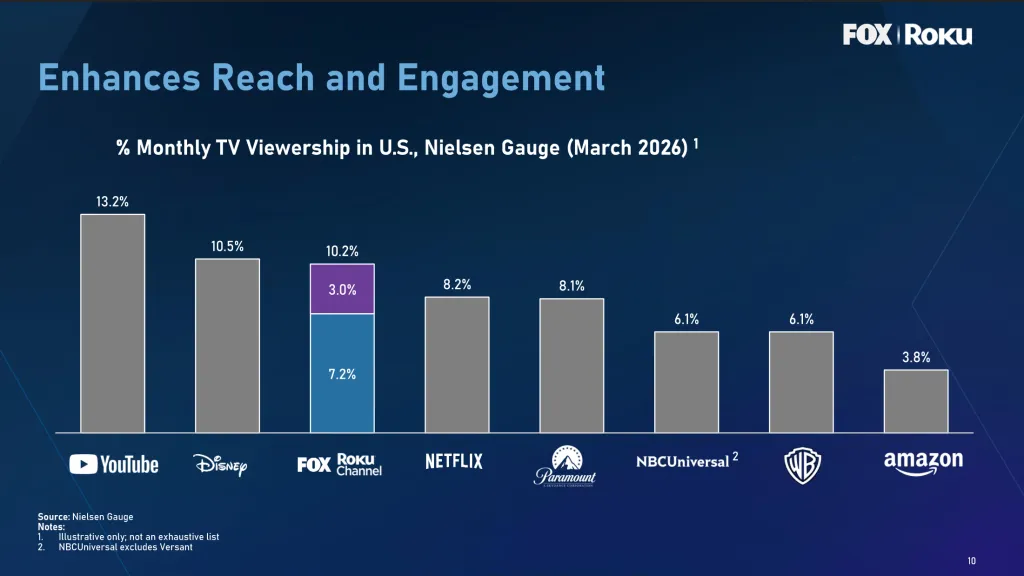
Similarly, Roku will be able to leverage Fox’s content and various services to boost its scale and content offering, as well as revenue on its platforms and home screen. It could also create a simpler, more unified platform designed to alleviate fragmentation at a time when consumers are facing rising costs and juggling multiple streaming services. And both companies would be poised to take a larger share of subscription and advertising revenue and become the third largest player in the U.S. player by viewership.
The deal comes amid a period of aggressive consolidation in the media world as factors including the shift to streaming, lower linear viewership and ad revenue, the entry of tech giants and the rise of AI has forced players to explore different options. It’s clear why Fox was attracted to Roku, with the company posting strong first-quarter results that included a higher full-year outlook and continued video advertising growth.
Total U.S. streaming subscription and connected TV advertising spend is poised to reach roughly $85 billion and $60 billion by 2030, respectively, according to a Fox presentation on the deal. The combined company forecast $9 billion in combined ad revenue, or around 14% of all spending on U.S. television, according to Madison & Wall. Per the firm’s estimates, combining Tubi and The Roku Channel would create a platform that would represent roughly 16% of U.S. streaming ad revenue.
But experts warned that it also comes with its fair share of risks, such as weakening Fox’s credit upon closing in the first half of 2027 and the potential for pushback from content partners over maintaining Roku’s neutrality as a distributor. Roku’s control of the home screen, search results and ad inventory that different services depend on and its overlap with free ad-supported streamer Tubi will likely also face antitrust scrutiny by the Department of Justice or Federal Trade Commission.
“Roku grew by being neutral and carrying everyone,” regulatory attorney Braden Perry told TheWrap. “Regulators will ask whether Fox could favor its own apps and squeeze competitors.”
Fox shares fell 15.7% to $49.70, while Roku shares fell 1.3% to $141.77.
Fox and Roku’s combined scale
The combination of Roku and Fox would bring Fox One, Fox Nation, budget streamer Howdy, live service Frndly TV and free, ad-supported streamers Tubi and The Roku Channel under a single umbrella.
Fox reported a total TV viewership share of 7.2% as of March, per Nielsen, with Tubi accounting for 2.2% of that. Fox reaches a total of more than 230 million users per month, including 100 million monthly active users at Tubi, according to an investor presentation.
Meanwhile, Roku reaches 100 million streaming households and 125 million people daily, with those viewers watching an average of more than 4 hours per day. The Roku Channel’s share of TV came in at 3% in March – making it the biggest FAST service by reach, per Nielsen. Roku’s streaming devices are also used in more than half of broadband households.
During a call with investors, executives said the overlap between the viewers of Tubi and the Roku Channel is about a third. Roughly 90% of Tubi’s viewership comes from on-demand content, while over 80% of Roku’s viewership comes from its FAST channels. Around 25% of viewing for the Roku Channel comes from users clicking on the tile for the app, while 75% comes from other entry points.
In addition, Madison & Wall noted that the Roku acquisition exposes Fox to the low-margin original equipment manufacturer (OEM) business, with additional costs tied to manufacturing, software development, physical marketing and device distribution. Per the investor presentation, Roku’s share of hours spent viewing CTV content sat at 44% as of the fourth quarter of 2025, much larger than its TV operating system competitors including Fire TV, Samsung, Android TV, Apple TV and Xumo.
What are the risks of the deal going through?
Though Moody’s Ratings senior vice president Jason Cuomo said that a Fox-Roku deal would drive greater scale, faster growth and increase the combined company’s streaming revenue to over 30%, he warned it would “significantly weaken” Fox’s credit metrics at closing due to “higher leverage, margin compression, and a high purchase multiple.”
Fox and Roku executives said they expect to return to a debt leverage ratio of 2.5 to 3 times within two years post-closing. Roku is on track to reach $1 billion in free cash flow by 2028 and Fox has an outstanding $2 billion note that will come due in January 2029 that it plans to repay. The companies are also targeting at least $400 million in synergies, not including revenue, and Fox plans to continue buying back stock.
Experts also warned that a deal could risk certain content partners reducing their dependence on Roku given Fox’s access to valuable and strategically sensitive competitive viewership data. Marketers with OEMS such as Walmart, LG, Sony, and Samsung, may also become more reluctant to work with Fox.
“If any partners view the net trade-off less favorably, the loss of content partners is a risk assuming there is no contractual friction that would stop or slow any partner loss,” Cuomo said. “However, we believe Fox is unlikely to implement any changes that could lead to unfavorable economic or strategic outcomes driven by partner losses given its focus on growing the Roku business.”
When asked about the neutrality issue, Roku CEO Anthony Wood said that the company would continue to operate as an “open, partner-friendly platform,” citing its history distributing and promoting both owned-and-operated services and partner services on its platform, and that there are policies and processes in place to allocate ad inventory appropriately.
Murdoch pointed out that Fox has previously balanced hosting and distributing partner content while monetizing its own content when it controlled Sky in the U.K. and Europe and Star TV. He also said that the intention is to keep The Roku Channel and Tubi brands operating separately.
“The likely outcome is approval with conditions, such as commitments on how Roku treats competing apps,” Perry said. “The recent clearance of the Paramount and Warner Bros. Discovery merger tells you the current enforcement posture is open to large media combinations.”
The post How Roku Will Supercharge Fox’s Streaming and Advertising Businesses appeared first on TheWrap.