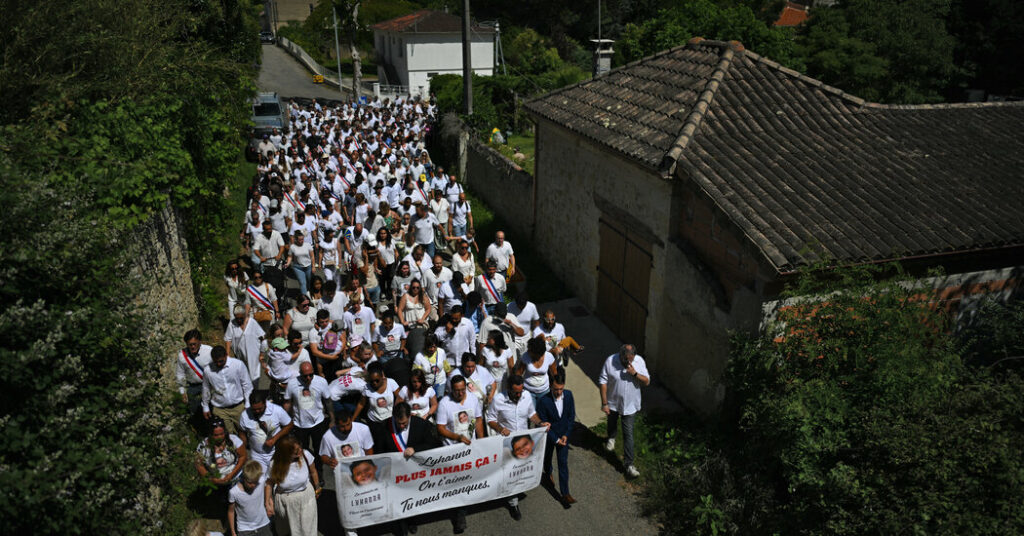
Protests took place in front of courthouses across France on Monday for the second consecutive week amid escalating public anger over the case of Lyhanna Rameau Bernard, an 11-year-old schoolgirl who disappeared in late May and was found dead days later.
The protests erupted after local authorities announced that a man arrested on suspicion of kidnapping Lyhanna, Jérôme Barella, had previously been reported to the police and other agencies, accused of several earlier instances of rape and assault, but not questioned in those cases by police officers. Asked about the accusations, Mr. Barella’s lawyers declined to comment.
The case has amplified a growing dissatisfaction in France over the effectiveness of the justice system, the resources allocated to it, and the ability of its different branches to pool information about people accused of sexual violence.
Who was Lyhanna and what happened to her?
Lyhanna Rameau Bernard was an 11-year-old girl studying in Fleurance, a small town near Toulouse, in southwestern France. She vanished on May 29 after leaving school around 3 p.m., according to a missing-person report posted by local authorities.
Two days later, the authorities announced that Mr. Barella, a 41-year-old maintenance worker, had been arrested in connection to her disappearance. A witness had reported seeing Lyhanna in Mr. Barella’s car, according to the French news media.
Lyhanna’s body was found on June 4 in a grain silo in a town roughly two hours’ drive from Lyhanna’s home.
Why has her case spurred so much anger?
Protesters say Lyhanna would not have been killed if Mr. Barella had been arrested in connection to earlier and unrelated accusations.
Clémence Meyer, a senior regional prosecutor, told reporters in early June that police had first been contacted in 2017 by a mother worried over her 17-year-old daughter’s relationship with Mr. Barella. But the girl said the relationship was consensual, so the report was closed without further action, Ms. Meyer said.
In 2020, Mr. Barella was fired from his job as a maintenance worker because of “an inappropriate relationship with a high school student,” Ms. Meyer said.
In 2022, a girl born in 2013 accused Mr. Barella of raping her at his home two years earlier, Ms. Meyer said. That case was dismissed after “thorough investigative measures did not provide sufficient evidence to substantiate these statements,” Ms. Meyer added.
In August 2025, a woman accused Mr. Barella of repeatedly raping her daughter, who was born in 2014, at his home. Ms. Meyer said that prosecutors were investigating that case when Lyhanna disappeared nine months later. Ms. Meyer added that Mr. Barella had not yet been questioned or detained in connection to it.
Lyhanna’s family did not respond to a request for a comment. Their lawyer, François Roujou de Boubée, speaking to reporters last week criticized France for allocating too few resources to the criminal justice system.
How have protesters and politicians responded?
The case has compounded fears within French society that the authorities are failing to protect women and children from sexual violence. It follows that of Joël Le Scouarnec, a surgeon convicted of sexually abusing hundreds of children, and recent allegations of sexual abuse and other misconduct against more than 70 school workers in Paris.
The mayor of Lyhanna’s hometown, Grégory Bobbato, summarized those concerns last week at a march in Lyhanna’s memory, where he said that her killing was not an isolated case caused by individual mistakes but a “societal failure.”
Advocacy groups for women and children are demanding changes to how the judicial system investigates sexual violence. They have called for demonstrations to be held every Monday evening in front of courthouses around the country. Roughly 60,000 protesters gathered across the country last Monday in the first such demonstration, according to a government estimate.
The cause bridges the country’s political divides. Opposition leaders — including Mathilde Panot, the top lawmaker for France Unbowed, France’s far-left party, and Jordan Bardella, the leader of the French far-right party the National Rally — have called for the resignation of Gérald Darmanin, the justice minister.
How has the government reacted?
Mr. Darmanin acknowledged in a TV interview that “the judicial system failed to protect this little girl” and apologized “to this family and to the French people, who are rightfully shocked and terrified to witness such failures.”
The government has launched an investigation into how the justice and interior ministries handled the previous complaints against Mr. Barella. President Emmanuel Macron has promised its findings would be made public by next week.
Mr. Darmanin said that the authorities had enough resources to investigate sexual violence but had not adequately prioritized such investigations, calling on regional prosecutors to focus more on those cases.
Of three million criminal complaints currently pending in France, 70,000 involved alleged rape or sexual abuse of minors, he said. He called on prosecutors to review all 70,000 by July 14.
The post French Justice System Under Scrutiny After Killing of 11-Year-Old Girl appeared first on New York Times.