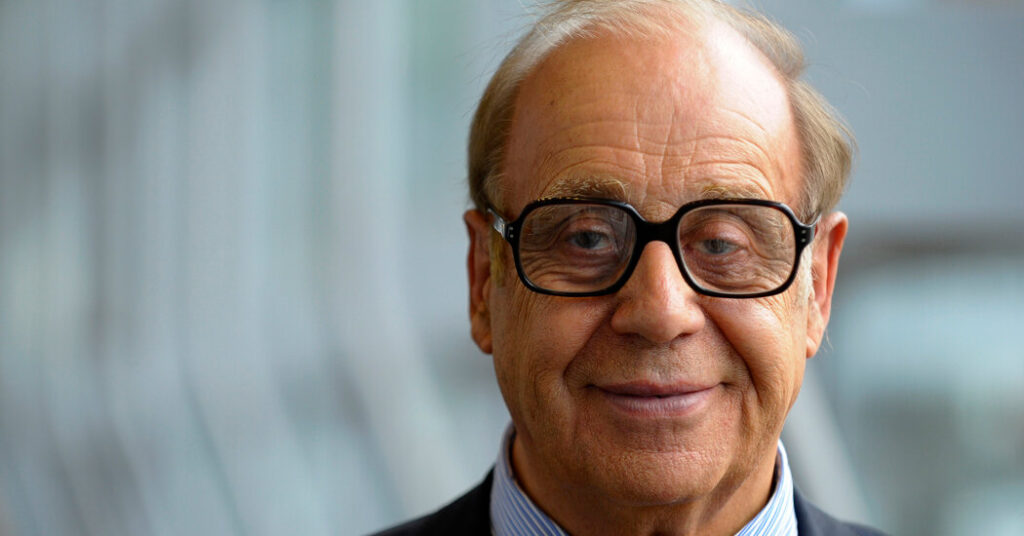
Jean Ziegler, a prolific Swiss writer, sociologist and politician who infuriated his compatriots by calling attention to the dark underside of their cuckoo-clock paradise, earning him lawsuits, death threats and fierce reprobation, died on Wednesday in Geneva. He was 92.
His death, in a retirement home, was confirmed by his son, Dominique.
Mr. Ziegler was a rare figure in a country that sees itself as a tranquil oasis of contented prosperity and business virtue.
He didn’t go along with that vision. Police were stationed near his house to protect him from his numerous critics. More than half a dozen defamation lawsuits over the years bankrupted him with fines and legal fees; his salary from the University of Geneva was garnished. Mr. Ziegler persisted and didn’t leave Switzerland.
He was its “national troublemaker,” according to a profile of him in Le Monde in 1997.
After nearly 30 books — many of them sharp critiques of global capitalism and, especially, its Swiss variant — that made him a hero of the European left, The Guardian called him “Switzerland’s most notorious public intellectual,” in an article last year.
A former Socialist Party deputy in Switzerland’s parliament and a former sociology professor at the University of Geneva, Mr. Ziegler attained that notoriety by taking direct aim at his country’s pride: the vaunted banking culture.
In his view, far from being a model of probity, Swiss banks were deeply mercenary, tainted especially by the profits they made dealing with Nazi Germany. That idea, which had largely been accepted by historians, was at the heart of the book that brought Mr. Ziegler the most thunderous opprobrium, “The Swiss, the Gold and the Dead” (1997, translation 1998).
“I avow myself a member of the nation of guilty innocents, and innocent guilty,” he wrote in the book. “I belong to that nation, but the story of the Nazis’ looted gold and the proceeds of the Holocaust have tainted it to a degree I can no longer stomach.”
The vast majority of the gold stolen by the Nazis, down to the gold fillings in the teeth of Holocaust victims, moved through Switzerland during World War II. There it was laundered as foreign currency, otherwise unobtainable by the Germans, or as industrial goods for the German war effort.
“The gold looted by Adolf Hitler and his henchmen, much of which is still in Switzerland, does not differ in essence from the blood money held by major Swiss banks in the private accounts of the Zairian ex-dictator Joseph Désiré Mobutu,” Mr. Ziegler wrote.
Outside Switzerland, the book was mostly treated with respect, though some criticized a prosecutorial tone and sloppiness. Inside the country, the reaction was sharp.
“Ziegler’s latest broadside has provoked anguish among the Swiss,” the veteran New York Times correspondent Peter Grose wrote in a review of the book. “At best they are astonished; more often they are outraged.”
So much so that a group of citizens formally asked the Swiss federal prosecutor to pursue Mr. Ziegler on treason charges, a request permitted under Swiss law.
Adding to their anger was Mr. Ziegler’s testimony against the banks, in July 1998, in front of the U.S. Senate Banking Committee led by Alfonse M. d’Amato, a Republican from New York. He was investigating the dormant accounts of Holocaust victims in Swiss financial establishments, an effort that resulted in a $1.25 billion settlement with the World Jewish Congress.
Mr. Ziegler was not prosecuted on the treason charge, and he rejected the accusation of “calumny” his detractors had made.
The real “calumny “ to Switzerland, he asserted in a 1998 interview with The New York Times, came from the behavior of the country’s bankers. “The banking establishment’s collaboration with the Nazis has given my country a very bad name,” he said.
Mr. Ziegler’s many critics, both in and out of Switzerland, accused him of being too hard on capitalism and too naïve about the crimes of the developing world against its own people.
Favorable remarks over the years about Fidel Castro, Col. Muammar el-Qaddafi and other dictators; his association with the Gaddafi International Prize for Human Rights; and his unstinting criticism of Israel earned him a mixture of derision and denunciation.
“In his agitator’s temperament there’s a mix of Don Quixote and libertarian socialism, in the style of Bakunin, a rejection of power in all its forms, along with a gargantuan ego,” André Laurens of Le Monde wrote of him in 1993.
Hans Ziegler — it was Simone de Beauvoir who persuaded him to change his first name to Jean when she published him in Les Temps Modernes, the monthly she edited with Jean-Paul Sartre — was born in Thun, Switzerland, near Bern, on April 19, 1934.
He was one of two children of Hans Ziegler, a judge and artillery officer in the Swiss army, and Elisabeth Walther — conservative and bourgeois parents who embodied a “humanist Protestant culture,” Dominique Ziegler said in an interview.
Jean Ziegler obtained advanced degrees in law and sociology from the University of Bern in 1958 and 1967, and was admitted to the Geneva bar in 1960. In 1961 he was recruited by the U.N. in its precarious Congo mission, as that nation gained independence; seeing African poverty helped radicalize him, he later told interviewers. He wrote about it in Les Temps Modernes; Ms. de Beauvoir and Mr. Sartre became his friends.
His commitment to socialism deepened with a 1964 encounter in Geneva, when he served briefly as a driver for the Cuban revolutionary Che Guevara. He taught sociology at the University of Geneva from 1972 to 2002, and was a Socialist member of the Swiss federal parliament from 1967 to 1983, and 1987 to 1999.
It was during those years that his most incendiary books appeared, beginning with “Switzerland Exposed” (1976; English translation 1978), where he pointed the finger at Swiss banks and multinational corporations, suggesting they were behind much of global iniquity.
The defamation lawsuits and threats began, and continued forcefully with “Switzerland Washes Whiter” (1990), a polemic against the whitewashing role of the country’s banks in accepting money from the drug trade and other illicit activities. The Swiss Bankers Association was furious, and Mr. Ziegler lost his parliamentary immunity.
From 2000 to 2008 he was the U.N.’s Special Rapporteur on the Right to Food, a position he used to attack multinational corporations and multilateral institutions and Israel, calling Gaza “an immense concentration camp.” He told Le Monde that “every child who dies of hunger in the world today is the victim of murder.”
Besides his son from his first marriage to Wedad Seinier, which ended in divorce, Mr. Ziegler is survived by his wife, Erica Deuber Ziegler.
Mr. Ziegler never expressed regret for his own pugnacity.
“I lost all the lawsuits,” he said in a 2022 interview. “But I thought to myself that it was also an opportunity to fight using the courts — the bankers had to answer the questions that were raised there.”
The post Jean Ziegler, Swiss Gadfly Who Provoked His Countrymen, Dies at 92 appeared first on New York Times.