For much of Friday afternoon, the four defendants sat in orange jumpsuits, their hands cuffed in front of their waists, as a judge weighed a federal prosecutor’s request to keep them locked up ahead of trial.
That prosecutor, Maggie Smith, told a judge that the defendants were members of a group that vandalized the homes of University of Michigan leaders, damaged the property of companies with ties to Israel and defaced the outside of the Jewish Federation of Detroit’s building. Ms. Smith said that the group had threatened its victims, discussed acts of violence and indicated support for Hamas. Letting them out of jail, the prosecutor argued, would be dangerous.
Defense lawyers pushed back, with several describing their clients as high-achieving students with no criminal records. They noted that prosecutors had not accused the defendants of physically hurting anyone.
The four defendants in that courtroom in downtown Detroit were among eight pro-Palestinian activists with ties to the University of Michigan whose indictments on federal conspiracy charges were unsealed this week. Three others had separate hearings and the eighth was out of the country.
The case reflected an escalation of the Trump administration’s efforts to crack down on pro-Palestinian activism at universities in recent years, and raised divergent concerns about antisemitism, free speech and how politics might be shaping the Justice Department’s priorities.
Liz Jacob, a lawyer representing two of the defendants in separate civil cases against the university, saw the Justice Department’s approach as part of a broader effort by the Trump administration “to silence dissent and to try to silence any kind of opposition to what the government is doing.”
“When activists and organizers and people who speak out think that the F.B.I. could be coming to their door in ski masks to arrest them because of their protest activity, that is terrifying, and that alone chills speech,” said Ms. Jacob, of the Sugar Law Center for Economic and Social Justice.
Steven Ingber, the chief executive of the Jewish Federation of Detroit, praised law enforcement for its handling of the case. He described receiving a call about anti-Israel graffiti covering the federation’s building on Oct. 7, 2024, the first anniversary of the Hamas-led attack on Israel that ignited war in Gaza.
“We are a Jewish building, and it’s clearly identified as a Jewish facility,” Mr. Ingber said, “and so when you attack a Jewish facility for no reason, that’s just pure antisemitism and hate.”
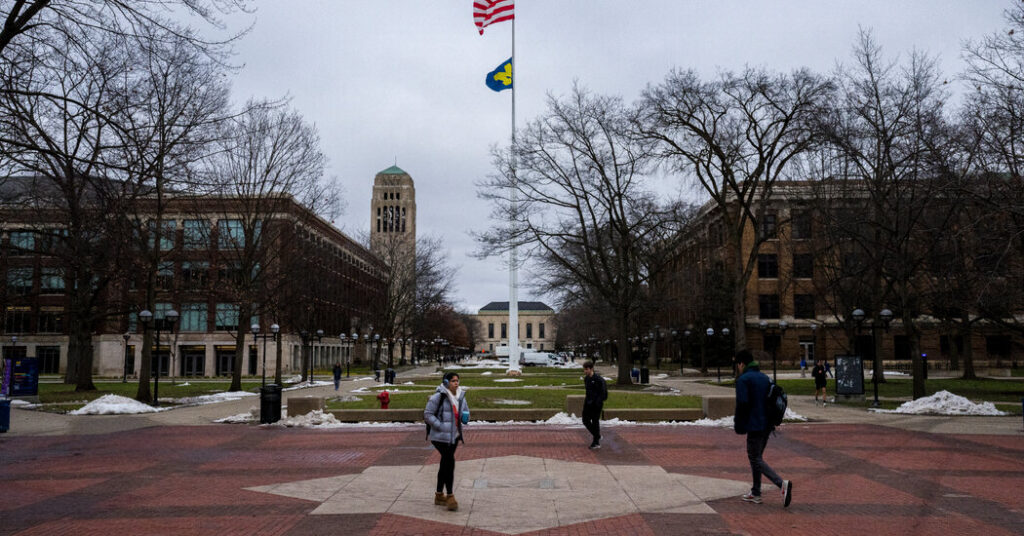
Pro-Palestinian activism at the University of Michigan played out, at first, like many of the protests on American campuses in 2023 and 2024. There were tents on the campus quad, calls for divestment from Israel and clashes with law enforcement.
But after police officers shut down Michigan’s encampment in the spring of 2024, federal prosecutors said a core group of activists ratcheted up the pressure, defacing the homes of university leaders and making demands that crossed into threats.
“They broke windows and threw glass jars filled with noxious chemicals into family homes while children slept,” prosecutors said in a court filing. “They damaged door locks, security cameras and cars. They posted their conquests on social media to threaten the victims and warn those complicit with their targets that they would be next.”
In all, eight people linked to the university — three current students, three former students and two former employees — were indicted on conspiracy charges that could carry years in prison. Some defendants were also accused of witness intimidation and destruction of property to prevent seizure.
At universities across the country, pro-Palestinian demonstrators pushed for divestment from Israel and called for changes to campus policies, citing deaths and destruction in Gaza.
President Trump campaigned on a promise to crack down on protests, and his Justice Department has launched numerous criminal investigations of student activists, pressured administrators to take a harder line on demonstrations and sought to deport some student advocates.
Though thousands of people were arrested at the peak of the campus protest movement in 2024, those cases generally resulted in relatively minor charges in state courts or no charges at all.
Asked whether the Michigan case would be the first of more federal cases against pro-Palestinian activists at colleges, the Justice Department did not directly answer, but said it “will follow the evidence and apply the law.”
In court on Friday, lawyers offered vastly different descriptions of the defendants.
The prosecutor described the four defendants as dangers to the community and potential flight risks. She said that the prosecution was not seeking to punish anyone for exercising rights to free speech or protest, but also spoke at length about inflammatory Signal chats and social media posts linked to the group.
“These defendants have something in common here: an extreme violent view tied directly to terrorism,” Ms. Smith told Magistrate Judge Anthony P. Patti, of the U.S. District Court for the Eastern District of Michigan.
All four defendants at the hearing on Friday faced multiple counts of conspiracy to transmit threats, though the number of counts and specific allegations differed from person to person. Ms. Hakim and Ms. Feyock were also charged with witness intimidation.
Lawyers for the defendants pushed back forcefully on the idea that their clients were public safety threats who should remain in jail until trial.
A lawyer for one defendant, Zainab A. Hakim, 23, said her client was a National Merit Scholar who worked at a school and had graduated from Michigan with a 4.0 G.P.A.
Another defendant, Paige E. Feyock, 26, had worked as a doula and was planning to move to Illinois for medical school later this month, her lawyer said.
Colin H. Weger, 24, had a job and was planning to resume studies at a community college in the fall, his lawyer said.
A lawyer for Jonathan H. Zou, 22, described him as an award-winning engineering student who had mentored high schoolers and had the support of professors.
Judge Patti noted at several points how upset he had been reading some of the allegations.
“It saddens my heart and I find it completely distasteful to hear this type of antisemitic communication,” he told Ms. Hakim.
He told Ms. Feyock that “the evidence that the government has shown in respect to you is very troubling.”
But ultimately, Judge Patti rejected the prosecutors’ request for pretrial detention and said the four defendants in his courtroom could leave jail on Friday without posting any bond.
They would have to surrender their passports, their travel would be restricted and they would either be on home detention or under curfew, among other conditions. In separate hearings, judges also ordered the release of three other defendants in the case. An eighth defendant was traveling abroad when the indictment was unsealed and had not yet been arrested, prosecutors said.
In court, Judge Patti warned the defendants before him not to violate bond conditions, and also described what he saw as a “need for civil discourse in this country.”
He told Mr. Zou that he was clearly “incredibly smart,” but that his actions had been “incredibly dumb and in some cases incredibly mean.” He asked Ms. Feyock to reflect on what kind of doctor she wanted to become. He encouraged Mr. Weger to take an American government class at community college.
Devlin Barrett contributed reporting.
The post Threats, Free Speech and the Case Against U. of Michigan Activists appeared first on New York Times.