What does it say about President Trump — and America — that the soon-to-be octogenarian plans to celebrate his 80th birthday with a series of U.F.C. matches on the White House lawn? On “The Opinions,” the Times contributor Robert Siegel and fellow contributors E.J. Dionne Jr. and Peter Wehner debate this form of “human cockfighting,” and take stock of the state of the nation ahead of America’s 250th birthday.
Below is a transcript of an episode of “The Opinions.” We recommend listening to it in its original form for the full effect. You can do so using the player above or on the NYTimes app, Apple, Spotify, Amazon Music, YouTube, iHeartRadio or wherever you get your podcasts.
The transcript has been lightly edited for length and clarity.
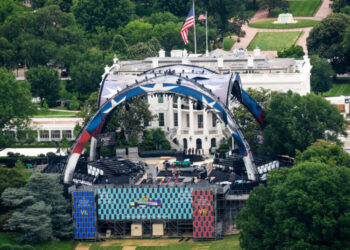
Robert Siegel: We’re going to start by taking note of the birthday that falls on this weekend — Donald Trump’s 80th. We went more than two centuries without having an octogenarian in the White House, and now we’ve had two in a row, and I’d like to hear your thoughts about Trump at 80, and especially how that landmark is going to be observed. The Ultimate Fighting Championship will present a seven-fight card in a cage that’s been hoisted onto the White House South Lawn. E.J., why don’t you start things off? First of all, this birthday celebration is billed both as U.F.C. Freedom 250 and U.F.C. at the White House. It’s been folded into the celebration of the country’s 250th birthday.
E.J. Dionne: Well, first, to anyone out there thinking that all of us are ignorant about M.M.A., I want to point out that you, some years ago, did a 13-minute piece on NPR, quite fair and balanced — forgive me for using that term — that included a philosopher who does M.M.A., so let’s get that out of the way.
Siegel: And it included a very young reporter, Tam Keith, out of San Francisco, who went and witnessed the fight for us.
Dionne: A couple of things about this: First, I don’t think it’s a great idea for Donald Trump to be reminding everyone that he’s 80 years old at this moment, when he shows various signs of faltering or saying very odd things. Second, it is not at all surprising, but still astonishing, that he has really tried to fold his own birthday into the country’s birthday, and suggest that somehow these are equivalent or equal events. I mean, perhaps that goes too far, but he’s really merged the two. But there’s a third thing here, which is — and I know this thanks to a very good piece that Michael Scherer did in The Atlantic — that this has been a real fight over control of the 250, and believe it or not, there was bipartisan agreement on how we should celebrate it.
There was a group called America250, and then President Trump came in and essentially took it over, kind of knocked that aside. But there was a great quote in Michael Scherer’s piece: “This is straight out of ‘It’s a Wonderful Life,’ when Henry Potter steals George Bailey’s money and tries to drive him to the brink.” And with Trump, it is always playing to the base. These numbers are hard to find, for sure, but as best I can tell, it appeals to about 16 percent of us, overwhelmingly male. It’s once again going to the base, and at a moment when we could talk about the Constitution and the Declaration, and while we do argue a lot — and they’re good arguments, I think, about the meaning of the Constitution and the Declaration — we all honor them. But instead, we’re just thrust into starting out with a sport that the late John McCain described as “human cockfighting.”
Siegel: Yes. Pete, mixed martial arts, U.F.C. — one can just say this is stuff that Donald Trump likes. Or is it a calculated appeal to this cult of masculinity?
Peter Wehner: I’d say it’s both. He clearly likes it. This is one of his longest-standing cultural institutional affiliations. I mean, he was promoting M.M.A. and U.F.C. back in the early 2000s. When it was banned by various states, he allowed his Trump Taj Mahal in Atlantic City to host them. So, he’s had an attachment to it and to Dana White, who’s the president of it, for a long time.
I do think it’s cultural signaling of a sort of populist gesture. I would say that the only sporting event that Donald Trump could go to these days, and not get booed at, would be the U.F.C. or M.M.A. If you saw him ——
Dionne: Good reference, Pete.
Wehner: If you saw him at Madison Square Garden, for the Knicks game earlier this week, it was just a cascade of boos, and that’s happened elsewhere. I would say that, apart from that, something is different. One is that previous presidents have hosted athletes all the time — Super Bowl winners and others. That’s not unusual. The idea of not just hosting athletes, but making an event a centerpiece for the White House, bringing it into the executive space, that’s different.
The last thing I would say that makes this different is that it’s not a one-off for Donald Trump. This sport, if you consider it a sport, captures his ethic. There’s a brutality and a cruelty to it, and an effort to dominate people, that has been a through line through Donald Trump’s life. And so, this U.F.C. event is very consistent with who he’s been and how he treats people.
Siegel: I’d add here that, according to The Washington Post, the military personnel who were selected to have tickets to this event, and at least half of the people watching it — a few thousand will be military — are required to meet current waist-to-height ratio and physical fitness standards. So, the crowd should look good.
Wehner: Yeah, well, I guess there’ll be an exception for the president.
Siegel: Pretty soon, the country’s going to be celebrating the 250th anniversary of American independence, which brings back for me some memories of the 200th — the bicentennial. I wonder if you have strong memories of that, Peter?
Wehner: I was a relatively young kid at the time, but that’s probably true of all of us. My memory of it was the ships in the harbor. The tall ships. And I had that memory of Watergate, Richard Nixon having resigned two years before, and there was a palpable sense of unity in the country and a celebration. And I think that, to me, this kind of flipped the switch of when we got out of that Watergate era and began to look into something and enter into something better.
Siegel: E.J.?
Dionne: I have a very similar memory to Pete’s, in a political sense, that you looked back at Watergate and you looked back at the country rising up against corruption and actually getting a president to resign, and you felt that whatever flaws we have had — and certainly we have had flaws as a country — we’ve set up a set of institutions that, when they work and when people are willing to make them work, can protect our democracy and our freedom. So, I thought it was entirely significant that we were celebrating this 200th after Watergate.
Siegel: I actually have a very strong, truly New York memory of the bicentennial, which was that everybody was very excited about the coming of the tall ships. And a couple of weeks before July 4, we were at a party and met a couple. He was a psychiatrist. That’s the only thing I remember about him. When he heard where our apartment was, he offered to cater our watch party if he could just come and take pictures out the window. We had a wonderful gathering and watched the tall ships, which had no connection before that to July 4 that I knew of — and none that I’ve heard of since — but it was a wonderful day.
And yes — as you said, Pete — in those days the political mood was pretty united. The mood this time, I mean: Is the 250th going to get the kind of broad buy-in from people, or has it become politicized?
Wehner: Oh, I think it’s become politicized. That’s in large measure because Trump has put his imprimatur on it in a way that was bound to make it politicized. And you know, all presidents are partisan, but prior to Trump, most presidents picked moments. Sometimes they were moments of national tragedy, sometimes they were anniversaries. And they used those moments to try and unify the country. And in this case, Donald Trump, because of his own peculiar sociopathy and psychology, uses everything to divide us, and that includes the celebration. And so, a lot of the country is just checking out, and that’s a shame.
Dionne: You know, it’s interesting, because when you think of the year 1976, that is very close to a period when our country was deeply divided. We think of the year 1968 when we had the assassinations of Martin Luther King Jr. and Bobby Kennedy; the Vietnam War tore us apart; we were in the midst of a vast cultural change. And so, that division in the country could easily have played out in 1976, and there were interesting arguments that year. I mean, we shouldn’t sanitize the past and say that we were completely united. But the incentives in politics were radically different at that moment. And in particular, as Pete suggested, the incentives for Gerald Ford, who felt that the right thing to do, and the politically smart thing to do, was to bring the country together. And he had a campaign song that was very effective, which contained the words: “I’m feeling good about America.” And his desire in that bicentennial was to make people feel good about America. That’s not the leadership we have at the moment.
Siegel: It’s really a reminder that the presidency is a double job. It’s head of government and it’s head of state. And Gerald Ford knew that gear, that was head of state and nonpartisan. Years later, I remember Bill Clinton speaking in Oklahoma City after the bombing there, and he was in terrible political shape, as I recall, at that time. But as head of state, he was masterful. That nonpartisan national gear doesn’t exist in the current president.
Wehner: Yeah, and that hurts a country. George F. Will wrote a book, back in the early 1980s, called “Statecraft as Soulcraft,” and it was about the notion that statecraft, including the words of presidents, shapes the souls, if you will, of a country. And how cultures are shaped and formed is a very, very complicated thing.
But one of them is that the leadership of a country either honors or dishonors what they value, what they celebrate, or, on the other hand, what they tear down. And the founders understood this. If we go back to the real founding of the country, it wasn’t just the structures of government; it was the values, the beliefs, the virtues of the citizenry — and that is shaped by a lot of things. And part of what it’s shaped by are the words that we use and the way that we treat each other.
Dionne: The philosopher Nancy Rosenblum wrote a really interesting book called “On the Side of the Angels,” where she argued that in a democracy, partisanship is patriotic, but it has to be partisanship that is rightly understood. Partisanship is about having very strong views on where the country should move, but it also accepts that in a free and democratic society, people will disagree on this; and you accept, by your very partisanship, that disagreement is legitimate, that it can be fought out in ways that are peaceful and respectful, and you have a sense that if we lose now, we can win later. There are no final victories or defeats. What we’re seeing now is worse than partisanship, I think, and we ascribe it too much to partisanship. This is a politics of friend and enemy — the philosopher Carl Schmitt’s view of politics. And a politics where we divide ourselves not as citizens who disagree but as friend and enemy, is just a very dangerous politics.
Wehner: And I just wanted to add one thing to that, E.J., and it alludes to something you had said earlier. Sometimes viruses create their own antibodies, and I think in the life of an individual, just like in the life of a country, you begin to take for granted certain virtues, certain qualities, and then, when they’re stripped away from you, you realize why they mattered after all.
And I do think that this sort of stripping of the public square — the immorality, the depravity, the cruelty, the antipathy, all of those things — that takes a toll. And I would say that this year, more than at any moment in the last 10 years, I’m beginning to see something else. I think despondency is giving way to people who are energized, and it’s focusing itself on the repair.
I’m hopeful. I wouldn’t predict it. Life is complicated, but I’m hopeful that we’re seeing these civic antibodies kick in, and that we’re going to go into a better time having gone through a really hard time.
Dionne: I so agree with that, and I’ve thought, for the last decade — or really since the gentleman came down that escalator — that this entire period has been brought to you by the philosopher folk singer Joni Mitchell: “That you don’t know what you got ’til it’s gone.”
Siegel: Both of you have written recently about politics and values and faith. Pete, you’ve written about the strong connection between Donald Trump and white evangelical voters, how that connection fits into American Christianity. How unusual, first of all, is his success with white evangelical voters?
Wehner: Well, on one level, it is unusual, and the reason it’s unusual — why people are kind of shocked, particularly people in the Christian faith — is kind of obvious. They’d say, “Look, for most of my life, conservative evangelicals considered character, honor, integrity to be crucial to leadership, especially political leadership.” You both will remember the late 1990s, when Bill Clinton was caught up in a scandal with Monica Lewinsky, and it was conservative evangelicals that every other day were taking a figurative two-by-four upside his head in criticizing him on moral grounds. The S.B.C. passed a resolution on the importance of moral character.
Siegel: Southern Baptist Convention.
Wehner: Yeah, Southern Baptist Convention. And so, now you fast-forward to Donald Trump, who in many ways makes Bill Clinton look like a Boy Scout. He’s easily the most corrupt president in American history, and one of the most corrupt political figures in American history.
And now, they have aligned themselves with him, and they very rarely criticize him. So, there’s brazen hypocrisy. What I do think that some people miss, and why it’s not unusual, is that Trump didn’t fundamentally change the sensibilities of many evangelicals. He personified them. He embodied them.
And if you are familiar with the evangelical subculture that existed, there was a real effort to push this narrative of warrior mentality. And he tapped into the resentments of a lot of white evangelicals, and their feeling was that: “He is going to do to our enemies what I want him to do. He’s going to hurt them. He’s going to make them bleed.” It’s an ugly sentiment, but it was very evident that it existed.
Siegel: And you’ve offered, as a response to that phenomenon, a turn to Christian humanism, a tradition that joins the pursuit of human reason and the classics with tradition and faith.
Wehner: Yeah, I did an essay in The Atlantic on Christian humanism, because I wanted to think about what might be a pathway out for what I think is a kind of wreckage that many American Christians have created. And I would say, E.J. would know it very well as a Catholic, because I think it mirrors a lot of Catholic thought, social thought.
Pope Leo XIV’s most recent encyclical mentions Christian humanism. Essentially, it’s the notion that everyone bears the image of God, and so they therefore have inherent dignity and equal worth. So, that’s one. One other thing that Christian humanism does, which I think is relevant to this moment, is that it’s very wary about the fusion of the Christian faith and political power. It’s not a separatist view; it doesn’t say that Christians shouldn’t have anything to say about public life, but it’s very wary about what happens when Christians get wed.
And the last thing I’ll say is that there’s a temperamental aspect to Christian humanism that contrasts with a lot of what you see in American Christianity. Irenic, calm, curious, nonanxious. I’d say Christian humanists generally are more comfortable with shades of gray, and I think, when they see the world, their impulse isn’t to judge the world; I think it’s to try and enchant the world.
Siegel: E.J., you’ve written recently about what you call the new “values voters.” Are they Pete’s Christian humanists?
Dionne: I was listening to Pete talk, and I think the calm way in which he spoke about this embodied the very point he was trying to make about Christian humanists.
What I wrote about is the idea that we often get used to something being true and assuming it’s always been true. Things have always been like this. That’s a normal human reaction. If you look at American history, we’ve gone through cycles where, at times, we did argue mostly about personal behavior, personal morality, prohibition, abortion, trans stuff now. But at other times, we have linked a moral critique to the larger society, to political corruption, to corruption and unfairness in the economy. And my piece argued that we are going through a transition. The obvious person representing that is James Talarico, the Democrat running in Texas. But there are a whole lot of people talking about this; Pope Leo reflects this. A lot of people in politics reflect this right now. Andy Beshear, the governor of Kentucky, is going to write a book inspired by “The Parable of the Good Samaritan.”
There’s something going on out there that reflects a different kind of moral argument. I welcome it since I am broadly on that side of the argument, but I also think it’s just a fact that we’re going to have to grapple with.
Siegel: Let’s talk about something that Donald Trump has contributed to this year’s campaign for the midterms — a claim that is absolutely unsupported by any facts — which is that there is a nationwide conspiracy to rig elections, involving not just Democrats, but also the media, election officials. It’s all fixed. The whole thing is rigged. And I’m curious: It has been suggested that perhaps President Trump is laying the groundwork for dealing with a Democratic victory in the House, maybe the Senate — who knows? — and questioning its legitimacy. And what does that mean? Can a president simply claim that the Congress is illegitimate and not deal with them?
Wehner: Well, he can claim it because he’s been doing it. And its effects are deeply damaging to American democracy, because it presupposes a faith in the outcome of elections. And you go back to almost every election, certainly in my lifetime — including something like Bush-Gore in 2000, which was really highly contested, decided by the Supreme Court. And Al Gore gave a very gracious concession speech.
This is part of the acids that he spills onto American democracy and the destruction of bonds and tearing through norms. And I do think that we should assume that he’s going to make every effort to try and overturn these legitimate elections. He did it once before.
Siegel: I should add, by the way, that it doesn’t help people, defending the electoral process, that very deep blue California takes amazingly long to count its ballots, and that this feeds into the whole idea that there’s something fishy — there isn’t, as far as I know — about the count.
Dionne: I just want to say, don’t get me started on Bush v. Gore. Look, a couple of things on this: Trump did it once, and so he can do it again — and I think there are threats here, before the election day, on Election Day and after Election Day. You’re already seeing efforts to sort of grab voting records in places, knock people off the rolls theoretically, or with the claim that they’re ineligible to vote.
There’s fear that ICE agents might be sent to polling places where there are a large number of immigrant voters, who, in this election, will probably tilt very strongly Democratic. But then there’s a real danger, particularly in a close election, of what happens after the election.
And the House votes on the results of the election, and what if Speaker Mike Johnson says that these results are fraudulent? To go to your point about California, I honor why California does this. But they have to speed this up. And I think there is pressure now to speed it up. But there’s a great irony of their claims that California is rigged, because the conservative candidate for mayor of L.A., Spencer Pratt, indeed fell behind after late votes came in. The Democrats voted later this year because their field was in such disarray, and they didn’t want to vote in a way that put two Republicans on the November ballot as their system went.
But if the system is rigged, how did Steve Hilton, the Republican endorsed by Donald Trump, emerge as the victor? He was declared, I think yesterday or the day before from where we are now, the victor of that primary election. So, you can’t say that the result was rigged in one race, but in the other race, hooray, we got the right nominee.
So, it is just so clearly pretextual to challenge things down the road.
Wehner: And one other thing, I’d just add to what E.J. said, is that there’s no Mike Pence or Bill Barr in this White House as there was in Trump’s first term. He’s surrounded by people who are almost as corrupt as he is. And if he challenges, if this unfolds in the scenario that you laid out, which is entirely possible, then it goes to the Supreme Court. And then you have a situation in which the court is going to rule presumably one way. And then the question is: What does Trump do? Does he abide by the court order? And if he doesn’t, then we’re in a whole new ballgame.
Dionne: Even at this point, I’m not sure what the Supreme Court would do. But then that would just bring us back to Bush v. Gore.
Siegel: One more topic. Trump’s recent outburst, in fact, about how rigged the election is, according to him, took place just before he stormed off the set of his interview with “Meet the Press.” I should add that “Meet the Press” is almost as old as Donald Trump. It went on television in November 1947. For decades it was synonymous with NBC. We’ve also been hearing all about the purge at “60 Minutes,” which is a rarity, a successful TV news program, which was breaking stories and building an audience.
And at CBS, a lot of the staff is now gone. These are two big stories that involve, of all things, old-fashioned, legacy media, over-the-air television, or maybe you see it on cable. And I was thinking: Those are programs that used to be able to make or break political careers. How important is television today to our politics?
Wehner: Well, television is important. It’s less important than it was, and networks are less important than they were. Moments can be important, as you illustrated with “Meet the Press.” I mean, that got a lot of attention. It’s not like “Meet the Press” when Tim Russert was on, and a lot of influential people would watch every Sunday. Sometimes candidates would announce their candidacy.
Siegel: He nailed Bill Richardson on whether he had indeed dreamed of playing for the Yankees or the Boston Red Sox, I remember that.
Wehner: Yeah, it’s really entering into tricky territory. So, you know, the networks are not what they once were. I remember when I was in college, and my parents were both interested in public life, international affairs, and we used to watch three networks, ABC, CBS, and NBC, and it was striking. It was always the same stories and pretty much the same approach, and that had both a virtue and a vice. The virtue is that it was a single narrative, and people could essentially have conversations with a certain degree of common ground. I think the vice was it was a single narrative, and it meant that if there were other points of view, they weren’t able to be entered in.
Fox came in the 1990s. That was when Fox was responsible, and I think that this was useful. But since then, the fracturing of the media environment, the echo chambers and the out-and-out mendacity of it is deeply harmful to our democracy. And these days, Tucker Carlson or Candace Owens or Megyn Kelly could have as much influence, or more influence, than the anchor of ABC or CBS or NBC, and I would say that’s not good.
Siegel: And a rant about something might have as much influence as a documented multisource report.
Wehner: Exactly, and it’s more likely to get covered, too, which is another problem.
Dionne: You know, a friend of mine — and I hope he forgives me if I’m garbling his title — is writing a book about something else called “Both Things Are True,” and I love that title because I think it really applies in this case, which is, of course, the old networks and old television is on the decline, given the multiplicity of options, alternatives that people have. So, yes, television is not what it used to be. On the other hand, it’s the case that these networks still have millions and millions of viewers.
You add up total viewership of the evening news — the television evening news — and you still beat most cable shows. You certainly beat most podcasts. And these networks do report information — “60 Minutes,” most famously — that can still very much influence the debate and can still penetrate the political conversation.
So, these media institutions are still important despite their decline. And what you’re seeing in the United States, not yet on the same scale, is that Donald Trump is trying to do with the media what Viktor Orban did in Hungary. It wasn’t like a direct state takeover. He used state power to make sure that major media institutions were in the hands of his political friends. And the kind of pressure that Trump is trying to bring is twofold: One, he is trying to affect ownership, as we’re seeing in the CBS case. But he’s also trying to protect behavior. It’s an intimidating approach to the media, and he’s trying to discredit the media, as he has for a long time. Again, some of this has a long history. Attacks on the so-called liberal media go back a long way, but Trump has pushed these to a different place.
And what is happening at CBS, at least from my point of view, is really disturbing, because that was historically one of the greatest news institutions in the United States. And they’re not on that path right now.
Siegel: Well, it’s time to wrap up, Pete, by trying to leave politics and conflict and arguments aside and focus on something that brought us joy recently. And as our new guest, you go first. Something that recently brought you joy.
Wehner: Well, I’ll tell you something that brought me joy, which was the Miracle at the Mecca, Madison Square Garden. The New York Knicks were down by 29 points in the second half, and they won by a point on a last-second tap-in, and it was the greatest comeback in N.B.A. finals history. I’m not a particular Knicks fan. I’m actually a Stephen Curry, Steve Kerr, Golden State Warriors fan, but I love basketball, and I am rooting for the Knicks in this series. So, that was great. I was even texting with my wonderful editor at The Times, Aaron Retica, who’s a great Knicks fan, and David French. And beyond that, I’ve loved sports since I was a kid, and when I think about why, I think part of it is that it just captures the large human drama. And it’s often a demonstration of human excellence. And so, when you see that, and you see it compressed in a period of time like that, it can really be uplifting.
That’s true for me, and I think it’s true for a lot of other people.
Dionne: I, too, stayed up too late to watch that amazing game, and I do think watching excellence — I love basketball as well — is just really a gift. A couple of quick things: One, I want to thank you for the joy you gave me out of your joy last time we were together, Robert, because I went home and listened to that Sonny Rollins-Thelonious Monk album that you suggested, and it was awesome. And secondly, I’m going to prove how far out of date I always am. Because of late, “Homeland,” a show that first went on the air in 2011, has totally grabbed Mary, my wife, and me. Claire Danes, Damian Lewis, Mandy Patinkin. It’s a spy story. That doesn’t do it justice; it’s a very complicated, interesting spy story, and it’s totally grabbed us. And I want to say that this is an awfully farsighted show, because Season 3 focuses on Iran and Venezuela. So, they saw something coming.
Siegel: Well, for me, I feel it would be dishonest to do anything other than second what Pete just said. I grew up when starting with the Knicks were Kenny Sears, Willie Naulls, Ray Felix, Carl Braun. And it’s been a long time. The ’70s were great, and the ’90s were OK, but I’d given up on ever seeing the championship. And they could yet lose the N.B.A. championship, but that was one game. Thanks to both of you guys for such smart commentary on things.
Thoughts? Email us at [email protected].
This episode of “The Opinions” was produced by Vishakha Darbha. It was edited by Kaari Pitkin and Jillian Weinberger. Mixing by Carole Sabouraud. Video editing by Steph Khoury and Kristen Williamson. The postproduction manager is Mike Puretz. Original music by Carole Sabouraud. Fact-checking by Mary Marge Locker. Audience strategy by Shannon Busta and Kristina Samulewski. The director of Opinion Video is Jonah M. Kessel. The deputy director of Opinion Shows is Alison Bruzek. The director of Opinion Shows is Annie-Rose Strasser.
The Times is committed to publishing a diversity of letters to the editor. We’d like to hear what you think about this or any of our articles. Here are some tips. And here’s our email: [email protected].
Follow the New York Times Opinion section on Facebook, Instagram, TikTok, Bluesky, WhatsApp and Threads.
The post The Spectacle of Trump at 80 appeared first on New York Times.