I first actually met David Hockney in 1982 — the very midpoint of his life and, as things turned out, a decisive fulcrum moment in his career.
Of course, I’d long followed his career, starting with his explosively successful debut right out of art school in London in the late ’50s and early ’60s (it’s difficult nowadays to credit the sheer freshness and élan with which he so matter-of-factly expressed his gay inclinations, which were still entirely illegal in Britain at the time). And then his wordly peregrinations, culminating in his arrival in Los Angeles, when he quickly helped we longtime residents to start seeing again, as if for the first time: the pools, the palms, the sprinklers, the building facades, the sky and that light!
He was regularly showing up in the social pages of the papers, a veritable flâneur, his love life (achingly chronicled in his drawings and paintings) an object of public fascination. I imagined I knew him, though almost all of my preconceptions would now quickly be upended.
For starters, the facade of easygoing dandyism. I somehow had grown to imagine him as almost always out partying or else lollygagging on extended vacations. On the contrary, I grew to realize, he was one of the hardest nose-to-the-grindstone art workers I’d ever encountered.
All those images of him lazing about (St. Tropez, China, Malibu): He was working the entire while, prolifically generating the very images that promoted the illusion. Think for instance of “Le Parc des Sources, Vichy” (1970), that magnificent painting of two seated friends gazing out into a pair of receding tree lines in a French spa, flanked by a third empty chair (which would have been his, except he’d gotten up to ever so painstakingly record the scene).
As for the party-boy image, he insisted to me that he really didn’t go out that much, didn’t like to, it’s just that whenever he did, the paparazzi descended and then kept recycling images of the same outing. He much preferred to stay home and read — and indeed, he was a voracious self-improver, burrowing into an ever-widening private library to make up for the relative narrowness of his art school education and always eager to declaim on his latest discoveries.
The early ’80s signaled a distinct shift. The Vichy painting and the whole series of similarly vivid double portrait masterpieces that had famously characterized his production during the previous decade (“Christopher Isherwood & Don Bachardy”; Ossie Clark and Celia Birtwell and their cat Percy) had generally been locked into a receding one-point perspective.
He’d often used photographs as study tools in those efforts, but he had increasingly grown to suspect the vantage afforded by their constricting one-point vise.
“Photography is OK,” he said to me that first day in 1982 — as he held in his hand a veritable deck of such “snaps” —Polaroids in that instance—gazing over an intricate photo collage he was in the midst of fashioning — “if you don’t mind looking at the world from the point of view of a paralyzed Cyclops, for a split second.”
Indeed the collages he was now working on — notwithstanding the fact that they were deploying literally tens of thousands of photos — called into question the very claim of any individual vantages to define reality, because, as he said, “that’s not what the world is actually like — it’s simply not true to life.”
His progressive separation from the hegemony of the optical (as he took to calling it) had been signaled just a few years before that, first in his depiction of a bedlam asylum in his 1975 staging of Stravinsky’s opera “The Rake’s Progress” as an array of solitary prison cells receding in one point perspective, and then, in 1980, in his wall-length masterpiece “Mulholland Drive: The Road to the Studio.” It was a sweeping portrayal of the ridgetop road astride which he’d recently purchased an adjacent home and studio, and of the entire city over which it straddled.
In “Mulholland Drive,” drive was a verb as Hockney invited his viewer on a ride across a moving focus, the succession of vantages afforded by each new curve successively laid out and zoomed past. If Hockney in California was a ferocious autodidact, he put the auto in that passion, and as important as the boys and the pools and the light were to him, in some ways the most important thing was becoming the driving, the sheer bliss of not standing still.
“Yes,” he concurred enthusiastically a few months ago when I offered up that observation in person, on a late-life visit to his London studio, “my very first week in L.A., I took driving lessons, took the driving test, got a driving license and bought a car!”
That moving focus began consuming him in all sorts of ways — in a fresh fascination with the implicate order physics of David Bohm and George Rowley’s explication of the endlessly shifting perspective across the unfurling of Chinese scroll paintings, and on and on (each new body of work entailing its own fresh mentor).
An ever more pronounced liberation from the monocular could be seen across the work leading out from the photocollages. Just sense the transition from that 1970s double painting of his dear friends Isherwood and Bachardy through the Polaroid collage of them a few years later, and on through the subsequent painting of the trip to their home a few years after that.
But it could also be seen in the mammoth undertaking upon which he launched himself around the turn of the millennium, a deep scholarly dive across six centuries of Western painting, which he splayed across the two-story-high walls of his Hollywood Hills studio. It grew into the controversial tome “Secret Knowledge” in which he asserted (and would insist proved) that Western artists had been using optical aids — curved mirrors and projecting lenses long before most scholars had previously imagined, as far back as 1430!
His obsession with moving focus was increasingly consuming his opera stagings as well. His excellent technical assistants rigged up a mini theater atop a table in his studio, complete with miniature lights, for his work on Wagner’s “Tristan und Isolde,” providing him with a dashboard of light controls, which he then proceeded to “drive around” for any visiting guests.
It was a delight that he presently flipped into a series of actual drives, deploying the latest in audio tape-players in his car trunk. He took guests at his Malibu cabin out into the surrounding Santa Monica mountains, keeping precise time through a succession of perfectly apt snippets of classical pieces (Sousa, Mozart, Schubert), and then cresting the final ridge and heading back toward the sea into which the sun was setting at that very moment (Wagner!).
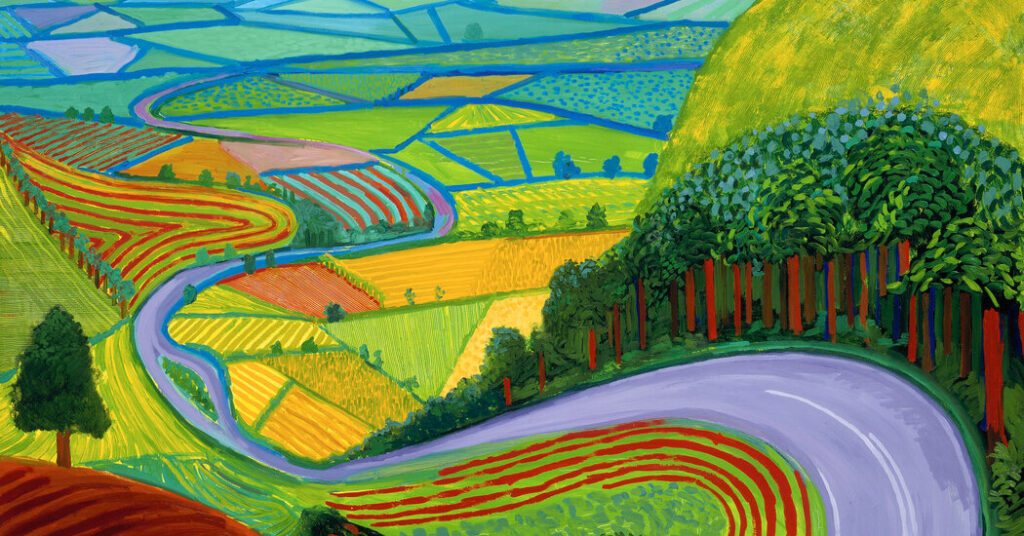
In painterly terms, the obsession culminated with “Garrowby Hill,” a heart-rending painting produced after a season of driving back and forth from his coastal Yorkshire base in England to a hospital in York to visit his dear boyhood friend Jonathan Silver, who was now dying. Back in L.A., after Silver’s death, Hockney launched into the final painting in the series, the view from the top of a ridge he’d had to drive over each fresh time with York Minster brooding in the distance, and all the fields splayed out in reverse perspective.
It was somehow clear that you were coming over that hill (overcoming it, as it were) in a car whose back wheels were on one side of the summit and front wheels already on the other. Instead of your eyes going for a drive, as in “Mulholland Drive,” you were now in the car, surging — a moving focus in an utterly moving moment — into the future.
But mortality — the cessation of movement — had already been a contrapuntal theme in Hockney’s work for some time. That period around 1982 were also the very years of the horrendous onslaught of AIDS. Hockney sometimes had the reputation of a bon-vivant, a lightweight, not an entirely serious person. He was even criticized at the time for not confronting AIDS directly in his work. Instead, people claimed, good lord, he’d taken to painting his dogs!
But as with his first paintings, he wasn’t taking to a bullhorn; the facts of the situation simply saturated the work. Indeed, his was a continual assertion of life against death, and more specifically love against oblivion. Those dachshunds, look at them: At a moment he could no longer heedlessly paint sleeping or cuddling naked young men, he took to portraying his beloved pooches in the very same sorts of languorous poses.
Several of the people in those photocollages were, in fact, dying of AIDs as he snapped their final multiple vantages.
His was a deeply profound witness, an arcing sorrow (albeit traced with a light touch), a refusal to be crushed by death, and a continual insistence on remaining true to life (the title I eventually gave my own collection of 25 years of conversations with him).
I am thinking of a little canvas he painted one evening during those worst plague years, through the sea-facing window of his Malibu outpost: a dainty porcelain tea-setting delicately ranged against the roiling, boiling storm-waves surging just beyond. Like his fellow English master W.H. Auden in the late poem “Thank You, Fog,” Hockney was a profound aficionado of the cozy, only for him, in this image, coziness was an assertion, an achievement, sustained up against the chaos.
Around the same time, Carl Sagan, another of his virtual mentors, died, and Hockney produced a loving tribute, a drawing of a tombstone with Sagan’s name engraved atop under which he’d slotted the typescript of a particularly prized passage from Sagan’s writings. He made copies of the image and sent them out to friends, and in the one he sent me he signed off with one of his frequent exhortations.
Those who insisted on viewing David through the gossipy rubric of his love life failed to take in the power and grace of that simple, overarching (albeit hard-won) assertion: Love life.
The post David Hockney and the Bliss of Not Standing Still appeared first on New York Times.