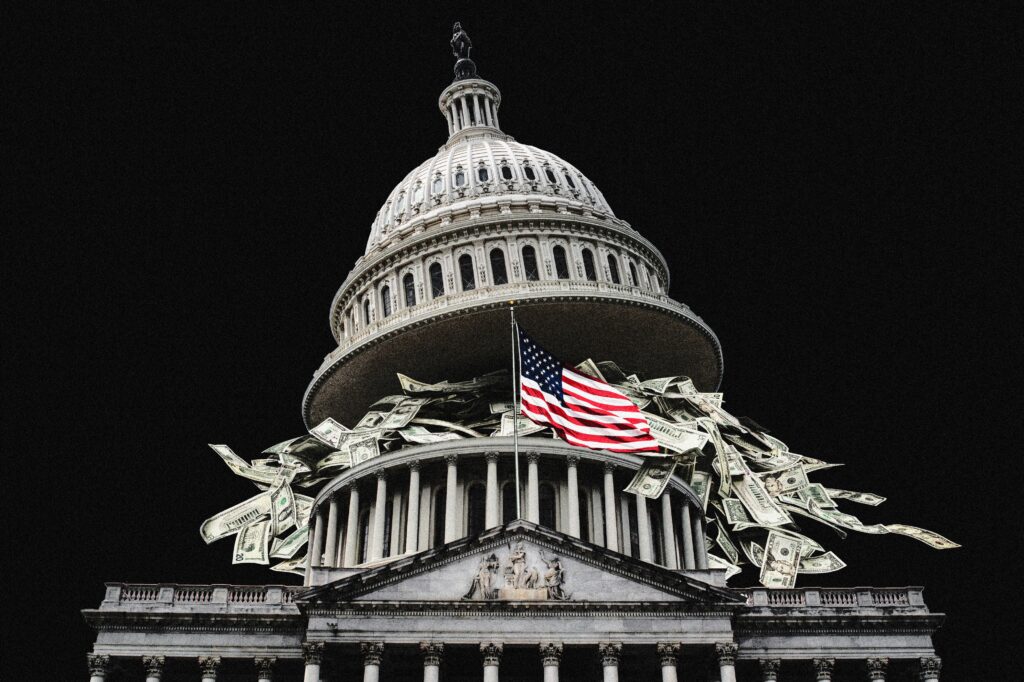
Congress’s most important job is deciding how federal money is spent. But it hasn’t passed annual funding bills on time since 1997.
But the normal act of budget-making has become all but impossible, with partisan gridlock and President Donald Trump’s push for Republicans to go it alone, opening new cracks in an already-battered system.
The breakdown in bipartisan budgeting every year threatens public programs that millions of Americans rely on and further endangers the government’s long-term fiscal health.
“The process at this point is completely broken, and the political environment is completely poisoned,” said Maya MacGuineas, president of the Committee for a Responsible Federal Budget. “There needs to be a group of lawmakers who are willing to work together to say: getting the budget done, the government funded, and being willing to compromise to do so is more important than the political food fight that the annual appropriations process has become.”
Earlier this week, Republicans narrowly passed funding for two immigration enforcement agencies through a “fast-tracked” process called reconciliation designed to overcome the filibuster, because it can be passed with a simple majority in both chambers, bypassing Democrats.
Trump is also urging Republicans to again sidestep negotiations with Democrats and pursue a new set of spending priorities, including $350 billion in defense funding, outside of the traditional appropriations process.
This week’s events underscore a breakdown in the government funding process. The appropriations committees, once among the most coveted assignments in Congress, are sidelined, as lawmakers turn to reconciliation to bypass the traditional bipartisan process. The shift could impart greater consequences for government funding, if the pattern continues.
Already the federal government has shut down three times since Trump took office for his second term and new signs of a fourth are looming.
“It’s clearly getting worse as tensions are getting deeper, and at the same time we’re seeing a huge rejection of basic budgeting norms,” MacGuineas said. “Everything from misusing baselines to trying to fund the government in ways that was never intended.”
Also, things are looking bad when it comes to the regular appropriations process for next year, which lawmakers are already behind on. This week, Senate appropriators traded public criticisms as they deadlocked over the budget, which must be passed by Sept. 30, leading them to cancel meetings to revise the legislation for a second week in a row. Key Senate Republicans said this week that they are not on board with Trump’s ongoing push to go it alone with another reconciliation bill.
Already, the Trump administration has taken bold efforts to wrestle appropriation power from Congress, withholding billions of dollars from low-income housing services, education assistance, medical research grants and other programs approved by Congress, centralizing sweeping authority in the executive branch.
In a more recent example, the Justice Department established a nearly $1.8 trillion payout fund for individuals who claim they were wrongfully prosecuted by the federal government, drawing from a Judgment Fund, which Congress permanently appropriated to pay court judgments against the federal government. Lawmakers from both parties denounced the move, and it has been temporarily blocked by a judge before the Trump administration said it would abandon the fund.
“Consolidation of executive powers has happened under both parties,” MacGuineas said. “You hear rumblings in Congress about taking back the power of the purse, but to really go back to the norms we had before in regular order, or some new version of regular order, the two parties would have to cooperate and come up with some big fundamental reforms and overhauls.”
Now, with Trump pressing Republicans to pursue spending levels outside of the recent norm and Democrats holding firm on their demands, the appropriation system is growing more fractured — setting the stage for another funding fight ahead of the Sept. 30 shutdown deadline.
It is not unusual for Congress to fail to make its own budget deadlines. Lawmakers have passed nearly 140 temporary stopgap measures to avoid a shutdown in the last 30 years. And once again, the appropriators can’t seem to get the annual funding process on track as they are stuck in a standoff over how much to spend in each area.
Trump has requested $1.5 trillion in military funding for the next fiscal year beginning in October, a 44 percent increase from 2026 fiscal year funding levels. He has only asked for $660 billion for nondefense funding, a 10 percent cut compared to the prior year.
Democrats are refusing to agree to defense funding increases without a comparable boost in domestic spending.
“We made it clear to Republicans that we are not going to accept a gigantic war budget offer,” Sen. Patty Murray (Washington), the lead Democrat on the Senate Appropriations Committee, told reporters Monday. She called Republicans’ offer “lopsided and unreasonable.”
On Thursday, Trump called on Republicans to pass another reconciliation bill that includes $350 billion in defense spending to help meet his goal of $1.5 trillion for defense spending, without Democrats help.
“I am hereby calling on Republicans in Congress to IMMEDIATELY advance and pass the forthcoming $350 Billion Reconciliation Bill (Recon 3.0) — which, at the request of our Great Department of War — will include THE SAVE AMERICA ACT as well. No games, no delays, and no weak compromises! Do this ASAP,” Trump wrote on Truth Social on Thursday.
But such an endeavor faces an uphill battle in the Senate.
“I am skeptical that a third reconciliation package would be approved,” said Sen. Susan Collins (R-Maine), the chair of the Senate Appropriations Committee, to reporters Thursday. “And I also don’t think it’s the best route for us to follow.”
Also, the reconciliation effort that Congress passed this week upset at least one Republican appropriator. Reconciliation is normally used to supplement the normal annual funding process. Congress this week used reconciliation for the first time to replace federal agencies’ normal appropriations and fund those agencies for multiple years.
“I think another round of reconciliation is going to be very, very, very challenging,” Sen. Lisa Murkowski (R-Alaska) told reporters Thursday. She was the only Senate Republican who voted against the Immigration and Customs Enforcement and Customs and Border Patrol funding bill, because she said she opposed forgoing the normal appropriations process to fund agencies.
Senate Majority Leader John Thune (R-South Dakota) said Thursday that, ideally, military funding would be passed through a supplemental bill or the normal appropriations process, but he’s “open to using reconciliation” if there’s something Republicans can agree to.
Chances of another reconciliation bill passing the House are also unclear. House Majority Leader Steve Scalise (Louisiana) told The Washington Post on Thursday that House Republicans are discussing a third package but are “not at consensus yet.” Scalise said he’d like a package to include some military funding, as well as provisions in government fraud and affordability.
Margins in both chambers are tight, meaning Republicans need near-unanimous support to advance another package.
Rep. Rosa DeLauro (Connecticut), the top Democrat on the House Appropriations Committee, said Thursday using reconciliation removes accountability and erodes Congress’s constitutional spending power.
“The power of the purse resides in the Appropriations Committee, and this administration has been trying to eviscerate that power from the outset,” DeLauro said.
Theodoric Meyer and Anna Liss-Roy contributed to this report.
The post Congress is struggling to do its most important job: Spend Americans’ money appeared first on Washington Post.