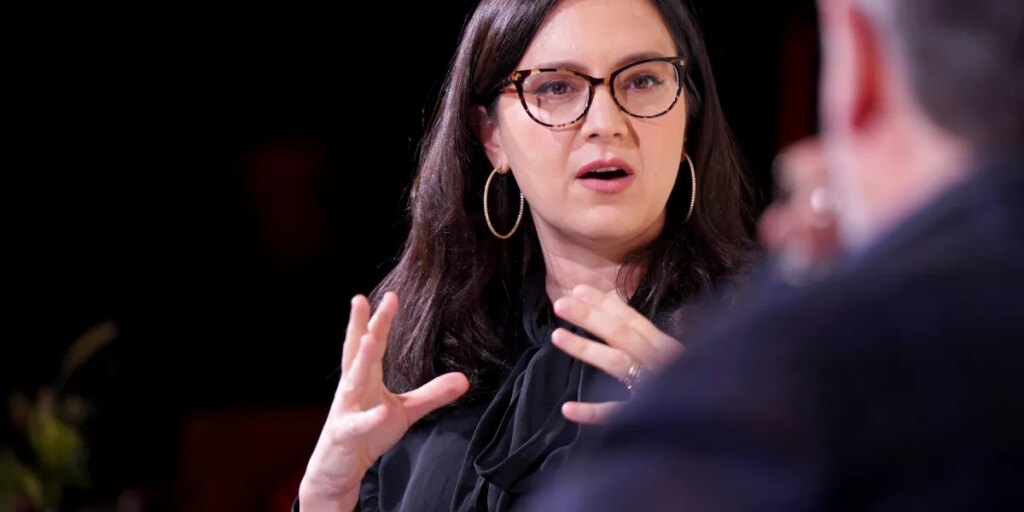
Bari Weiss never intended to play things safe. “I wanna blow this up,” she reportedly told colleagues early in her tenure as editor-in-chief of CBS News, the legacy broadcaster whose parent company, Paramount, bought her news and opinion site, the Free Press, in October.
Paramount CEO David Ellison appointed Weiss to remake CBS News as it struggles with an aging audience, programming that trails rivals, and reputational damage from its decision to settle a $16 million lawsuit brought by the Trump administration.
Weiss’s tenure so far has been explosive. Staff reportedly fear that she is compromising editorial norms, and some have accused Weiss of editorial meddling that favors the Trump administration. (Weiss has rejected the accusations.)
The most seismic episode was longtime 60 Minutes journalist Scott Pelley’s ouster last week after he clashed with Nick Bilton, the executive producer Weiss had just hired to lead 60 Minutes. At a staff meeting, Pelley questioned whether Bilton, a tech journalist with no broadcast news experience, had adequate credentials to run the show and said that he would never be welcome at 60 Minutes. After Pelley’s firing, Weiss told the newsroom that CBS had tried to engage with Pelley and “find a way back,” but “unfortunately we weren’t able to do so.” (CBS News told CNN that Pelley’s claims were not credible and that there is no political interference at the news organization.)
Even for an executive as audacious as Weiss, the tumult arguably has become a distraction, drowning out—at least for now—any sort of change narrative she’s hoping to advance. Indeed, many media observers—inside and outside the network—have gone so far as to suggest that demolishing the status quo seems to be central to Weiss’s mandate. Pelley last week accused Weiss of “murdering” the CBS show, shortly before he was fired. In an interview with CJR, Lowell Bergman, a former 60 Minutes producer, questioned why Weiss would immediately disrupt the storied news magazine program when it remains the network’s crown jewel and the nation’s top-rated television newsweekly.
Organizational change experts say that this kind of rupture is almost never necessary, and that the messiest transformations are often the least effective ones. “A generation of people actually believe that disruption is virtue, and that’s an enormous mistake,” says Ronald Heifetz, a senior lecturer in public leadership at the Harvard Kennedy School.
Change can be hard, especially for companies with deeply entrenched cultures. But a drama-free reinvention of an organization is possible—and if you can pull it off, it’s the ideal way to transform a company, Heifetz says. “In trying to change a successful and large organization, you want to find minimally culturally-disruptive innovation,” he explains. “When you look at innovative companies, they are building from a lot of strategy, values, structures, procedures, competencies that work, and it should be preserved…Otherwise, you’re throwing out the baby with the bathwater.”
Start with the why
To be clear, even the most drama-free company overhaul won’t make everyone happy. “The goal is not to eliminate discomfort, but to prevent distrust and dysfunction from overtaking the story,” says Amy Edmondson, a professor of leadership and management at Harvard Business School. The first step, she says, is being “very clear about why change is needed.”
“Keep repeating that message in plain language, because when people don’t understand ‘the why’—economic, marketing, technological, whatever it is—they will fill in the gap with their own explanation,” she says.
CBS News’ audience and ratings numbers justify some kind of change. But they don’t explain the purge of 60 Minutes‘ top talent after what Pelley called a “triumphal year.” The show had garnered 9.1 million viewers on average in its most recent season, a 9% increase from the season prior. Pelley said that going into the ill-fated meeting with Bilton, he and his 60 Minutes colleagues were looking for an explanation as to why CBS had parted ways with several of the show’s high-profile correspondents and leaders, including executive producer Tanya Simon, and correspondent Sharyn Alfonsi. Alfonsi had accused Weiss of political interference after Weiss abruptly pulled a scheduled segment on torture in the Salvadoran prison receiving Trump administration deportees. Weiss said at the time that the piece wasn’t ready and urged the reporters to seek additional comment from the White House. Alfonsi said her ousterfrom the show was an effort to “penalize a journalist for refusing to sanitize accurate reporting.” Referring to the 60 Minutes team, Pelley told the New York Times: “[T]hese bonds are pretty tight, and when somebody wipes out, murders, a large number of your family members, people are desperate for some explanation, and as you and I sit here today, there still has been none.” CBS has said it cannot share why someone was fired, for legal reasons.
Selling the future
If Weiss failed on the ‘why,’ she seems to have struggled equally with expressing to her staff ‘what’s next.’
Laying out a vision for the future is critical for a drama-free transformation, says Rita McGrath, an author and academic director in executive education at Columbia Business School. Weiss’s vision for the future of CBS News has centered on restoring audience trust, building brands around talent, and pivoting to a “streaming mentality.”
In a memo to 60 Minutes staff introducing Bilton, Weiss and CBS News president and executive editor Tom Cibrowski said they were seeking a new approach that involved “expanding 60 Minutes beyond a one-hour television broadcast, deepening its role across CBS News, and holding everything we produce to the ambition, fairness, and fearlessness that have defined 60 Minutes at its best.”
But “[Weiss] hasn’t succeeded in really making that compelling enough for those that are involved in the situation,” McGrath says.
A company transformation has to be framed as a learning process, rather than top-down execution, says Edmondson. “You can’t roll out a change program, you have to cycle it out. It’s a journey of hypothesizing, trying, learning, tweaking, trying again.”
Edmondson says Ford’s experience under CEO Alan Mulally exemplified the principle that turnarounds are works-in-progress that improve with honest feedback. Mulally revived the automaker by creating a single, unified strategy and a culture of accountability. Years into the overhaul, Mulally’s then-heir apparent Mark Fields recalled how the CEO had empowered executives to defy Ford’s longstanding culture that buried bad news. At one point, Fields raised red flags about a model rollout, and Mulally applauded him. “That meeting was a tipping point at Ford,” Fields said.
To his credit, Bilton said he intended to enlist 60 Minutes staffers in setting the show on a new course. In an introductory message to staffers, he said his first order of business was meeting with the show’s team to “hear what you’re working on. Hear what isn’t working…In about 30 days, I’ll come back to all of you with where we go from here. It will be a conversation that we have together.”
That’s the right approach, experts said, at least on paper. “If leaders are willing to acknowledge the uncertainty that lies ahead, and share what they’re seeing, share what they’re learning, and show that they can change course in response to good data, then others will do that too,” Edmondson says.
Slow and steady
The most successful transformations look less like detonations and more like construction projects—unglamorous, incremental, and mapped out well in advance. The third step in a drama-free overhaul—“removing obstacles between where we are and where we want to get to”—demands a “systematic” approach rather than “a chainsaw,” McGrath says. Turnarounds take time.
She points to Adobe’s well-timed decision to disrupt itself and evolve from selling boxed software to offering software as a service. McGrath recalls how its CFO spent weeks on the road convincing investors that the years-long transition would work: “He gave them what he called ‘markers’: ‘This is how you will know whether we’re doing well or not, whether we’re succeeding or not, and this is what you could hold us to.’”
Patience is in short supply in every corner of corporate America, but buying time—from the board and investors—is part of a leader’s job too, says Heifetz.
Creating a shared sense of value can ease any transformation, McGrath says. She says private equity firm KKR went to extremes to do just that when it brought C.H.I. Overhead Doors in 2015. It paired the deal with a broad employee-ownership model, giving every worker equity while also improving operations, safety, and productivity. The company was later sold to Nucor in 2022, awarding all 800 employees cash payouts of about $175,000.
“When you’re trying to bring people along, then what you want is to help find common ground, something we can all agree on, and then build from there,” McGrath says.
The question for Weiss and CBS News is whether bringing people along is a priority—or if, as they blow things up, they’d rather people get out of the way.
The post The chaos at CBS News shows the limits of ‘blow it up’ leadership appeared first on Fortune.