Steven Spielberg’s “Disclosure Day” is one of those movies that sweeps you up from the start and rarely lets you down. A rollicking science-fiction adventure, it finds Spielberg revisiting a genre that he has populated with charming and horrifying extraterrestrials, genetically engineered dinosaurs and plugged-in psychics, and which has inspired some of his most popular and critical successes. The first time I watched the new movie, I scribbled I am having so much fun in my notebook. It was a nonsensical thing to write down as well as redundant. I didn’t need a reminder of the contact high that stayed with me after the credits.
Most overtly, “Disclosure Day” serves as a companion piece to “Close Encounters of the Third Kind,” the 1977 blockbuster which, two years after “Jaws,” solidified Spielberg’s status as a New Hollywood chart-buster. In the decades that followed, he began to broaden his horizons with self-consciously serious, weighty subjects in films that were greeted in some quarters as evidence of his maturity. Throughout, he also continued to return to science fiction, an elastic genre that allowed him to stick to familiar types, pet themes and narrative patterns even as he pushed himself yet further stylistically, technically and cosmically.
There’s a lot going on in “Disclosure Day,” story wise and otherwise, but its maximalism is coherent and strategic. It was written by David Koepp, a genre adept who’s provided Steven Soderbergh with some of his best recent material. Spielberg conceived of the story for this movie, which effectively plays out as a feature-length chase involving some likable, enigmatically connected people who are racing toward a shared destiny while evading powerful forces. As the race goes on, the movie veers between comedy and suspense, action and contemplation, the sounds of squealing tires mixing with sober interludes that touch on belief, reason, trauma, self-governance, the common good and higher powers.
The movie opens mid-chase with a skittish Spielbergian Everyman, Daniel Kellner (Josh O’Connor), fending off a phalanx of Spielbergian heavies led by Noah Scanlon (Colin Firth), a smooth talker with a plummy accent and a raptor’s gaze. It’s night in the generic big city, and Daniel has a frightened woman at his side, Jane Blankenship (Eve Hewson), and a small mysterious object in hand that Noah wants. Daniel also has skills, and with some fast moves and nimble footwork he and Jane manage to evade capture in an S.U.V. It’s one of the first in a series of amusingly preposterous escapes that Spielberg orchestrates, and is in keeping with the perilous getaways that filmmakers have been perfecting since early cinema.
Soon after Daniel and Jane peel off, other characters emerge in quick succession in what becomes a prickly intrigue. Something very big, potentially explosive and obviously dangerous is underway here, which helps feed the deepening mystery and mounting unease. In one corner of the world, there’s Hugo Wakefield (Colman Domingo), a paternal figure who’s in what at first looks like an interior construction site, where he’s surrounded by scurrying workers and false walls. He tethers one of a handful of story lines that eventually join together and routinely delivers guidance to Daniel. Hugo also embodies values that seem in direct opposition to Noah’s and which introduce the story’s larger Manichaean divide.
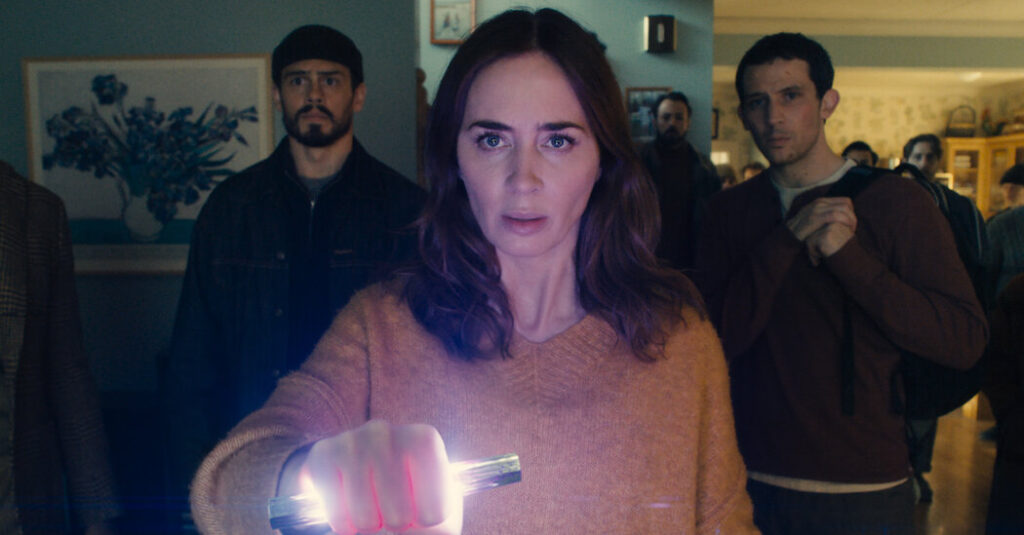
As promised, there are extraterrestrials, too, though they largely hover in the background rather than taking center stage as E.T. does. Spielberg and Koepp tease the aliens here early on in dramatic, somber fashion, incorporating them into a progressively complex conspiratorial web. The greater, more surprising jolt, though, is how funny the movie is. That’s particularly true of the scenes with Emily Blunt, as Margaret Fairchild, a Kansas City, Mo., TV weather presenter who — in what seems like one of the movie’s many autobiographical allusions — yearns to be taken more seriously. Blunt’s Margaret is a fast talker and mover, a human cyclone whose rhythms dovetail with the accelerated pacing.
To a degree, the genesis of “Disclosure Day” can be traced to Spielberg’s stargazing when he was growing up in Arizona; it’s no wonder the movie feels personal, especially when compared with the bloodlessness of his version of “War of the Worlds.” By the time he was a teenager that pastime had fused with his love of movies, and he had made “Firelight” (1964), a feature-length film about scientists investigating alien abductions. In the decades since, he has directed genre standards that, even when they go light on science, often take far-out flight. Many also thrum with the same moral questions that he’s engaged elsewhere, notably what responsibility people owe others, whether human, machine or alien.
However deeply Spielberg cares about some of the subjects that he lights on here — and I think that he does take them seriously — the movie never gets bogged down by them. At times, it also plays like a greatest-hits compilation. Like his film-struck compatriots in the 1970s, Spielberg has long filled his work with allusions to screen favorites. The misterioso monument that looms in “Close Encounters,” for one, evokes Monument Valley, John Ford’s stomping ground, and “A.I.” is richly embellished with references to the Disney animated film “Pinocchio.” A bridge figure between New Hollywood and its corporate successors, Spielberg himself has now loomed large over American cinema for over half a century.
A number of the more memorable allusions in “Disclosure Day,” by contrast, are references to Spielberg’s own filmography, including both early successes (“Duel”) and later ones (“Minority Report”). Wyatt Russell, for instance, who plays Margaret’s boyfriend, Jackson, is the son of Goldie Hawn, a star of Spielberg’s “The Sugarland Express.” It’s unclear whether Jackson’s guitar is a nod to a motif in “Amblin’,” another of the director’s early efforts; I like to think that the gold and purple that Margaret wears at one point is an ode to the Los Angeles Lakers from Spielberg’s longtime hometown. These self-referential moments are pleasurable, and evoke the freewheeling spiritedness of the likes of the Marx Brothers and Bugs Bunny. It’s commonplace for contemporary movies to be filled with such winks, if only for fan service.
Spielberg isn’t so much resting on his laurels in “Disclosure Day” as flaunting them, which is entirely understandable; he’s earned the right. I also think that with every reference to his earlier work he’s making a de facto argument about movies, their past, present and possible future. He was in his mid-20s when he directed “Duel,” a television movie that he made while under contract with Universal Studios, and that helped lay the foundation for a career that benefited him, the industry and the audience. It’s the kind of trajectory that, as the larger studios have declined, now seems near-impossible. That Firth’s villain is an arrogant corporate overlord with withering contempt for other human beings seems instructive.
Spielberg and his very fine lead players — O’Connor’s yielding softness works contrapuntally with Blunt’s crispness — keep the individual parts moving smoothly, even during some lurching transitions. He seems particularly revved up during the action sequences, which have an appealing looseness to them; some of the wilder, more improbable choreographed mayhem is more likely to make you laugh in appreciation than gasp. Spielberg isn’t straining to wow you. He reached the summit a while ago, which gives you latitude to get in his groove and have a good time. As I said, he has something to say about the world and our place in it, and while you might dismiss his ideas and sincerity, there’s no dismissing his filmmaking.
One of the striking things about Spielberg’s interest in science fiction is how closely the genre emblematizes cinema itself in its expansiveness, its relationship to the real world, its capacity for awe and potential idealism. “What did you expect to find,” someone asks Richard Dreyfuss’s character in “Close Encounters” shortly before its big finish. “An answer!” he all but yells. Having seen some mysterious flying objects, his character has become obsessed with finding out what they are, a search that ends with his leaving his family on a cosmic trip. Here, by contrast, Spielberg has created a de facto family — Domingo makes an excellent Dad — in a movie that insists that cinema itself is an empathy machine that we can all hop aboard.
Disclosure Day Rated PG-13 for guns and fairly mild action-movie violence. Running time: 2 hours 25 minutes. In theaters.
The post ‘Disclosure Day’ Review: Spielberg Plays His Greatest Cosmic Hits appeared first on New York Times.