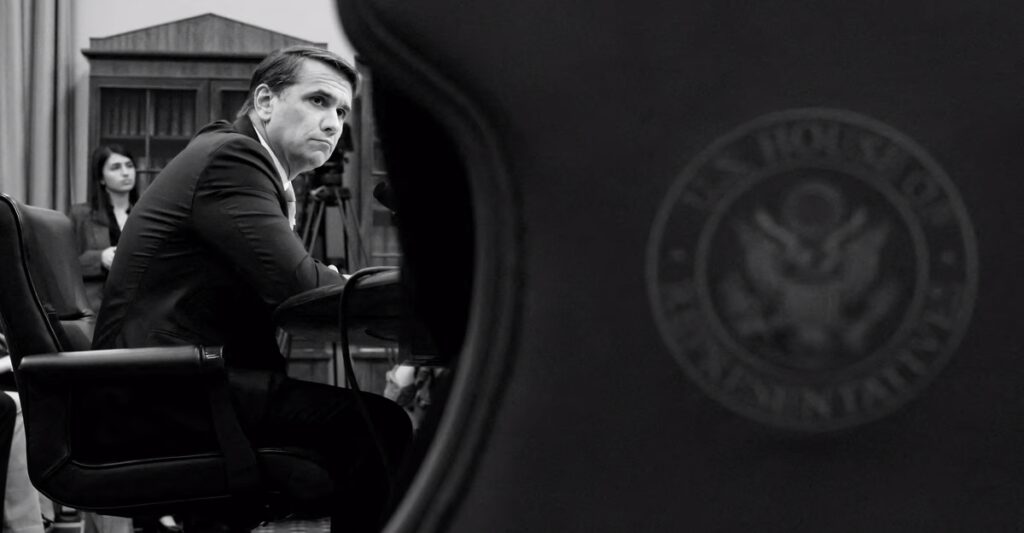
When Acting Attorney General Todd Blanche appeared before Congress last Tuesday, senior administration officials hoped that his testimony would be enough to quell the uproar over a $1.776 billion payout scheme for Trump loyalists, including January 6 rioters. “We’re not moving forward with the fund,” he told a House appropriations subcommittee.
But Blanche, who was not under oath, refused requests from a representative to put that in writing. He asked instead for Congress to take him at his word that President Trump’s politically inconvenient project for rewarding those who were allegedly victimized by the Biden-era Justice Department had truly been abandoned.
It turns out that it’s not that simple. Behind the scenes, Justice Department and other Trump-administration officials have quietly assured allies that plans for some form of payout remain on track. I spoke with eight people familiar with the so-called Anti-Weaponization Fund—including current and former Justice Department officials, current and former members of Congress, a defense attorney, and political operatives close to the administration. All said that Justice Department officials and people close to the White House have indicated that the payout idea has not actually been scrapped. Rather, they say, officials are exploring whether elements of the fund can be reactivated while also examining alternative arrangements to make sure loyalists get compensated. Across the administration, and even within the Justice Department, officials have differing perspectives on whether the fund itself will ultimately be restored. But either way, officials see a path forward for the government to pay those who say they are victims of supposed government “weaponization.”
Neither the White House nor DOJ provided on-the-record comments in response to a list of questions I emailed about the fund. A senior DOJ official who was familiar with the department’s plans said there have been no discussions at the highest levels about reviving the fund since Blanche testified, though the official acknowledged DOJ was a large institution and there may have been conversations at lower levels.
Those familiar with the internal conversations—all of whom spoke with me on the condition of anonymity because they feared possible retaliation—told me that the work is being kept quiet while the Trump administration waits for opposition to the fund to blow over. Crucially, the administration is also trying to avoid a fight over the payout plan, which has been deemed a political slush fund by critics, while the Senate considers Blanche’s nomination for attorney general.
[Read: Trump might already be a lame duck]
Republican John Curtis of Utah suggested to reporters earlier this month that holding up Blanche’s nomination was an option for the Senate, noting that congressional amendments are “not our only chance to kill the fund.” Republican Thom Tillis of North Carolina, who has grown vocal in his criticism of the administration as he heads toward retirement, has indicated that he may not vote to confirm Blanche unless the fund is truly dead. Republicans currently maintain a slim majority on the Senate Judiciary Committee, and Republicans I spoke with acknowledged that defections over the fund could prevent a nomination from moving out of the committee, though it is too early to know for sure, given that the process could take weeks. But Republicans have little margin for error if they want the nomination to go to the full Senate. Blanche’s confirmation depends in part on his ability to convince skeptical Republican senators that the fund is no longer a live possibility.
Shortly after Trump took office for the second time, the White House asked the Justice Department and Trump’s legal advisers to find a way to reimburse him and those close to him for the millions of dollars in legal expenses he has incurred, including over the Mueller probe into his campaign’s relationship with Russia as well as multiple impeachments and criminal investigations. That effort was later combined with a separate but related push by Trump supporters to pursue financial restitution for those convicted of crimes related to January 6, providing a broader context for a massive transfer of taxpayer dollars from the government to those who have been charged with, and in many cases convicted of, federal crimes.
On May 18, Blanche announced the establishment of a $1.776 billion Anti-Weaponization Fund as part of a settlement to a suit brought by Trump, his sons, and the Trump Organization against the IRS and Treasury Department. The settlement resolved claims related to the disclosure of Trump’s tax returns, and a subsequent addendum barred the IRS from auditing the tax returns of Trump, his family, and his businesses. A DOJ press release highlighted Blanche’s central role in the fund’s creation and administration, explaining that he would appoint a five-member commission to decide who would get paid, and how much. The president was given the authority to remove any of the commission’s members. “The machinery of government should never be weaponized against any American, and it is this Department’s intention to make right the wrongs that were previously done while ensuring this never happens again,” Blanche said at the time.
The announcement provoked bipartisan criticism. Democrats pointed out that the fund could be used to pay January 6 defendants who had assaulted police officers. Some Republican critics said the same, while noting that the political optics of paying taxpayer money to presidential allies would be terrible for the party at a time of rising gas prices and other costs. Tillis derided the fund as a “payout for punks.”
Under pressure from fellow Republicans, the administration backed off the plan—but never renounced it. One DOJ official and one political strategist close to the White House told me that that officials there didn’t think the fund was a bad idea; they just regretted that the rollout, which had been intended in part as a way of shoring up Republican support ahead of the midterm elections, had been too public and invited too much scrutiny. They hoped to do things more quietly in the future—and those who are seeking money from the government say that’s exactly what’s happening.
“Right now, you have to be an insider to know who to talk to,” one attorney who had advised multiple individuals seeking compensation told me. One Republican former member of Congress told me that he and others had been assured that the administration’s public statements about the weaponization fund being abandoned were “all part of the plan; nothing has changed.” One Justice Department official and two Republican political advisers told me that public backing for the fund was dropped to clear the way for Blanche’s confirmation, but that they had been promised that payments would eventually be made to January 6 defendants, pardon recipients, and those close to the president. “Trump didn’t want to fight this out in public,” the official told me.
[Read: Trump’s purge may be just beginning]
Justice Department officials are still figuring out the exact mechanisms by which people who seek compensation can be paid. Officials told me that those who believe they were victims of a weaponized government may ultimately need to file lawsuits so they can then receive settlements from a previously established Justice Department fund. Suing the government is not a new idea. But typically the government looks for ways to defend itself; in this case, officials are exploring proposals to facilitate litigation and to expedite payments without requiring an expensive and lengthy process that might draw attention. One former DOJ official told me that discussions are happening about how to provide legal support at scale to those who want to file lawsuits. “They’ll sue, and they’ll settle,” the former official said of the plan.
Blanche may have denied before Congress that the weaponization fund was moving ahead, but others have been less categorical, dropping hints that payouts remain in play. Last week, Stanley Woodward Jr., a former Trump White House official who now serves as associate attorney general and who signed the settlement agreement, appeared to telegraph that the financial-restitution effort was still in progress. He responded “we’re on it” to a post by Senator Lindsey Graham on X that suggested that victims of so-called weaponization during the Biden era could still be compensated through claims under the Federal Torts Claims Act. That law enables individuals to pursue claims in federal court for personal injuries, wrongful death, or property loss caused by the negligent or wrongful acts of federal employees. Woodward later deleted the post.
In multiple interviews over the past week, Trump has declined to confirm that the payout effort has been abandoned. When asked by NBC News if he was “looking for a way to revive it,” Trump did not dispute that: “Well, look. If it was up to me, I’d pay them the kind of money that they deserve,” he said. He added, “I think the weaponization fund is a great idea, and so do many other Republicans.” Although officials say the fund was intended to be available to any victims of government weaponization, regardless of party, the president has focused his comments exclusively on allies who he feels were wrongfully targeted.
[Read: Why Republicans aren’t condemning Trump’s Meet the Press walkout]
When Blanche testified, the acting attorney general resisted multiple attempts from lawmakers to pin him down. Representative Grace Meng of New York asked repeatedly if he would provide written statements that reflected his comments to the committee, but the acting attorney general declined. “I’m not committing to putting anything in writing. I’m going to say it over and over again. I don’t know what the purpose of putting something in writing,” he told lawmakers, growing visibly frustrated.
Four days before Blanche’s appearance in front of Congress, a federal judge had ordered DOJ to cease “any further action pursuant to the creation or operation” of the fund before a June 12 hearing. The Justice Department said it would comply with the court’s order, and later cited Blanche’s statements to Congress in its motion to dismiss the case, arguing that litigation that had been brought by Trump critics and other entities was now moot, because the fund was not going ahead.
On Monday, Woodward wrote, in a letter to plaintiffs’ attorneys that I reviewed, that “no members have been appointed to the Anti-Weaponization Fund, no process for accepting claims has been established, no money has been moved, and no claims have been paid.” Still, DOJ would not provide any additional statements that would clarify the status of the fund.
On Tuesday evening, lawyers for plaintiffs who are challenging the fund, from the legal advocacy group Democracy Forward, submitted filings alleging that the government’s shifting posture made it “impossible for Plaintiffs or the Court to credit Defendants’ representations” regarding the fund. The filings cite the president’s own words expressing continued support of the weaponization fund, while declining to answer whether the effort has been halted. “We’ve seen this administration say one thing and do the complete opposite far too many times, and we’re asking the court to have them show us the truth about their assurances that the slush fund has actually been abandoned,” Skye Perryman, the president and CEO of Democracy Forward, said in a statement to me. She was more direct in her response to Blanche on social media: “If you can say it on TV, you should say it in court.”
Blanche’s nomination hearing is expected to be scheduled after he submits the required documentation, which includes financial disclosures and an FBI background check. Democrats and Republicans told me it is unclear whether Blanche will be able to win confirmation. Rejection of Blanche, who was Trump’s personal attorney before he returned to office, would mark another setback for a president who is not used to taking no for an answer. Trump has privately told associates that he was drawn to the idea of the Anti-Weaponization Fund because he believes he is “owed” for the “witchhunt” investigations he’s endured, a senior aide and an outside adviser told my colleague Jonathan Lemire. He has raged against the Russia probe that he felt consumed his first term and the criminal investigations he faced while out of office. Now he is seething about acts of defiance from members of his own party on Capitol Hill, including their opposition to the fund. “Republicans wouldn’t have balked,” the outside Trump adviser said, “if his poll numbers were better.” But the historically unpopular president now seems powerless to bring them back into line.
Jonathan Lemire and Marie-Rose Sheinerman contributed reporting.
The post Trump’s ‘Anti-Weaponization’ Payouts May Not Be Dead After All appeared first on The Atlantic.