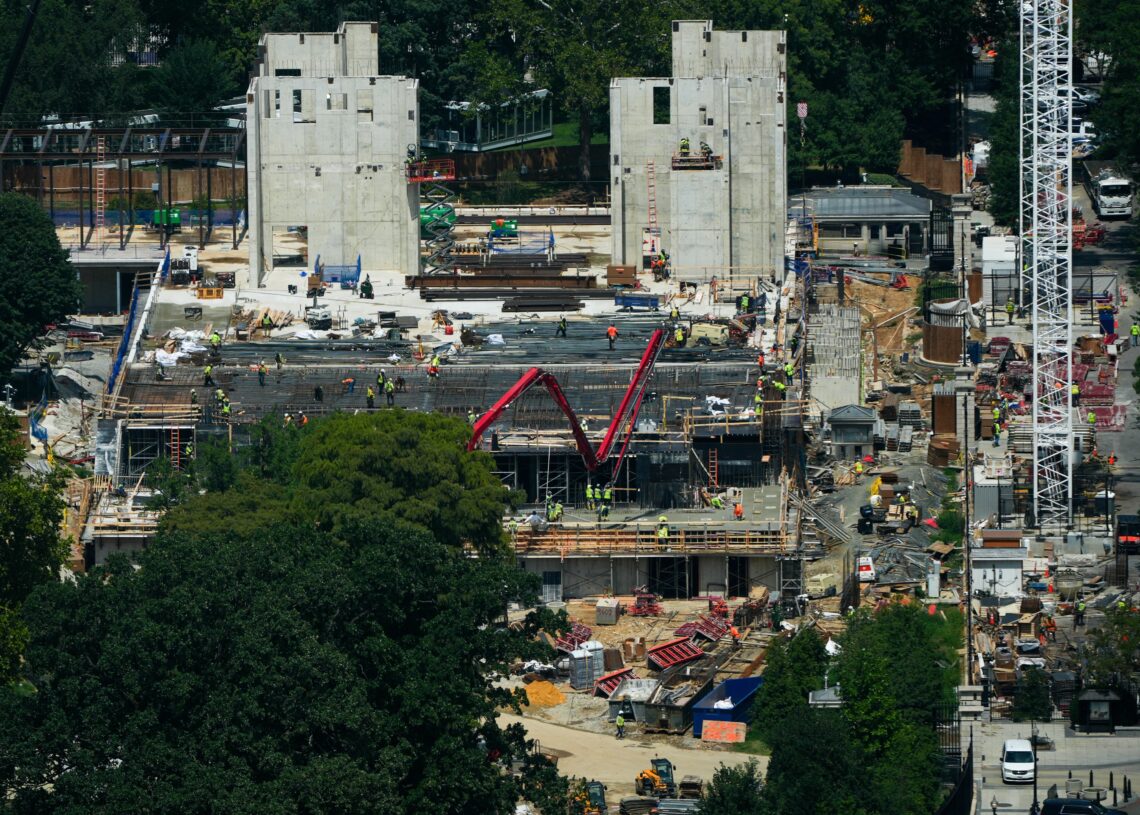
The Supreme Court on Monday allowed construction to continue on the White House ballroom, handing President Donald Trump a major victory as he races to complete the largest expansion to the executive mansion in decades.
The justices found that the historical preservationists who challenged the controversial project had not suffered the direct personal harm required to bring a lawsuit, but did not rule on the project’s legality.
Still, the decision means the lawsuit by the National Trust for Historic Preservation is all but dead. The group argues that tearing down part of the historic building known as the ‘People’s House’ to build a new ballroom required the approval of Congress.
Legal experts said Congress might be able to challenge the project, but the Republican-controlled body has shown no interest. It’s unclear if any other group might have what is known as standing to bring suit.
Trump has been fixated on completing the ballroom, with the president frequently invoking the project in public remarks, giving personal tours to show off its construction and characterizing the building as a capstone to his real estate and political careers. Trump has said is part of a larger complex necessary for national security.
“We are living in the Golden Age of America, and this Building will be one of the Greatest ever constructed in Washington, D.C.,” Trump posted on Truth Social after the court’s decision.
The National Trust’s argument that ballroom construction must stop until approved by Congress had prevailed in lower courts, which twice ordered the White House to pause work. But amid legal machinations, those orders were put on hold, allowing construction to move forward without interruption.
The ballroom, which is expected to be able to hold about 1,000 guests, is being built in conjunction with a five-story underground military complex that will include a hospital and shelters to protect the president and senior officials.
Trump has said that the total cost of the ballroom may be $400 million and will be paid for with private donations, but contractors’ invoices obtained by The Washington Post show that the cost of the project will be $600 million and that taxpayers will foot about half the bill.
Lower courts have not blocked work on the underground complex, and the justices’ decision pertained only to the aboveground portion.
The majority in the unsigned ruling said the trust had not met the required legal standard.
“Today, we do not pass upon the legality of the government’s East Wing project,” the majority wrote. “We conclude only that, based on the submissions before us, the government is likely to prevail in showing that the Trust lacks … standing to challenge the project in federal court.”
The ruling came over the objections of an unusual coalition of justices, who often are on different sides. Chief Justice John G. Roberts Jr., a conservative, joined with the court’s three liberals in dissent.
Writing for the group, Roberts said the decision “is no victory for the separation of powers.”
He referenced Alison Hoagland, a National Trust board member, whose declaration that she was harmed by the planned construction was the underpinning for the trust’s lawsuit.
“I would suffer both professional and personal injuries, including to my aesthetic, cultural, and historical interests,” Hoagland, a historian and Washington resident, declared last year. She described her experiences walking past the White House and enjoying its current structure, and her fears that Trump’s addition would distort the historic building’s character.
“The White House is not just any building, and — when it comes to historic preservation — Hoagland is not just any person,” Roberts wrote. “In failing to appreciate as much, the Court misconceives the plaintiff’s injury, allowing the Executive’s likely infringement of the Legislature’s power of the purse and authority to regulate federal property in the District of Columbia to continue.”
Brent Leggs, president and CEO of the National Trust for Historic Preservation, said in a statement the group was “deeply disappointed” with the ruling.
The case on the legality of the ballroom technically continues, but legal experts said the high court’s ruling likely leaves little room for the group to prevail.
“This is not the final decision on the merits of our case and does not resolve our fundamental argument — that each President is a temporary steward of the People’s House and does not have the unilateral authority to demolish and redesign it without the approval of Congress,” Leggs said.
Jonathan Adler, a law professor at William & Mary, said the Supreme Court has been skeptical of the breadth of standing in recent rulings. He also said it is not uncommon for no person or group to have legal standing to challenge an initiative. He said that might be the case with the ballroom.
But Adler said the case points to a recurring issue in recent years — the deference a Republican-controlled Congress has shown to the president. The Constitution assigns the power to manage and regulate federal property to the legislature, but Congress has not acted in the ballroom case.
“As with a lot of areas involving Trump, our constitutional structure is dependent upon the legislature being an active check or counterbalance to the executive,” Adler said. “This case, like a lot of cases we’ve seen in recent years, creates pressure on the system because we ended up asking the courts to step in when it’s really Congress’s job.”
Before the Supreme Court order, the U.S. Court of Appeals for the D.C. Circuit upheld a federal judge’s April ruling that work on the 90,000-square-foot addition to the executive mansion probably requires congressional approval to continue.
Shortly after U.S. District Judge Richard Leon ordered work to stop, the appeals court stepped in and paused that ruling while it decided whether to issue its own injunction.
The appeals court blocked aboveground construction anew on Aug. 7, finding that Trump had exceeded his power in authorizing the destruction of the East Wing of the White House and the building of the ballroom.
That decision was stayed for two weeks to give the Trump administration time to appeal to the Supreme Court. Roberts then continued that pause to give the high court time to weigh in.
“We are aware of no instance in American history in which a President unilaterally and using privately collected funds demolished substantial portions of the White House that Congress authorized to be built and American taxpayers paid for. Until now,” the appeals panel wrote.
In its filings with the high court, the Trump administration argued that it was too late to stop ballroom work because the project was 65 percent complete, and that the injunction put the lives of Trump and others at risk.
Contracting and budget documents obtained by The Post suggest that the project is far less complete. Trump on Monday reiterated his pledge that the building will be open in the summer of 2028.
The administration’s filing to the Supreme Court also cited a number of alleged attempts on Trump’s life, including a 2024 incident at a Pennsylvania rally when a would-be assassin’s bullet grazed his ear.
“The injunction would wrongfully install a single district judge as sole arbiter of what further construction is ‘strictly necessary’ to protect the safety of the President, his family, staff members, and visitors to the White House, including foreign dignitaries, and presidents and prime ministers of other countries,” Solicitor General D. John Sauer wrote.
Trump initially characterized the ballroom as necessary for presidents to entertain VIP guests, but in recent months he has shifted to arguing it was crucial on security grounds.
The Trump administration has said the ballroom, which will be built with missile-resistant columns, a drone-proof roof and blast-proof windows, will shield the military complex below and the White House more generally.
To bolster the claim, the administration shared affidavits from Secretary of State Marco Rubio, FBI Director Kash Patel and others who claimed that completing the ballroom was necessary to protect the president.
Trump recently posted on Truth Social that the ballroom was a “desperately needed National Security structure” and derided the preservationists as “treasonists.”
The White House announced the project in July 2025, saying at the time that the privately funded addition would hold 650 guests and cost $200 million. But both the capacity and the price have spiraled upward.
The National Trust sued to block construction of the ballroom in December, saying that the Trump administration had not gone through the legally mandated review process and that Congress has sole authority to authorize major White House construction.
The group was skeptical of the claims that pausing the project would create a security risk. In recent court documents, the National Trust argued that the Trump administration was racing to complete the ballroom to thwart oversight.
“Rather than obtain permission from Congress, Petitioners have instead decided to try to outrun judicial review,” the National Trust wrote in its filing.
The group also cited a National Park Service environmental assessment that found the ballroom would interfere with sight lines and disrupt the historical continuity of the White House grounds.
About 30 congressional Democrats filed an amicus brief supporting the National Trust in the case.
“Questions about how best to protect current and future White House residents, staff, and visitors fall well within the ambit of Congress’s powers over federal property and federal spending,” the Democrats wrote.
The Post reported in June that an internal contractor’s estimate put the final cost of the project at about $600 million and that roughly half the money would come from taxpayers. The administration has approved a $500 million no-bid contract to construct the ballroom.
Jonathan Edwards contributed to this report.
The post Supreme Court clears way for White House ballroom construction to continue appeared first on Washington Post.