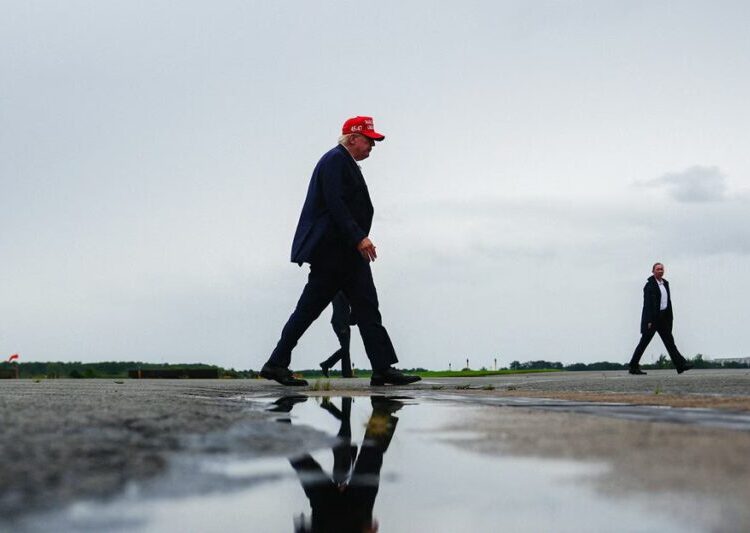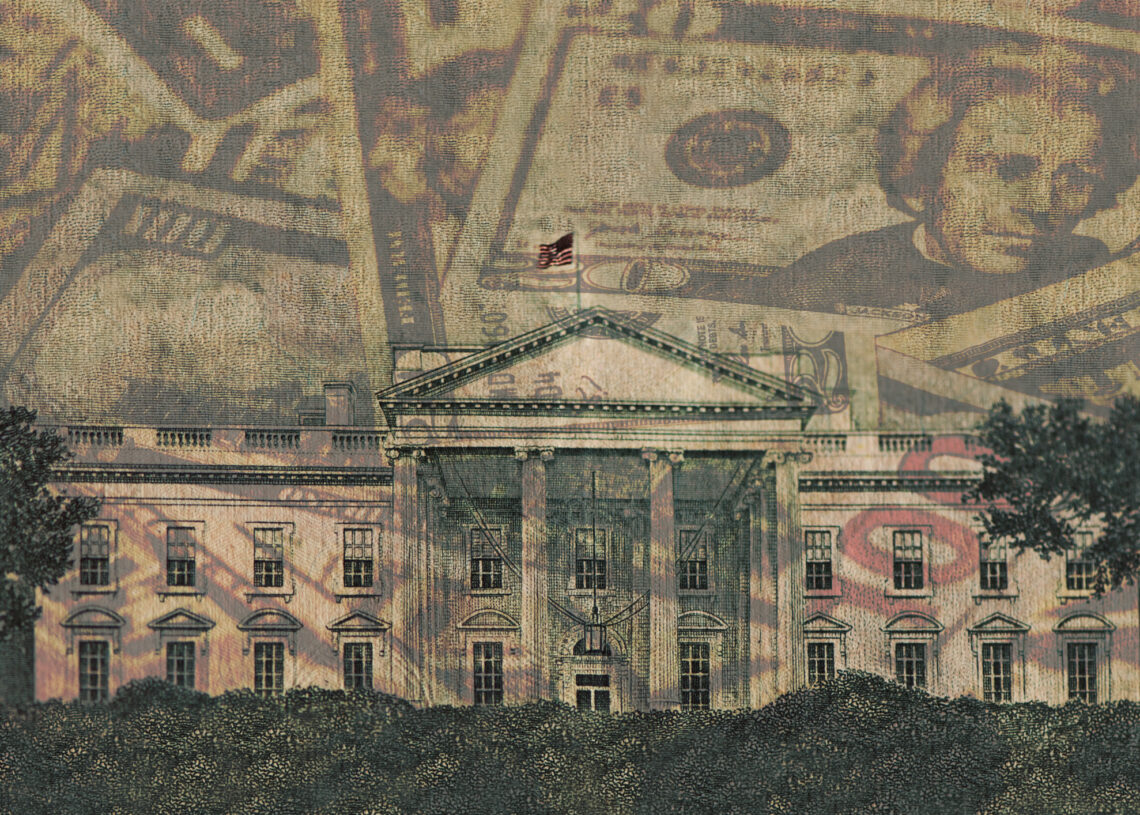
An unaccountable concentration of political and private power is increasingly reshaping how America’s federal government operates, bending its political, legal, and economic systems away from the public good and toward private interests. Political scientists have a name for this: state capture, the systemic manipulation of public institutions by narrow interests for their own benefit.
What was once more commonly discussed as a danger in fragile democracies is now an urgent American concern. Recent developments suggest that this form of institutional seizure is no longer theoretical; it is taking hold here.
The warning signs are already visible. Among them has been President Donald Trump’s attempt to create a $1.776 billion Justice Department slush fund, reportedly abandoned only after intense legal and bipartisan political backlash. There have also been reported instances of conflicts of interest involving financial activity by government officials, as well as ongoing concerns of political pressure being applied to independent institutions. In parallel, efforts to strip inspectors general (IG) of their independence have undermined many of the federal agencies that rely on them for oversight and accountability.
Public confidence in institutions reflects these concerns. A recent Pew survey found that 68% of Americans—including a majority of voters from both parties—believe the United States has declined as a model of democracy in recent years.
That loss of confidence reflects a broader crisis of government, fueled by the increasingly held belief that corruption in our government is pervasive. A December 2025 Yale and George Mason survey similarly found concerns about corruption now rival or exceed concerns about inflation and the cost of living, even amid sustained economic pressure. Focus group research among white working-class voters in North Carolina captured a related sentiment more directly: that economic and political systems are perceived as increasingly tilted towards well-connected corporate and political actors. Taken together, these indicators suggest that many Americans believe our economic system is not just failing to work for them, but is fundamentally rigged against them—a conclusion made harder to dismiss by the massive, multi-decade rise in inequality.
As a former local prosecutor and now a state inspector general, I have investigated and prosecuted fraud and corruption. That work is essential. However, I believe that when corruption is not merely a matter of isolated misconduct and instead reflects a broader institutional breakdown, traditional enforcement tools are not enough. Criminal prosecutions address specific violations by specific people. But state capture requires something broader: a public accounting of how institutions became vulnerable to manipulation, who benefited, and how to transform our institutions to prevent it from happening again.
There is precedent for this kind of response. In 2018, South Africa created a Commission of Inquiry into State Capture to examine corruption in public institutions and evaluate institutional vulnerabilities. The Commission heard from over 300 witnesses and reviewed over 1.7 million pages of documentary evidence through a highly transparent process, including televised and livestreamed hearings. Critically, the Commission’s inquiry extended beyond the acts of government officials to include the corrupting role of private-sector actors—including prominent international firms, consultants, advisors, bankers, and auditors—who were alleged to have enabled, benefited, or engaged in corrupt contracting practices. The Commission’s final reports offered a roadmap for reform and helped restore public trust.
The United States should consider a comparable commission of inquiry to examine modern forms of institutional failure, agency by agency, and rebuild public confidence in government. Such a commission would require nonpartisan leadership with strong public credibility and clearly defined independence from political influence.
While this may seem like a tall task in today’s polarized political landscape, we need not base our own inquiry on international examples. In fact, we have had our own share of fact-finding, non-partisan efforts to restore public confidence in the United States, including the Warren Commission, which investigated the assassination of President John F. Kennedy, chaired by the then-sitting Chief Justice of the Supreme Court, and composed of congressional leaders from both parties, and two private citizens appointed by the President; and the Church Committee, a truly bipartisan Senate Committee, that investigated abuses by our major intelligence agencies in the 1970s.
Plus, we already have the infrastructure to staff such a nonpartisan Commission of Inquiry: inspectors general. Across the country, inspectors general like myself serve as independent watchdogs who investigate, prevent, and publicly report on fraud and corruption across government and make recommendations for future prevention. The federal IG offices remain among the most technically capable investigative bodies in the federal government. The investigators, auditors, and lawyers who work within them possess deep expertise in funding, procurement, enforcement systems, and internal controls, as well as the statutory authority to investigate fraud, waste, and abuse needed to retroactively conduct a wholesale review of this moment of American capture—and, crucially, to report their findings to the public. Each inspector general’s office would conduct the inquiry within the agency it already oversees: the Department of Justice IG would review and report on DOJ, the Department of Education IG would review and report on that department, and so forth throughout the federal government, all reporting up through a nonpartisan leadership structure to the public.
Despite the 2025 firings of the leadership of 17 of the federal IG offices, the public servants still staffing those offices are ready, willing, and able to undertake the critical investigative and truth-telling work required to restore public confidence, but require a mandate to undertake a holistic state capture assessment, as well as a commitment from government and the public that they will not experience retaliation for their truth-telling. The offices of the federal inspectors general staffing a coordinated effort to assess and report on how individual federal agencies have experienced elements of state capture by private interests, and on those that have successfully resisted, under nonpartisan, credible leadership, will ensure that institutional assessments are thorough, credible, and free from political interference.
As the United States approaches its 250th anniversary, Americans should insist that the semiquincentennial mark a renewal of democracy, not its decline. To meet this moment, our country should call for a Commission of Inquiry into State Capture, and employ our inspectors general—first created by our founding fathers during the Revolutionary War and later embedded into civilian government during the post-Watergate crisis of public trust—to shine the light necessary for a restoration of public trust.
The post The U.S. Needs a Commission of Inquiry into State Capture appeared first on TIME.