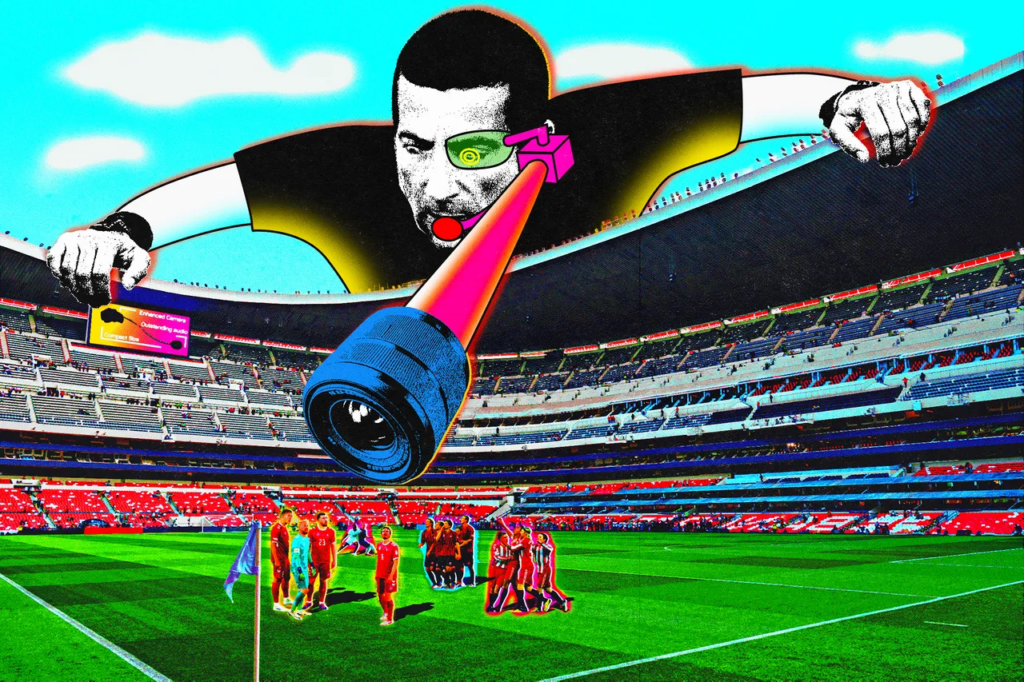
When you tune in to the 2026 World Cup, you’ll get a peek at something you probably haven’t seen before: an up-close live feed at what’s happening on the field from the referee’s perspective.
Broadcasts will incorporate a point-of-view captured feet away from the action by a tiny camera attached to the official’s headset, sitting just near their temple. The images are be beamed wirelessly to the broadcast booth, where the video is digitally smoothed in real time and incorporated into the televised program.
If you’ve ever wanted to know what the game looks like from a ref’s vantage point—whether you want to study your favorite player’s footwork or just critique the ref’s calls—you’re getting your wish.
Ref cameras have been used in broadcasts for a few years across major sports. “Ump view” is being used more and more often on MLB broadcasts to give viewers a true feel for the raw speed and movement of pitches. Both the NFL and NHL have dabbled in uses of ref cams to bring fans closer to the game, the former as early as 2018. But when we get to zoom in to see plays from the official’s perspective, what we’re seeing isn’t typically live. Broadcasters will show snippets during an instant replay or during the postgame show, but rarely if ever as part of the live action.
Here’s WIRED’s complete guide to the 2026 FIFA World Cup.
Soccer lends itself pretty naturally to the idea of a live ref cam. During a televised match, the main cameras are almost always set up in wide shots, so viewers spend most of the game far away from players. A ref cam offers a change of pace, bringing the viewer right onto the field.
The earliest iterations of video feeds from ref’s body cameras, both at the English developmental levels and in a 2024 trial in the German Bundesliga, were run on delays. They were mostly used for referee training and development. But in March 2025, the International Football Association Board (soccer’s worldwide governing body) approved the use of ref cam footage on live broadcasts, which happened for the first time at the 2025 Club World Cup. And while it may seem like a small distinction, the technological lift required of FIFA and its partners to make that footage available for live broadcast was significant.
The first challenge: reducing the latency in the video stream. It takes time—less than a second, but still enough time to notice—to beam glitch-free, broadcast quality footage from the refs on the field to the stadium’s broadcast hubs. The cameras the refs wear aren’t typical broadcast cameras with Ethernet connections. They have to transmit wirelessly across a stadium packed full of devices and brimming with wireless interference.
Johannes Holzmüller, FIFA’s director of innovation, tells me his organization tested a handful of wireless data systems across multiple locations, including planned World Cup venues like Miami’s Hard Rock Stadium. They settled on a specialized 5G solution that wireless provider Verizon says uses high-frequency wireless bands for data.
Removing “jitter,” or the constant bouncing and sometimes motion-sickness-inducing effect created by a camera at the temple of a referee running, stopping, and spinning to follow the ball, was an even bigger puzzle.
“[Broadcasters] were telling us that they’d love to use [the ref cam] more often, but especially when the referee was running or sprinting, the footage was very shaky,” Holzmüller says.
That wouldn’t be tenable for an actual World Cup broadcast, so FIFA tasked tech partner Lenovo with creating AI-aided software to reduce this jitter to more manageable levels.
Simply defining this jitter effect and how much it should be tinkered with proved an early challenge. No one wants to watch raw footage from a camera that’s bouncing all over the place, but viewers also wouldn’t enjoy clearly manipulated, unrealistic video feeds where everything is smooth like a crappy video game. How do you find the sweet spot, then train software to maintain it?
“We’re blending dozens of variables that measure jitter” in different ways says Art Hu, Lenovo’s global chief information officer. The system recognizes which issues it needs to iron out and attacks those specifically.
For example, consider the various backgrounds that might come into view on the ref cam. A ref viewing a play low to the ground and just a few feet away might produce a feed that’s mostly grass and players’ feet; if the ref is looking higher, we’ll see other background textures like crowds, scoreboards, and even the sky. Lenovo’s machine-learning programs have to be able to recognize what’s in the shot and apply the right smoothing technique quickly enough for live broadcast feeds.
Lenovo uses an on-premise server at each stadium that runs several sub-algorithms, each tuned to its own type of background. These sub-algorithms are compressed when they aren’t in use to save bandwidth. If the engine recognizes there’s a lot of grass in the shot, it calls up a grass-backdrop-smoothing algorithm and activates it until the ref’s gaze turns to a different background. Hu compares it conceptually to large frontier LLMs like Claude or Gemini using smaller, compressed models that can be called up whenever they’re needed and packed away when they aren’t.
The live version of ref cam was first used on DZAN for the 2025 Club World Cup held in the US in June and July, then for a few other smaller competitions over the past year. Lenovo has continued to hone its jitter-smoothing software; both Lenovo and FIFA say they’ve been able to reduce the shakiness of the images from the ref cams by 50 percent. “We feel very comfortable going into the World Cup,” Holzmüller says.
The teams are so certain in the approach’s quality that ref cam views will even be incorporated into video-assistant-referee systems for the World Cup, Holzmüller tells me. This is the system that uses information gathered with sensors and cameras on the field to help officials determine whether players are offside or whether a ball went out of bounds and, if so, which player touched it last. If clips from the official’s own perspective can help make the right call, they’ll be used. Trusting the body cameras with potentially game-altering calls is quite the vote of confidence that the smoothing technology will work adequately every time.
Discerning Eye
Drew Fisher, a 20-year veteran soccer official who referees in both MLS and international leagues, has used multiple types of ref cam hardware. (MLS has its own version through different tech providers, which is used during broadcasts.) Fisher says the FIFA edition, which is mounted on the side of the earpiece of the radio headset officials have already been wearing for years, is light enough that he barely feels it once the game has started. Refs can choose where they place the accompanying battery pack and transmitter combo; Fisher says he and most of his peers strap it to their upper arms, but some others strap it to their back.
What happens if the ref cam breaks? Fisher says that happened only once during his past uses of the FIFA version, when one of his support pieces broke. Instead of wasting game time fixing it, though, Fisher says a tech just removed the camera at the next out-of-bounds stoppage and left it off for the remainder of the game.
Entertainment is the primary purpose of the FIFA ref cam, but Fisher says clips have also begun showing up in postgame debriefs where officiating crews review their performance with their bosses. They can provide unique angles for refs to judge whether they were standing in the right place for a given play or whether their sight line was optimal. Holzmüller thinks this sort of practice will become more common as smoothing techniques improve and the footage is even easier to watch in long chunks.
Fisher hopes the up-close experience of seeing the ref cam footage during the live broadcast will give fans a new appreciation of the realities of officiating.
“The speed of the game at close range and at those angles, I think it casts some of our work in a different light,” Fisher says.
Fisher seems to be getting his wish: Holzmüller says that element was a big part of “overwhelming” positive fan response to the Club World Cup version of ref cam used in 2025, particularly among younger people and on social media.
“Many people gave us the feedback that they now understand the challenging job of a referee,” Holzmüller says. “They understand the intensity, that referees need to make a decision within milliseconds.”
The post This World Cup, You Can Watch the Game From a Ref’s Point of View appeared first on Wired.