Many of the world’s largest technology companies have spent the past two decades generating ample cash to keep growing without the need for outside investment.
But in the race to dominate the artificial intelligence industry, companies are opening themselves up to new money, borrowing cash and raising equity from investors after years of relying on their own profitability.
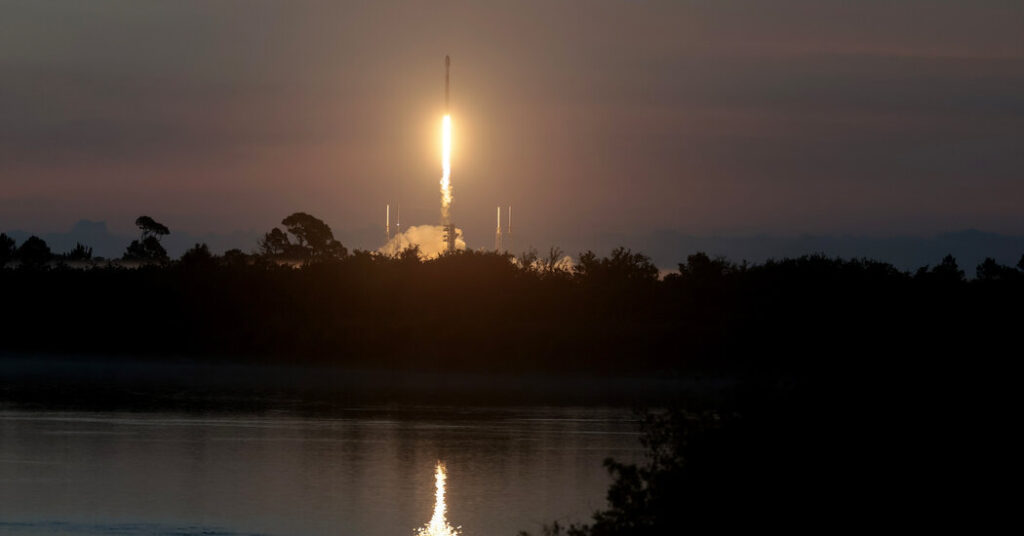
On Thursday, Elon Musk’s SpaceX, a rocket maker and leader in A.I., is seeking to raise $75 billion in an initial public offering that values the company at $1.77 trillion, making it the largest I.P.O. on record.
Last week, with much less fanfare, Google’s parent company, Alphabet, issued $80 billion in new shares to fund its own A.I. expansion. It was the largest ever stock raise from a company already listed on public markets.
The rapid pace of fund-raising has led to comparisons to the dot-com bubble. And like the early internet companies of the 1990s, today’s A.I. companies are finding deep, seemingly insatiable investor demand.
“It feels very much like the late 1990s,” said Steven Kaplan, a professor of finance at the University of Chicago Booth School of Business. “The markets are very risk-on, and there’s a new technology that investors are incredibly excited about.”
This is unusual. For much of their history, the marquee tech companies have generated large amounts of cash, limiting the need to raise money elsewhere. Alphabet had roughly $125 billion of cash sitting on its balance sheet at the end of March. Microsoft had $80 billion.
But the scale of the A.I build-out is now thought to be so colossal that even these cash-rich companies don’t have enough to finance it by themselves. At the start of May, Goldman Sachs estimated that the total spent on A.I. infrastructure this year would be $765 billion, with the total expected through 2031 rising to over $7 trillion.
Even if the companies involved could afford that on their own, the sheer willingness of investors to back A.I projects means that the cost to these companies — through the amount of interest on debt or from the amount raised for each new share issued — of bringing in outside investors has remained attractive.
Alphabet had initially planned to raise $80 billion by issuing new shares earlier this month but increased the total to closer to $85 billion because of strong investor demand, according to two people familiar with the deal.
The company also received a big endorsement from Berkshire Hathaway. As part of the deal, Berkshire Hathaway is investing $10 billion in Alphabet, a notable bet by a firm that has been relatively conservative about technology stocks. It’s one of the most significant deals that Berkshire Hathaway’s chief executive, Greg Abel, has done since taking the reigns earlier this year.
Last month, investor demand to buy into the semiconductor business Cerebras’s I.P.O. allowed the company to increase its initial share price from a low of $115 per share to a final listing price of $185 per share. Shares of the company are now more than 30 percent higher, even after falling nearly 20 percent from their peak in May. Quantinuum, another computing company, also increased its I.P.O. price in June, though shares have fallen 10 percent since going public.
Overall, new stock issuance among technology companies is running at a record pace in the United States, according to data from Refinitiv, a financial data firm. For the year through June 9, technology deals accounted for more than 40 percent of the equity raised from I.P.O.s, follow-up stock offerings and convertibles, a type of debt that converts to equity.
SpaceX alone is expected to surpass the total raised from all of the other 426 initial public offerings globally so far in 2026, according to Refinitiv. The A.I. companies Anthropic and OpenAI are also expected to list on public exchanges later this year.
Debt markets have also seen a boom in issuance tied to the A.I. demand.
The Magnificent 7 companies — Alphabet, Apple, Amazon, Tesla, Nvidia, Meta and Microsoft — have already issued more debt this year than in any other since the turn of the millennium.
Underscoring the scale of the borrowing, Amazon broke the record for the largest ever bond denominated in euros, followed up with the largest Canadian dollar bond this month. Alphabet borrowed the most on record from the British bond market, raising $1 billion repayable in 100 years — a strong indication that some investors expect the company to be around for a long time to come. Alphabet also issued the largest ever Swiss franc bond.
Tech companies more broadly have borrowed more than $150 billion so far this year, more than double their dollar-denominated debt issuance over the same period last year, according to Refinitiv.
Some bankers, analysts and investors say the foundation underpinning the A.I build-out is different than the circumstances of the dot-com boom, which finally burst in the early 2000s. Today, established companies that are still generating large profits are mostly the ones taking on debt and driving the capital expenditure, not money-losing start-ups.
But even those bullish on the future of A.I acknowledge that the high valuations investors have given these companies still represent a bet on an unrealized future.
“It’s still a question whether these companies will make money and their investments in data centers and infrastructure will actually pay off,” Mr. Kaplan, the finance professor, said.
“What you don’t know is whether it’s 1998 or 2000.”
The post Investors Feed A.I. Firms’ Voracious Appetite for New Money appeared first on New York Times.