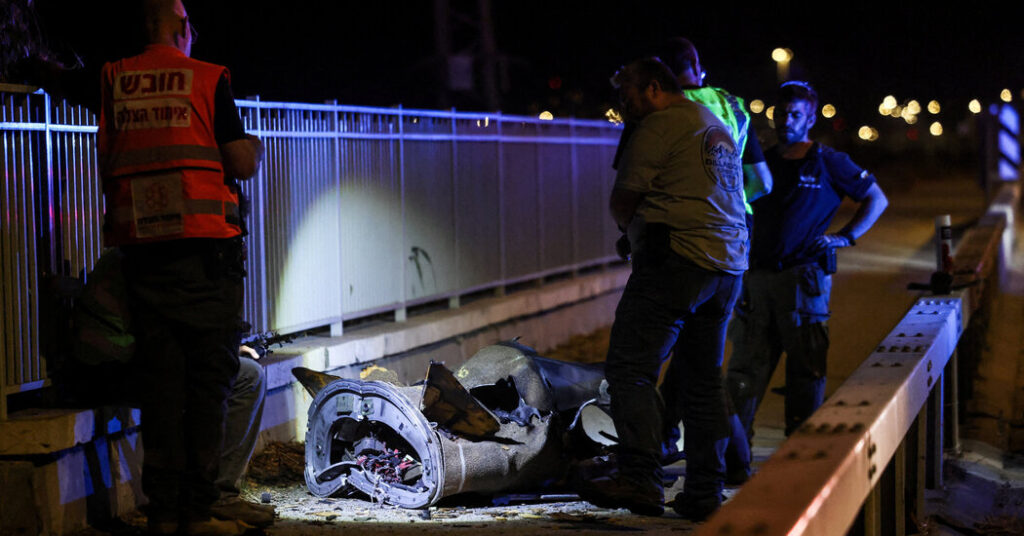
At first glance, Tehran’s retaliation for Israeli attacks in Lebanon might seem like a reckless act that risks rekindling a devastating regional war.
For Iran, those strikes were necessary — part of a more aggressive posturing that marks a strategic shift by its new rulers. For them, the lesson of the war has been that forceful retaliation has allowed them to survive, and even emerge with leverage against their more powerful enemies.
“Iran wants to project strength, and that they have the power to escalate,” said Omid Memarian, an Iran expert at DAWN, a Washington-based foreign policy think tank. “They are sending the message that they are ready to resume war if necessary.”
For the past decade under Iran’s previous supreme leader, Ayatollah Ali Khamenei, Tehran had been more cautious about striking Israel and the United States. In 2020, Tehran pursued only limited retaliatory strikes against Washington after the United States assassinated one of its most powerful military leaders, Qassem Soleimani. And it limited its entire retaliation to strikes on a single U.S. base in Qatar during the 12-day war last June.
In recent weeks, Iranian officials largely tolerated Israeli strikes on its most important ally, the Lebanese militant group Hezbollah. It criticized those attacks, warning that the fellow Shiite Muslim force should be included in the regional cease-fire it agreed upon with Washington in April. Yet as long as Israel’s strikes were contained to southern Lebanon, Iran did not respond.
Iran warned that calculus would change if Israel expanded those strikes to the southern outskirts of Lebanon’s capital, Beirut, where Hezbollah is dominant. On Sunday, Israel did just that.
“Iran’s attack in defense of Lebanon was not merely a military response; it was the formal declaration of a strategic doctrine,” said Sadegh Larijani, the chairman of Iran’s powerful Expediency Council, which advises Iran’s supreme leader.
“If any component of the Axis of Resistance is attacked, the response will extend beyond geographical borders and will alter the regional balance of power,” he said, using Iran’s term for the network of allied militant groups in the region that includes Hezbollah.
With its actions, Iran wants to show it is serious about defending its regional militia allies. That position had been undermined by its former leaders when they refrained from retaliating against Israeli attacks in 2024 that badly degraded Hezbollah and killed its charismatic leader, Hassan Nasrallah.
Since the U.S.-Israeli war began in February and killed much of Iran’s top former leadership, including Mr. Khamenei, Iran’s new rulers believe their willingness to act more aggressively — from blockading the vital Strait of Hormuz to attacking its Gulf neighbors — has been a major success.
To them, analysts say, being more aggressive allowed them to not only survive Washington and Israel’s attacks, but to inflict economic pain and emerge with strategic leverage through control of the strait, a crucial global shipping route for oil and gas.
Iran’s new leaders have also found President Trump more responsive to their more aggressive strategy. Last week, he convinced Israel not to strike Beirut. On Monday, after Israel’s strikes on Beirut’s outskirts and Iran’s retaliation, he called for both sides to step back.
After his comments, Iran’s Revolutionary Guards Corps quickly announced that it would halt its attacks but said it may attack again if Israel pursues strikes in southern Lebanon, a near certainty.
Such strikes may also offer Iran the opportunity to test the relationship between Mr. Trump and Israel’s prime minister, Benjamin Netanyahu, said Mr. Memarian, the analyst.
“They understand there’s a gap between Israeli and U.S. objectives,” he said, “and they want to put pressure on Trump to contain Israel.”
But the defense of Hezbollah is not only about testing or posturing. Iran assessed the group’s ability to continue attacking northern Israel during the recent war as critical to giving Iran room to focus its attacks on its oil-rich Gulf neighbors, said Hamidreza Azizi, an Iranian security expert at the German Institute for International and Security Affairs.
Allowing Israel to weaken Hezbollah further, he said, would therefore be militarily costly for Iran in a future conflict, which it deems inevitable.
Iran also saw its retaliation as necessary, he said, because it views Israel’s attacks as part of an apparent U.S.-Israeli strategy to try to quietly erode its strategic gains in the recent conflict even as it tries to negotiate a deal to end the war with Washington.
For weeks, U.S. forces have been quietly escorting vessels through the Strait of Hormuz. Many analysts describe this as a U.S. attempt to alleviate pressure on the global economy while it tries to increase the economic pressure on Iran by reinforcing its own blockade of Iranian vessels. Iran worries that Israel’s efforts to weaken Hezbollah are another facet of that strategy.
The Iranians believe the United States and Israel “are using the cease-fire to shape the realities on the ground in a way that would erode the leverage Iran has achieved during this war,” Mr. Azizi said.
Tehran’s willingness to retaliate forcefully also shows how unlikely Iran thinks it is Mr. Trump, who is about to host the World Cup games, and faces a deepening global economic crisis ahead of midterm elections this fall, to rejoin the fray.
“They don’t think Trump is going to go to war,” said Farzan Sabet, an Iran analyst at the Geneva Graduate Institute in Switzerland. “But even if he does, they’re fairly confident they can manage it.”
Sanam Mahoozi contributed reporting.
The post Why Iran Risked an Attack on Israel appeared first on New York Times.