The Tony Awards anointed lots of winners on Sunday night. “Schmigadoon!” won best musical. “Liberation” won best play.
Another notable winner, though, was not in the room at Radio City Music Hall: the producer Scott Rudin.
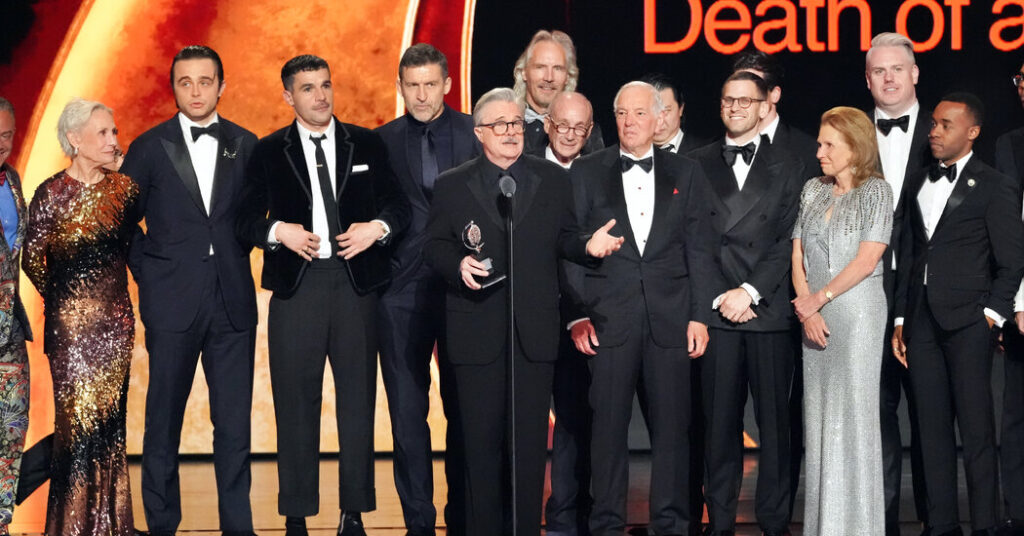
A Rudin-produced staging of the classic Arthur Miller drama “Death of a Salesman” won six prizes — more than any other show — including the award for best play revival.
The victory makes clear what has been obvious for months: Like it or not, Rudin is back.
But the victory also made clear how complicated his return has been. Not one of the six people who accepted the “Salesman” prizes thanked Rudin or even mentioned his name in their speeches. (They had Rudin’s blessing to omit his name, according to a person who worked closely with him.)
“There would be no ‘Salesman’ without Scott Rudin,” Barry Diller, a frequent Rudin backer who joined him as a lead producer on the show, said by email. “‘Salesman,’ with every respect to all, would not be the production it is without Scott Rudin. And I’m disappointed my colleagues did not thank him.”
Until 2021, Rudin had been one of the more powerful, and feared, producers on Broadway and in Hollywood, admired for his taste and tolerated despite his temper. He is among the small number of EGOT winners — people who have Emmy, Grammy, Oscar and Tony awards — and, even before Sunday night, had won 18 Tony Awards for musicals including “The Book of Mormon” and the Bette Midler “Hello, Dolly!” revival and for plays including “The Humans.”
But then a pair of news articles, one in The Hollywood Reporter and one in The New York Times, provided new details about his long-known bullying behavior. His career seemed to implode: He stopped actively producing, resigned from the Broadway League before he could be kicked out and moved out of New York City.
Rudin declined to be interviewed for this article.
Seemingly aware that his comeback is not universally welcome and hoping to avoid becoming a distraction for his shows, Rudin kept a low profile throughout the season.
He did not even show up at the “Death of a Salesman” opening night party at Katz’s Delicatessen in April. Rudin also skipped a variety of awards ceremonies at which “Salesman” was a contender, culminating with Sunday night’s Tonys ceremony; the trophy for best play revival — often accepted by a show’s lead producer — was accepted by its lead actor, Nathan Lane.
There were indications that laying low was a good strategy, given the concern some still have about his behavior. At the Drama Desk Awards last month, boos were heard when Rudin’s name was mentioned.
His comeback has been cautious, but growing in scale and impact.
Early last year, in an interview, he confirmed that he was planning to resume working, but promised change, acknowledging that “I was just too rough on people,” and saying “I have a lot more self-control than I had four years ago.”
Then last fall, he produced a small play on Broadway, Samuel D. Hunter’s “Little Bear Ridge Road,” about an aunt and a nephew in rural Idaho who are trying to reconnect after years of distance. Rudin’s only co-producer was Diller, and the play’s team included the director Joe Mantello and the actress Laurie Metcalf, two longtime Rudin collaborators. The production caused a serious — and contested — rift between Chicago’s Steppenwolf Theater Company, where the play had originated, and Metcalf, a longtime member of the company.
“Little Bear” opened in October to mostly positive reviews, but it struggled to sell tickets and closed early at a loss in December. (It had been capitalized for $4.1 million, according to a Securities and Exchange Commission filing.) But if that was the first test of his return, he passed — there were no protests, no boycotts. And in May, months after it had closed, the show picked up a nomination for the best play Tony Award.
Then early this year, Rudin, again with Diller, produced a new Wallace Shawn play, “What We Did Before Our Moth Days,” Off Broadway at the Greenwich House Theater. That show was also small — just four actors, sitting on chairs and telling a story — and received strong reviews as well. By the time it closed, it had made a 30 percent profit. (It had been capitalized for $1.6 million.)
“Death of a Salesman,” which opened in April starring Lane opposite Metcalf, was a bigger swing. This time co-producers, investors and a full-size cast were involved, meaning more relationships to manage — more opportunities to feel frustrated, more tests of Rudin’s self-control. Again, the reviews were strong, and this time, sales are strong too; it has been outgrossing all of the season’s new musicals. The production reaffirmed Rudin’s reputation for assembling high-quality casts and creative teams, setting high standards for craft and backing strong artistic visions.
Tony nominators clearly loved “Salesman,” which they showered with nine nominations — more than any other play. But within the industry, some thought that Tony voters, many of whom have witnessed Rudin’s behavior, would refuse to vote for the play, and they had a plausible alternative, a well-received new adaptation of “Oedipus.”
The doubters were wrong. “Salesman” not only picked up a Tony for best revival, but also for Mantello’s direction, Metcalf’s performance, and for scenic, lighting and sound design.
It was striking that no one mentioned Rudin’s name while accepting their awards. That was not true for many other shows.
The writer of “Liberation,” Bess Wohl, name-checked each of the lead producers on her play (which beat “Little Bear Ridge Road” and other nominees for best new play). The actress Lesley Manville paid tribute to Sonia Friedman, the lead producer of the “Oedipus” production for which Manville won a Tony. And Lorne Michaels, the “Saturday Night Live” impresario who was a lead producer of “Schmigadoon!,” was the first to speak in accepting the award for that show.
(Mantello, the “Salesman” director, did thank “our producers” from the stage without naming them. After receiving his award, the sound designer Mikaal Sulaiman told reporters in the press room: “I was really lucky that Scott Rudin, the producer, let me come in on Day 1 of rehearsals.”)
Rudin’s rebound is clearly not welcomed by everyone. Some of his former employees remain scarred by his behavior, and angry that he has been allowed to return.
“In my mind, a measly apology masked as accountability doesn’t forgive decades of abuse, but some people seem to just not care about that part,” said Max Hoffman, a former assistant who still works in the industry. “It’s embarrassing that a good number of well-established people in our community will ride long into the night for someone who would never return the favor.”
Rudin has not rejoined the Broadway League, an industry trade association that represents producers, among others. “Little Bear” was produced with an independent contract; for “Salesman,” Rudin was able to use the League’s union contracts because one of that show’s lead producers, Roy Furman, is a League member in good standing.
Rudin, according to those who interact with him, remains demanding, exacting and controlling. And some “Salesman” investors are frustrated that the show, capitalized for $8 million, has not recouped its capitalization costs yet; members of the producing team say they expect it will do so.
Diller said he believed that Rudin had altered his conduct in response to criticism.
“His behavior, in my observation, has truly changed,” he said in a phone conversation on Monday. “While he is certainly still a fierce arguer, and he leaves the tiniest stone turned in every single area of putting on shows, I do believe he did think through all of these issues, and I’ve seen him handle himself in every situation impeccably.”
Now, having survived — even thrived — during his first season back, Rudin has several new stage projects in various stages of development, some of them far more ambitious in scale and complexity.
He has not yet announced any of them, but his production company has posted audition notices for the development of an unnamed show choreographed by Michelle Dorrance with a “swing sensibility and style from the 1930s,” a description that fits a much-rumored new production of the musical “42nd Street.” He also continues to advise Diller on artistic programming at Little Island, a park that opened in 2021 on a pier in the Hudson River.
Malia Mendez contributed reporting.
Michael Paulson is the theater reporter for The Times.
The post He Was a Big Winner at the Tonys, Yet No One Said His Name appeared first on New York Times.