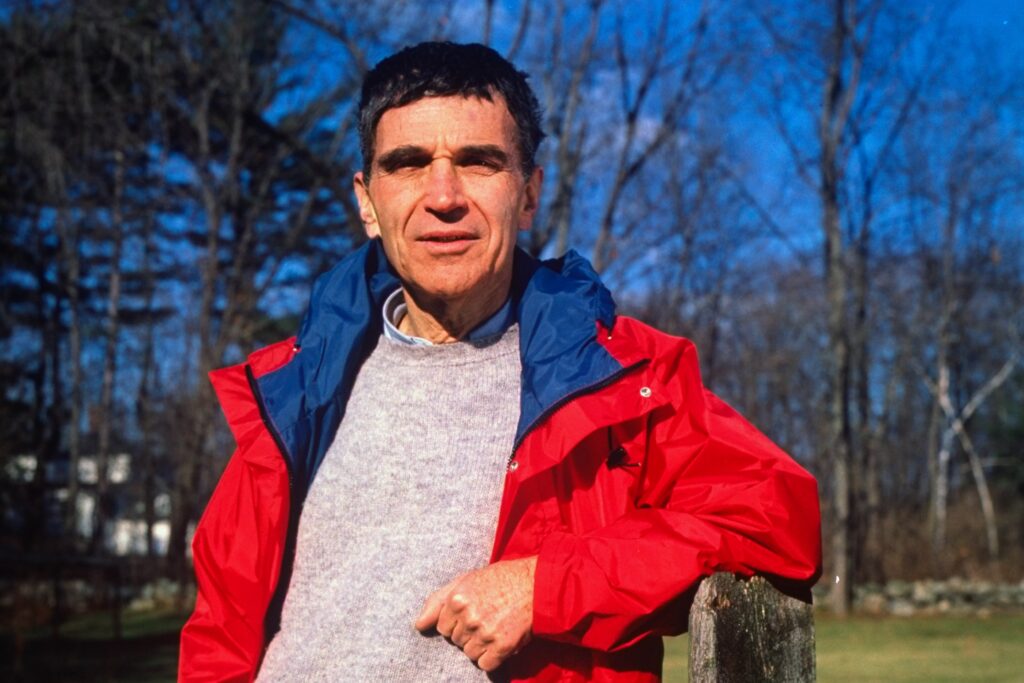
Robert Coles, an eminent child psychiatrist, Pulitzer Prize-winning author and Harvard professor who came to wide renown documenting social and political unrest and its impact on young people, the poor and the vulnerable, died June 4 at a hospice center in Lincoln, Massachusetts. He was 97.
His son Michael Coles confirmed the death.
Dr. Coles — described in a 1972 Time magazine cover story as “the most influential living psychiatrist in the U.S.” — collected some of the highest honors in American public life. He was the author of more than 50 books, with two entries in his five-volume series “Children of Crisis” sharing the 1973 Pulitzer Prize for general nonfiction.
For nearly three decades, he was a professor of psychiatry and medical humanities at Harvard University, and he wrote hundreds of articles in scholarly and mainstream publications. He was propelled as an author, scholar and at times social activist, Dr. Coles said, by his impression of the United States in the 1960s and 1970s as a country in the throes of greater suffering and social and political turbulence than at any time since the Depression.
He challenged his colleagues in psychiatry to step outside their professional cloister and be witnesses to the messy world of crisis in which life actually is lived — only then, he argued, could psychiatry play a useful role in the roiling social issues of the day. “In dwelling too much on the mind,” he told Time, “the mind would become abstracted from the body, from the neighborhood, from the society and — again — from the every-dayness.”
Because of his research, which involved years-long immersion in the lives of inner-city residents and the rural poor, Dr. Coles often testified before and was consulted by Congress on poverty, hunger and migrant workers’ health. At his peak of prominence in the late 1960s and early 1970s, he was credited with helping shape legislation and national policy.
His books were, in large part, oral histories — an approach that differed from that of most academicians. In addition to those of various racial categories, he sought the views of children and adults, liberals and conservatives, employees and managers, and blue- and white-collar workers. Letting people voice their own experiences and concerns would lead to more effective social programs, he argued, by injecting humanity into an often sterile policy debate.
In one of his studies, Dr. Coles quoted one Black woman — only 30 but calling herself “old” and “sick” — critical of the welfare system for what she called its patronizing mentality that robbed her of dignity: “They tell you they want to help you, but if you ask me they want to make you into them and leave you without a cent of yourself to hang on to.”
Of all his endeavors, Dr. Coles was best known for the “Children of Crisis” series. Published between 1967 and 1977, the five books brought journalistic rigor, anthropological research and psychological insight to an examination of America through the eyes of children.
A Boston native with an Ivy League pedigree, Dr. Coles had gone to the South in the late 1950s to fulfill a two-year military obligation as a psychiatrist at Keesler Air Force Base in Biloxi, Mississippi.
In 1960, on one of his regular visits to New Orleans, he happened upon the ugly scene that erupted daily at an elementary school in the city’s working-class Ninth Ward after a federal court ordered the school district to dismantle its system of racial segregation.
Dozens of armed federal marshals were escorting 6-year-old Ruby Bridges through a spitting, screaming mob of White parents as she integrated an elementary school. Artist and magazine illustrator Norman Rockwell immortalized Bridges’s experience almost four years later for Look magazine in his cover painting “The Problem We All Live With.”
Dr. Coles, who had never been exposed to such racial brutality, was so affected by what he had witnessed that he arranged through school officials to talk to the little girl and to her parents. As he later wrote in the Atlantic, he had “wanted to know what a child psychiatrist can learn about the feelings, the fears and hopes of youth in the actual situation of desegregation.”
Not long after getting to know Bridges, he sought out one of her teachers. She mentioned that the child had paused one morning as she entered the school building and said something to a woman who had spat at her and a man who had shaken his fist in her direction.
When Dr. Coles later raised the question with Bridges during one of their conversations over a two-year period, the first-grader told him she had not spoken to the protesters. She said she was talking to God, praying for the people in the street. When he asked her why, she responded, “Don’t you think they need praying for?”
“Can you imagine? A child praying for those who threaten to kill her?” Dr. Coles later told the Baltimore Sun. “It really got me going. I wondered what was going on in her mind. Here was this child, all alone, going through this terrible crisis. And I just thought, ‘God, what is she feeling?’”
That moment, he said, inspired him to devote his life to “trying to find out how children get on in the world.”
With the encouragement of Jane Hallowell Coles, his future wife and frequent collaborator, Dr. Coles conducted studies of school desegregation while living in cities and towns throughout the South for four years. He spent the summer of 1964 in Mississippi and narrowly escaped the dynamiting of a home used by Freedom Summer activists.
The Coleses spent days with the children, observing them in their homes, in their schools and where they played. With a ready supply of crayons and chalk, they invited the children to draw pictures and then encouraged the young artists to talk about what they had drawn. Despite the turmoil they experienced attending newly integrated schools, he found them unexpectedly well-adjusted.
“They have few temper tantrums or troubles in learning. They usually eat and sleep well,” he noted in the Atlantic. “During the worst heckling of the crowds which surrounded the schools and intimidated many of their classmates, they had the quiet support of the school routine, and they were closer than ever before to their parents.”
His first book in the “Children of Crisis” series, “A Study of Courage and Fear” (1967), featured the story of Bridges and examined the experiences of children, Black and White, growing up during school desegregation in the South. Dr. Coles’s two 1971 follow-ups — “Migrants, Sharecroppers, Mountaineers,” about the children of the Southern rural poor, and “The South Goes North,” about urban slums — collectively brought him the Pulitzer.
His final two volumes in the series, both published in 1977, were “Eskimos, Chicanos, Indians” and “Privileged Ones: The Well-Off and the Rich in America.” The latter volume, he once told the New York Times, was sparked by a child who remarked to him, “The rich folks are the ones who decide how poor folks live.”
Dr. Coles went on to write best-selling books about the moral intelligence and spiritual life of children, and their ability, whatever their background, to transcend challenges imposed on them by their environment.
“He was one of the key creators of a serious and humane psychology as applied to social issues, something that had always eluded psychoanalysis and a usually self-oriented psychotherapy,” Robert H. Abzug, a historian at the University of Texas at Austin, said in a 2023 interview for this obituary.
James Clark, author of a forthcoming biography, said Dr. Coles’s work, particularly his efforts to understand the roots of social conflict, continues to be relevant in contemporary debates.
“Coles emphasized the need for clinicians and researchers to respect the subjective experiences of people,” said Clark, a former dean of Florida State University’s College of Social Work. “Coles reflected this openness as he studied the moral lives of ordinary people.”
Driven to help
Robert Martin Coles was born in Boston on Oct. 12, 1928, the elder of two boys. His father was a steamfitter from England, and his mother, a homemaker, was the Iowa-born daughter of an Episcopal minister. Religious and artistic, she encouraged her sons to read.
Robert grew up in the Irish working-class neighborhood of Dorchester and attended Boston Latin School, where he ran track, played tennis and edited the school’s literary magazine. He majored in English at Harvard and had vague notions of becoming a teacher until one of his professors encouraged him to send a junior-year paper he had written about William Carlos Williams to the renowned New Jersey poet and physician.
Williams scrawled a reply on the back of a prescription form, “Pretty good for a Harvard student,” and encouraged him to visit.
In his senior year, Dr. Coles accepted Williams’s invitation to accompany him on his house calls to poor and working-class patients. He watched Williams listen to their concerns as he checked their temperature and blood pressure, and he never forgot Williams’s admonition to “go out and find people in the world that you can help.”
Dr. Coles graduated from Harvard in 1950 and, thanks in part to a letter of recommendation from Williams, was accepted at Columbia University’s medical school. He also volunteered at a Catholic Worker “house of hospitality” for the destitute operated in Manhattan’s Bowery by social activist Dorothy Day. (He later wrote two books about her.)
After first studying pediatrics, he shifted his focus to psychiatry and received a medical degree from Columbia in 1954. During residencies, he found he got on well with children but was not “tough enough” to even administer shots. “The child would cry,” he told the Times, “and I would try to comfort him, and then I would be fighting back my own tears.”
He eventually turned to child psychiatry, largely because of his encounter with Bridges but also through his exposure to the writings of Anna Freud (Sigmund’s daughter), a British psychoanalyst who had worked with war-scarred children in London.
Dr. Coles’s book “Still Hungry in America” (1969) — with Al Clayton’s photographs of families across Appalachia and the Deep South suffering from malnutrition and food insecurity — provided devastating evidence of want in the richest country on Earth. He also spent extended periods in coal country and became a prominent advocate for miners suffering from black lung disease
In the course of his field work, Dr. Coles met with radicals, reformers and political dissenters. The anti-Vietnam War priest Daniel Berrigan hid out in the Coles household in Concord, Massachusetts, while on the run after being convicted of burning draft records.
In addition to the Pulitzer, Dr. Coles was awarded a MacArthur “genius” grant in 1981, the Presidential Medal of Freedom, the nation’s highest civilian honor, in 1998, and the National Humanities Medal in 2001. He contributed articles to the Atlantic, the New Yorker, the New York Review of Books, the New Republic and other publications, and he taught at Duke University and the University of North Carolina at Chapel Hill while also on the faculty at Harvard, where his classes drew hundreds of students.
Although his most abiding interest was the formation of character in the young, he also explored topics as disparate as the works of French philosopher Simone Weil and the music of Bruce Springsteen, with whom he had bonded over their shared sympathy for the dispossessed.
Dr. Coles and his wife were married for 33 years, until her death in 1993. After retiring from Harvard in 2003, he continued living in the longtime family home in Concord, a quick bike ride from Walden Pond.
Survivors include three sons, Daniel, Robert and Michael Coles; and four grandsons.
Dr. Coles’s unconventional approach to psychiatry and the many books that grew out of his extensive interviews occasionally drew negative reviews. At Harvard, he was sometimes mocked as Robert “Never an Unpublished Thought” Coles. Some critics accused him of allowing his subjects to go on too long without his authorial reflection or interpretation, of failing to synthesize or evaluate.
But he considered listening an undervalued virtue, especially where children were concerned. Allowing them to express their hopes, sorrows and frustrations, he said, would ultimately improve their lives and society as a whole.
“I’m afraid I’m not a very good grown-up,” he told the Sun. “My wife has always felt I’m more comfortable with children than grown-ups. … I teach a fourth-grade class in a public school once a week — I teach them my version of art history — and I just love sitting in those little chairs.”
The post Robert Coles, Pulitzer-winning psychiatrist who shaped public policy, dies at 97 appeared first on Washington Post.