The cartel of influential oil-producing nations known as OPEC Plus on Sunday agreed to increase production by 188,000 barrels per day in July as the United States and Iran struggled to reach an agreement to end the war and fully reopen the Strait of Hormuz.
The move was the latest pledge in recent months by the group, the Organization of the Petroleum Exporting Countries, to step up output. In normal times, an increase by OPEC Plus countries would help push prices lower. But the effective shutdown of the strait has stranded a vast portion of the world’s daily oil supply, making the increase largely symbolic.
“The countries will continue to closely monitor and assess market conditions,” the consortium of oil-producing nations said in a statement, and noted “the importance of adopting a cautious approach.” The decision followed a meeting, conducted remotely, of the OPEC Plus countries, which include Algeria, Iraq, Kazakhstan, Kuwait, Oman, Russia and Saudi Arabia.
The war in the Middle East, which started with U.S.-Israeli strikes on Iran on Feb. 28, followed by Iran’s closure of the strait in retaliation, has sent oil and gas prices soaring, stoked worldwide fears of inflation and left countries scrambling for alternative energy supplies.
Ships transiting the strait, a narrow route to the Persian Gulf on Iran’s southern border, had ferried about one-fifth of the world’s energy supply before the war. In response to the waterway’s effective shutdown, Saudi Arabia, Iraq, the United Arab Emirates and Kuwait have been forced to slash crude production.
The conflict has not only rocked the global economy but also tested political relations in the Persian Gulf. In May, the Emirates decided to leave OPEC, dealing a blow to the Saudi Arabia-led oil cartel. The Emirates, which was the third-largest OPEC oil producer with capacity to drill more, had for many years expressed dissatisfaction with the group’s production quotas.
The increased production in July is part of a decision that OPEC made in 2023 to gradually reverse a 1.65 million barrel per day production cut to which the then-eight members had previously agreed.
In May, OPEC Plus announced a modest 188,000 barrel per day increase; before that, the group had said it would raise oil production quotas by 206,000 barrels a day.
Jacques Rousseau, managing director for global oil and gas at ClearView Energy Partners, a Washington-based research firm, said the new production boost means little.
“Everything is in a waiting game until the strait reopens,” Mr. Rousseau said, adding, “These barrels, most of them aren’t even coming to the market because for Saudi Arabia, Kuwait and Iraq, and previously the U.A.E. before they left, these barrels have nowhere to go.”
The longer the Strait of Hormuz remains closed, the longer it will take global inventories of oil to be replenished, potentially leading to continued higher prices, experts say.
The International Energy Agency reported in May that the closure was causing a “staggering” loss of oil supply.
Before the war, OPEC countries supplied more than a quarter of the world’s oil. Now, output is at its lowest levels in more than 35 years, the agency said.
The fossil-fuel supply shock has prompted many countries to say they want to accelerate the development of domestic renewable energy sources to ensure their national security.
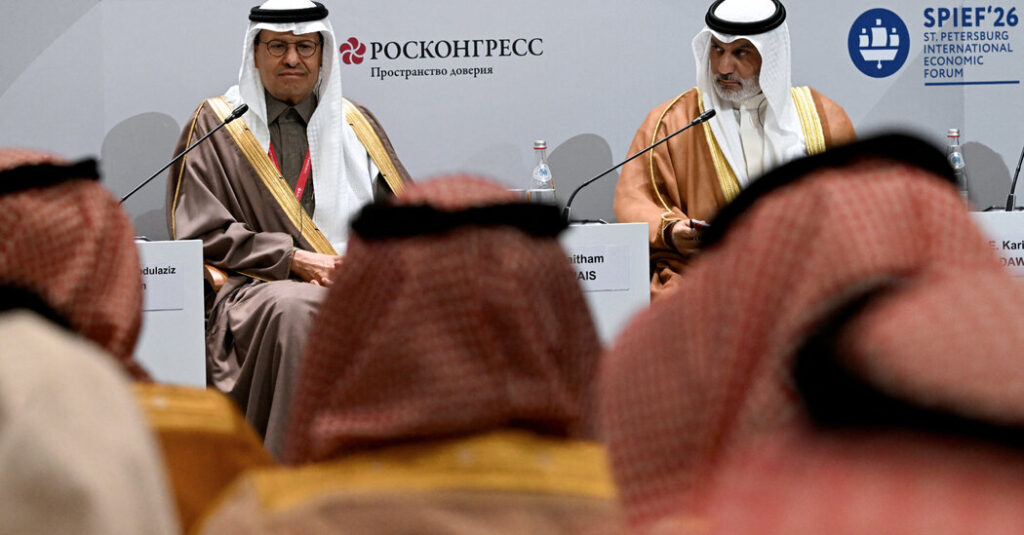
Haitham Al Ghais, the secretary general of OPEC, insisted this week that demand for oil has not waned.
“Despite all the commentary out there that oil demand is declining, we have not registered signs of that yet,” Mr. Al Ghais said at the St. Petersburg International Economic Forum.
Lisa Friedman is a Times reporter who writes about how governments are addressing climate change and the effects of those policies on communities.
The post OPEC Plus to Boost Oil Production as Ceasefire in Iran Remains Elusive appeared first on New York Times.