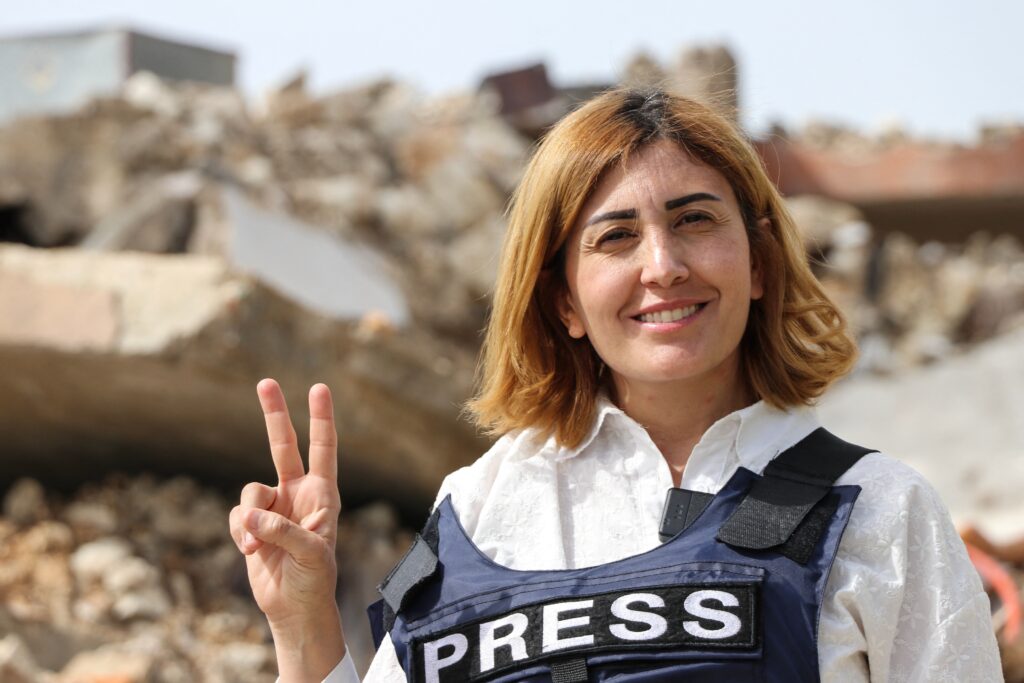
BEIRUT — For two hours on April 22, rescuers waited five miles away from where Lebanese journalist Amal Khalil was taking refuge, injured and bleeding but still alive inside a building that had been leveled by an Israeli airstrike.
Responders from the Lebanese army, Civil Defense and Red Cross awaited clearance from international intermediaries. But the Israel Defense Forces was not giving the green light, according to two people familiar with the approval discussions who spoke on the condition of anonymity to discuss sensitive details.
The rescuers first approached the building just before 6 p.m., but they retreated when a stun grenade went off near the team. By the time the IDF sent approval to intermediaries, at roughly 8:15 p.m., Khalil, 42, had succumbed to her injuries.
Medical records list her time of death as 7 p.m.
In a statement that evening at 8:26 p.m., the Israel Defense Forces wrote on Telegram that it was not “preventing rescue teams from reaching the area” and that it “acts to mitigate harm to [journalists] while maintaining the safety and security of its troops.”
News of Khalil’s situation had spread that afternoon, and organizations like Reporters Without Borders had publicly called for the international community to pressure the Israeli military to allow rescuers to reach her.
A Washington Post reconstruction of Khalil’s final hours — drawn from medical records, call logs, satellite and ground images, along with 17 interviews with survivors, witnesses, first responders and military officials, some of whom spoke on the condition of anonymity to share sensitive details — found that rescuers were denied access to Khalil during a crucial period when she was still alive.
Khalil was killed by the third of three successive Israeli airstrikes.
The first strike hit a car driving in front of her, the second destroyed her car as she hid nearby, and the third collapsed the building where she had taken shelter with another journalist.
Satellite images taken the next morning show what was left following the trio of strikes: a field of broken concrete, dust sprayed more than 200 feet in one direction. Other imagery shows the gutted shell of her car still sitting in the street.
Several press freedom and human rights advocacy groups have condemned the attack, saying the strike on a journalist and the denial of medical access constitute war crimes under the Geneva Conventions.
UNESCO’s Director General Khaled El-Enany called for an investigation into Khalil’s death, saying in a statement, “Journalists play a crucial role in ensuring the flow of information essential for peacebuilding in conflict situations,” he wrote. “Their protection is paramount for all parties.” The IDF has said it does not target journalists.
Of the 21 journalists and media workers killed worldwide in 2026, Khalil is the ninth to have died in Lebanon, according to the Committee to Protect Journalists (CPJ). In 2025, a year when a record 132 journalists were killed, a majority of the deaths were concentrated in Gaza. CPJ found that Israel was responsible for two-thirds of the deaths.
This isn’t the first time Israel has prevented emergency services rescuing journalists injured from their strikes, said Jodie Ginsberg, CPJ’s chief executive.
In December 2023, rescue workers spent five hours trying to reach Al Jazeera cameraman Samer Abu Daqqa after he was wounded in an Israeli drone strike near a U.N.-run school sheltering displaced Palestinians in Khan Younis in the Gaza Strip. Abu Daqqa bled to death before rescuers could reach him, The Post reported at the time.
“Journalists are civilians and protected under international law. Israel’s blatant disregard for such norms — and the international community’s failure to hold them accountable — is abhorrent,” Ginsberg wrote in a statement.
The IDF said in a statement that it is investigating Khalil’s death, but it claimed that two men accompanying Khalil — Ali Nabil Bazi and Mohammed Al-Kourani — were Hezbollah military operatives who were the target of the strikes. Ali was a Hezbollah-backed mukhtar, or local mayor, in a town in southern Lebanon, according to his relatives.
The IDF did not provide evidence that the men were Hezbollah military operatives and did not comment when asked about the reason for the second and third strikes, after the initial targets were hit. The IDF said it “regrets the injury to the journalist and views the incident with the utmost seriousness.”
In the early afternoon of April 22, two cars drove into al-Tiri, a Lebanese village about four miles from the country’s border with Israel.
Israel had issued evacuation warnings for large swaths of southern Lebanon, including al-Tiri. More than 1 million people across the country have been displaced, according to the Lebanese government.
Thousands of buildings have been damaged and more than 3,500 people have been killed since the fighting began, according to Lebanon’s Health Ministry, which does not distinguish between combatants and civilians.
Khalil — who was from southern Lebanon — rode in one of the vehicles with Zeinab Faraj, a 21-year old visual journalist. They were on assignment for the pro-Hezbollah Lebanese newspaper Al-Akhbar to cover the ongoing hostilities between Israel and Hezbollah.
Faraj filmed the destruction of al-Tiri with her cellphone as they drove by flattened structures peppering green fields, she said in an interview from her hospital bed.
Earlier that day, Khalil and Faraj had left the port city of Sidon, driving south to a hospital in Tebnine and then on to Kounine. They aimed to document the impact of Israeli airstrikes and controlled building demolitions, which resumed in early March after Hezbollah retaliated for the U.S.-Israeli joint attack that killed the Iranian supreme leader, Ayatollah Ali Khamenei.
Inside the other vehicle were Faraj’s cousin Ali and his friend Mohamad, who joined the journalists in Kounine. Along the way the small crew stopped to take pictures with flowers, Faraj recalled. On the way to al-Tiri, the men drove in front.
At about 2:30 p.m., Faraj heard an airstrike and Ali and Mohamad’s car suddenly exploded with a flash of red, she said. Neither man survived the bombing.
Terrified, Faraj and Khalil ran out of their car to shelter on the porch of a nearby building. “Amal was holding me the entire time,” Faraj remembered, as the two journalists huddled together for safety.
Khalil frantically dialed a close friend, journalist Jamal Ghourabi, pleading for help. He called the Red Cross immediately, he said.
Faraj and Khalil began calling anyone they thought could help rescue them: the Lebanese army, the Red Cross and the United Nation’s peacekeeping force UNIFIL.
At 2:56 p.m., Khalil sent a voice note to her brother, Ali Yousif Khalil. “They hit a car that was driving in front of us. But don’t worry, nothing happened to us,” she said in the recording reviewed by The Post.
Speaking rapidly and clearly, she told him they were waiting for the Red Cross and UNIFIL as a precaution, but that she was unharmed. “I’m okay, my loves, do not worry. I am good.”
A representative for UNIFIL said the Red Cross first contacted the agency with a planned route just before 3 p.m. UNIFIL, which facilitates safe passage for rescue crews, immediately passed the information, including the location of the entrapped journalists, to the Israeli military.
Around the same time, the Lebanese army contacted an international committee known as the ceasefire mechanism, which is in charge of enforcing a 2024 Israel-Lebanon ceasefire and relays information between Lebanese and Israeli forces to coordinate safe routes for rescuers, a spokesperson for the army said.
The ongoing warfare in southern Lebanon and the bureaucratic approval process has made it difficult and dangerous to rescue injured civilians, according to civil defense officials. Hussein Fakih, who oversees the group’s operation in the area where Khalil was killed, said “maybe one permission” comes through in every 10 rescue operation requests.
Without a cleared route, the rescuers waited. Around 4 p.m., roughly an hour after the first strike, a second strike hit the journalists’ car, which sat parked in the street, feet from where they hid.
An image of a hatchback sedan, singed white from the explosion, circulated on social media the next day. It sat amid a sea of shattered blocks of concrete in front of the building where the journalists hid. Downed wires in the photo canopied the street, tangled in low tree branches.
Faraj said the sedan was roughly in the same place as the car she and Khalil fled, which The Post confirmed through geolocation.
Khalil used her body to shield Faraj from the waves of fragments. They were panicked from the deafening noise and bright flashes, Faraj recalled.
“The sound was horrifying and scary. The whole world around us lit up in red,” Faraj said. After the explosion, the only sound was the continual buzz of a drone circling above, she said.
The two journalists shook with fear as they stumbled from the porch inside the building. Khalil was injured and bleeding, Faraj remembered.
Just before 4:22 p.m., Khalil called her sister, phone records reviewed by The Post show. It was the last call she would make.
“The army and others were telling us they cannot approach to rescue us,” Faraj recounted. “I am in my country, and my state and government cannot get in to take me out because Israel would not let them.”
Faraj was starting to feel faint, she recalled. The women’s phones died. The two stopped talking for stretches of time. “Amal would get close and hold me, telling me, ‘Don’t leave me.’”
Roughly five minutes after Khalil called her sister, a third strike hit. The force of the blast blew them apart. It was about 4:27 p.m. — nearly two hours since the first strike — according to Ghourabi, Khalil’s journalist friend, who was staying in the nearby town of Tebnine and heard the explosion.
A photograph taken by another journalist from several miles away shows smoke coming over the hillside.
The building where the two journalists were hiding crumbled, according to satellite imagery taken the next day. Dirt and debris sprayed in multiple directions, coating the road with ashen dust, according to the images.
Red Cross management said its vehicles departed for the scene just before 5 p.m., after UNIFIL confirmed a safe route. The IDF acknowledged the request around this time, the representative for UNIFIL said, but it had not yet granted safe passage for the rescuers.
It was slow going. The first rescuers from the Red Cross and the Lebanese army reached the scene about three hours after the journalists first called for help.
Rescuers quickly found Faraj, who said she had been propelled into the street by the third blast, and the bodies of the two men. They lugged Faraj and the men’s bodies into two Red Cross vehicles.
Shortly before 6 p.m., a stun grenade detonated, sending dust flying, and other explosions boomed, a spokesperson for the Red Cross said.
The cacophony led the Lebanese army and Red Cross vehicles to retreat with Faraj and the two bodies to a hospital in the nearby town of Tebnine. The Lebanese army spokesperson said they pulled back because it “was a message” to leave.
News of the trapped journalist spread. Reporters Without Borders said it contacted the IDF. An Israeli army spokesperson replied, “I’ll look into it,” at 6:30 p.m., according to RSF.
Rescuers again waited for coordinated clearance from the international committee or UNIFIL. As the sun lowered in the sky, Lebanese military officials, along with the country’s civil defense and Red Cross, decided they could no wait longer, the army spokesperson said.
Not long after the rescuers started down the road, they heard it would be safe to proceed, the army spokesperson and Fakih, from the civil defense, recalled.
Two people familiar with the approval conversations between the IDF and the international committee, including the spokesman from the Lebanese army, said it took the IDF more than two hours to grant permission for the rescuers to return.
At about 8:30 p.m., the army, civil defense and Red Cross entered the area with two ambulances, a rescue car and two excavators, Fakih said.
They trained the headlights of their vehicles on the debris and peered through cracks in the building rubble with flashlights, looking for a sign of the missing journalist. The roof of the building had collapsed. Jagged slabs of concrete carpeted the street, video and photos of the scene show.
For hours, the crew used an excavator to dig. They glimpsed Khalil’s body after 11 p.m. A column had fallen on her. She was dead.
Medical records reviewed by The Post say Khalil died at 7 p.m., while the first responders waited.
Kelly and Nover reported from Washington. Joyce Sohyun Lee in Washington, Imogen Piper in London and Lior Soroka in Tel Aviv contributed to this report.
The post An airstrike trapped a journalist. She died as rescuers waited for permission to save her. appeared first on Washington Post.