I’m a disabled veteran in a relationship with someone who has just been diagnosed with Stage 4 breast cancer. We first met about 10 years ago, as I was getting divorced, and we became friends. Eventually we started dating and moved in together, but it soon became apparent that we were incompatible in all sorts of ways. We parted on fair terms and remained in contact. I moved into my own house one city away with my daughter.
Over time, my disabilities took a toll, and I came to need modest assistance to remain active and navigate life. After my daughter went away to college, I became mostly homebound. I have no support network, no friends or family; I am tuned to care for others and chronically neglect myself. About a year and a half ago, my ex got a job in my city. She needed somewhere to live, and I needed someone to help me. We decided to live together with a clear agreement over roles and responsibilities. (I wanted a one-year lease; she persuaded me to do a two-year one.)
Within six months, it was clear that our incompatibilities remained. The help I was promised never materialized, and I realized I had been optimistic in perceiving certain improvements in her maturity and attitude. We agreed to part ways when the lease was up. Relationshipwise, though, things have remained blurred. We’ve been occasionally physically intimate and intermittently romantic, though I have always been clear that I was not pursuing marriage or even a formal relationship.
Now, six months from the end of our lease, she has been diagnosed with cancer. She is now expecting me to care for her full time until she dies. (Her family isn’t expected to provide any practical assistance.) I care deeply about her, and I am currently committing all my resources to her. But I don’t have the financial or physiological capacity or, if I’m being honest, a compelling personal interest in taking on this role. (I’m on a fixed income and guard my meager means, while she is a dedicated consumer with no savings.)
Part of me sees the decision to part ways as one that was already made, clearly and mutually, months ago. Another part of me recognizes that walking away is loathsome and something most people would judge harshly. Will you offer guidance? I am quiet and conflict averse. — Name Withheld
From the Ethicist:
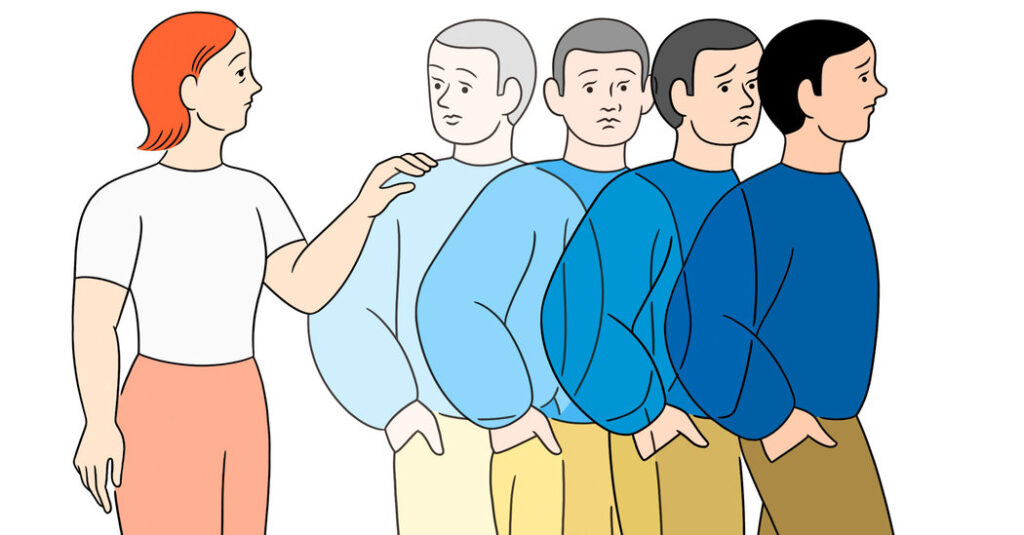
Treat this as a stark “either-or,” and you can give yourself permission to walk away without a backward glance. You’re obviously in no condition — physically, monetarily or emotionally — to be this person’s everything. Your understanding with her is rather complicated, to put it mildly: You believe that you’ve kept your part and that she’s being unreasonable to expect you to devote yourself to her as she navigates the shoals of metastatic cancer. Yet the choice isn’t, or shouldn’t be, all or nothing.
Given your concern for her, there are all sorts of ways you can be helpful without being any kind of partner to her. You evidently have familiarity with the medical world and could probably help her find an oncology social worker, assist her in filing for disability and so on. (People can, thankfully, live a long time with Stage 4 breast cancer.) You can stick to the boundaries you’ve established and still be someone who cares about what happens to her. If you don’t feel able to drive her to appointments or stay with her during treatments, say so up front. You’re allowed to put yourself first, by “airplane oxygen mask” logic, and should be very clear that you can’t be her caretaker.
What worries you, at least in part, seems to be your own difficulty in remaining resolute when you’re with her. You see her as someone who negotiated a one-year lease into a two-year lease. But I wonder whether your failure to stand up for yourself in the past is leading you to take an excessively absolutist stance today. You say that when you started cohabiting again, you realized she hadn’t really changed. The question now is: Can you? Husbanding your resources and protecting your own welfare doesn’t have to mean walking away. See if you can’t find a way to be firm but kind.
Readers Respond
The previous question was from a reader who worried that a family member was being pressured into donating a kidney. He wrote:
A 22-year-old in my family is being evaluated as a living kidney donor for a man he barely knows (a colleague of his stepfather’s). From what I can tell, the stepfather suggested him as the donor, and the process accelerated quickly from there. This young person is kindhearted but somewhat vulnerable and eager to please. He has embraced this as a “selfless act,” but I worry that such framing, combined with strong family encouragement, may be substituting for a fully independent choice. … At the same time, his father, in poor health, has told him to “save” the kidney for him — another form of pressure pulling in the opposite direction. … This feels less like a free choice and more like a young person being pulled by competing agendas. Is there a responsible way to intervene? Or is this something I have to accept? — Name Withheld
In his response, the Ethicist noted:
Transplant programs are supposed to assign an independent advocate (or advocate team) to a living donor, who must also undergo a psychosocial evaluation. The fact that this young man is being pressured by his stepfather to donate a kidney to the stepfather’s friend, while his father is urging him to “save” it for him, is very much the sort of thing that the advocate and the people doing the psychosocial evaluation should know about. The circumstances you describe don’t mean he is incapable of consenting freely. Still, you’re not wrong to be concerned. Your role isn’t to argue for or against the donation. If you can speak with him, ask whether he has discussed these pressures with the advocate and evaluators. You can also make plain that he can stop the process at any point, and that he owes no one an explanation if he does.
(Reread the full question and answer here.)
⬥
Immediate intervention is warranted here. Speak to the young man, set out the scenario from your point of view and try to accompany him to an interview with the donor advocate, in case he is unable to lay out the situation himself; it’s clear he is confused and torn. As to the biological father’s request to “save” the kidney for him: Knowing his son’s sensitivity and vulnerability, he may actually be using it as a ruse to counter the stepfather’s pressure. It would provide a plausible excuse for the young man to deny the stepfather’s dubious request and shut down the conversation. I am very much in favor of organ donation, but 22 is far too young to make such a life-determining decision that will impact not only him but the family he may raise — and certainly not to benefit a stranger. — Mary Jane
⬥
If the potential donor is not totally comfortable with either donation, the transplant team will tell everyone that he was not a good match. No one except him and the team will know that the reason he was not a good match was that he wasn’t totally comfortable. The teams are well aware of the extreme pressure that can be put on a potential donor and how difficult it can be for the donor to say, flatly: “No, I won’t donate.” — Ann
⬥
Just want to share a personal experience in our family. Although the majority of donors have no issue with having only one kidney, this did not work out for my sister, who donated a kidney to a work colleague. Owing to an undiagnosed condition, her remaining kidney did not take over for the missing kidney, and she is now in kidney failure. Although she went through lots of testing before the donation, it did not reveal the issue. It is rare but something a donor should be aware of. Nobody should be guilted into giving a kidney. — Dominique
⬥
If the young man responded that he had discussed the donation with an advocate, would that relieve the writer’s doubts? I don’t believe it should. The process sounds completely compromised, and the donor should not be considered capable of giving informed consent under the described circumstances. I don’t believe the donation would be moving forward if the transplant team were aware of what was going on. The letter writer should bring up their observations directly with a liaison for the medical team. — Alexander
⬥
As a kidney donor myself, I’d like to assure the letter writer that transplant programs (at least at the hospital I used) are very scrupulous about investigating the potential donor’s motives and the possibility that they are being coerced into donation, especially in situations involving family members. It’s shocking to me that both the stepfather and father are placing such an emotional burden on this young man, as if he existed to provide spare parts. If the transplant program rejects this potential donor for medical, psychological or any other reason, they will not reveal why, but only report that the donor is unsuitable for this recipient. — Peggy
The post My (Sort of) Ex Has Cancer. Is It Fair That She Expects Me to Take Care of Her? appeared first on New York Times.