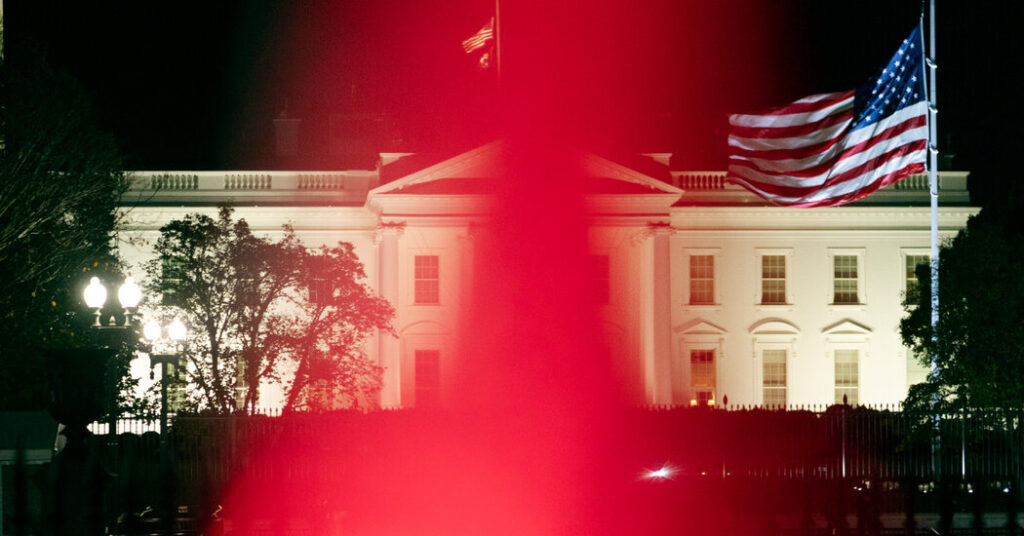
“They walk among us.” The glowing green letters emerge ominously against a dark backdrop. Above them hover the words “aliens” and “declassified,” suggesting the release — long awaited in some corners of the internet — of secret government files concerning extraterrestrials. Slowly, tantalizingly, more text appears: “For 60 years, the U.S. government has kept a closely guarded secret.” Then the big reveal: It’s not the trailer for a horror film; it’s a White House web page, posted last Thursday. And scary creatures in question aren’t extraterrestrials; they’re the other kind of aliens — the immigrant kind, the kind hunted by ICE.
“Aliens have been walking among us, living in our neighborhoods, and interacting with us in our daily lives,” the page announces. “They’ve shopped in the same stores, attended the same classes as our children, and lived seemingly normal human existences.” That’s the joke: Human beings are described as nonhuman invaders. Fascism, but make it a troll.
This web page, which invites users to look up the number of immigrants supposedly arrested on charges of criminal activity in American cities and towns, belongs to a subgenre of Trumpian gestures that are menacing and sophomoric at the same time. “Grotesque and terrifying and juvenile,” is how Ernesto Verdeja, a genocide-prevention expert at the University of Notre Dame, described it to me. These gestures are hard to write about: The ugliness is undisguised, so what is there to say? And yet, these statements, step by preposterous step, change the world we live in.
With phrases like, “They do not belong here” and, “Deport them all,” the page struck me as an incitement for Americans to commit acts of violence against immigrants. But Benjamin Valentino, a professor of government at Dartmouth College, thinks that the purpose of the page is not to get Americans to do anything: It’s to get them to do nothing, while the government commits its campaign of cruelty against millions of people just trying to live in peace. “They want a majority of the population to turn their backs,” he said. “That’s all that’s necessary.”
Valentino co-founded the Early Warning Project, which assesses the risk of mass atrocities around the world. To be sure, anti-immigrant violence in the United States does not approach the scale of the atrocities Valentino usually studies. But the dehumanizing language of the sort used by the Trump administration is, he said, “a pretty standard indicator” of risk, a necessary if insufficient condition of mass violence directed at a particular group.
“It’s not that it turns normal people into murderers,” Valentino said. “It’s that it turns them into bystanders.”
To the extent that the Trump administration has pulled back on its violent anti-immigrant campaign, it has done so because nonimmigrants have stepped up — in the courts and, especially, in the streets. The most dramatic confrontations took place this past winter in Minneapolis, but in the months since the federal government ended its occupation of that city, resistance has continued. In Newark, N.J., demonstrators have been protesting the conditions at the Delaney Hall ICE detention facility. At least 63 people have been arrested in the past week alone. In New York City, a relatively new coalition called Hands Off NYC has, since January, trained more than 7,000 volunteers to peacefully resist ICE. The Aliens web page, Valentino thinks, is intended to discourage this kind of activity.
“The key is that you are supposed to see your city with a big red dot over it,” Valentino said, referring to a map on the website, then click to read, supposedly, the number of immigrants who have been charged with crimes. (For example, “Jamestown, N.Y.: 10; Larceny, Obstructing the Police; Ecuador, Guatemala, Mexico, Nigeria.”) “And you see the charges — do you want to risk your life for this kind of person?”
When the page went up, the American Immigration Council, a pro-immigration advocacy organization, happened to be hosting a gathering of data experts. Participants thought they saw something interesting. “The page is poorly coded, badly designed, and yet weirdly transparent about some things the administration hasn’t been transparent about before,” Aaron Reichlin-Melnick, a senior fellow at the council, told me. It appeared that the map was based on raw data of ICE arrests — information that the government had mostly kept secret since the beginning of President Trump’s current term. The map is possibly the best document to date of the scale of the ICE campaign, which, it shows, has raged not only in big cities but in small towns, where it’s sometimes less visible.
As is usual for the Trump administration, the figures are decontextualized and misrepresented. In addition to the map, the page contains a supposed tally of “encounters,” a term that has one meaning in 1970s sci-fi and another in Customs and Border Protection-speak, where it typically refers to instances in which immigrants are apprehended. What struck me after spending too much time staring at the page was that it wants you to be afraid of all aliens: the space kind and the “illegal” kind, but also the “legal” kind, foreign-born people who have been living in this country for decades. As for the counter, it’s tracking nothing. The numbers just tick upward at a perfectly steady pace, one every second and a bit.
Underscoring the sophomoric aspect of this astonishing document is the fact that it’s shot through with references to “The X-Files.” I caught only one of them: The last lines say, “The truth is no longer out there. It’s right here. Right now” — a nod to the show’s tag line. Ernesto Verdeja, the Notre Dame professor, grew up with the show, so he pointed out some other echoes, such as the combination of interplanetary warfare and a deep-state conspiracy. But superimposed on all that pop culture are the white supremacist tropes. The sentences about aliens “walking among us, living in our neighborhoods,” Verdeja said, read to him like invocations of the Great Replacement theory, which has become so familiar as to seem almost mainstream. “It’s similar to the way Jews were talked about in Europe in the 1920s and ’30s,” Verdeja said.
He made the comparison gingerly, wary of falling into an alarmist cliché. But the ideologues of Trump’s immigration policies are taking no such pains. A couple of days after the “Aliens” page was published, Gregory Bovino, the former head of the U.S. Border Patrol who oversaw the federal immigration operation in Minneapolis, traveled to Portugal for a meeting of far-right politicians to discuss “remigration,” a concept that refers to the forcible displacement of millions of people on the basis of their ethnicity in the wake of World War I — what we now call ethnic cleansing.
Driven by the same nativist and xenophobic ideas, the United States adopted the Immigration Acts of 1921 and 1924, which ended mass immigration by introducing national-origin quotas designed to favor Northern and Western Europeans and exclude nonwhite immigrants almost entirely. These quotas stayed in place for four decades — until they were repealed just over 60 years ago, which is when the White House page claims the story of the aliens begins.
The point of making historical connections is not to say that any two actions, or any two eras, are exactly alike. Context always changes. But it’s important to see that this web page isn’t just a troll. It didn’t come out of nowhere. Provocations like this are part of an old and terrible story, and it’s still being written today.
The Times is committed to publishing a diversity of letters to the editor. We’d like to hear what you think about this or any of our articles. Here are some tips. And here’s our email: [email protected].
Follow the New York Times Opinion section on Facebook, Instagram, TikTok, Bluesky, WhatsApp and Threads.
The post The White House’s Latest Provocation Is ‘Grotesque and Terrifying and Juvenile’ appeared first on New York Times.