Alice has been down a lot of rabbit holes.
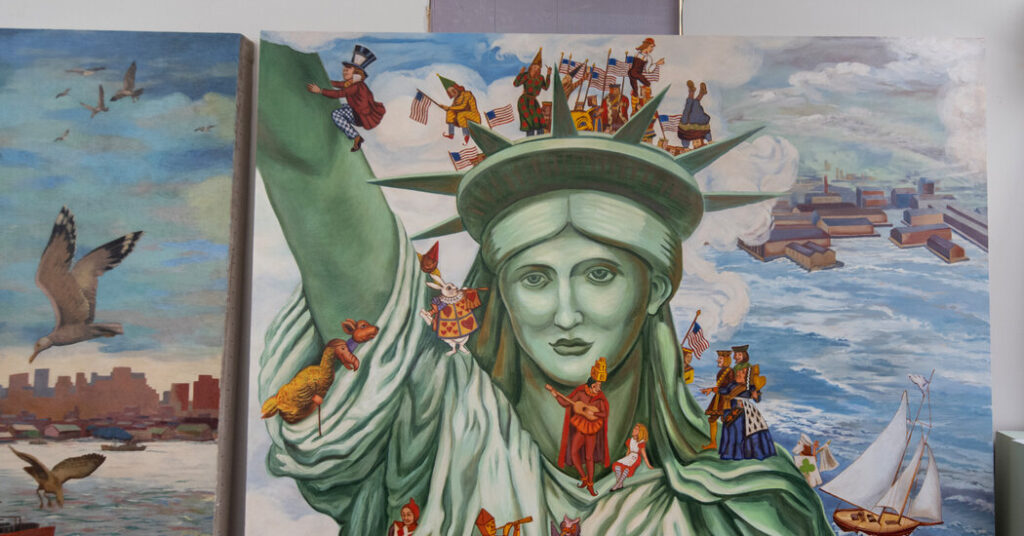
The eternally curious children’s book character and her menagerie of fantastical friends tumbled into the wonderland of New York City in a raucous, exhilarating mural painted by Abram Champanier from 1938 to 1940. Across 16 monumental panels that once wrapped the children’s ward of Lower Manhattan’s Gouverneur Hospital, which served immigrant communities, Alice and company buzzed over the Empire State Building and the East River in tiny planes, scaled the crown of the Statue of Liberty, parachuted into Coney Island, rode the stone lions of the 42nd Street Public Library and squeezed onto a subway at rush hour.
Champanier’s was one of some 2,500 murals commissioned by the Federal Art Project for public buildings nationwide between 1935 and 1943 as part of the W.P.A.’s New Deal program putting people to work. But in the 86 years since the Alice Mural was installed it has seen further adventures, including a guerrilla-style rescue operation led by a renegade conservator in 1981 from the abandoned hospital as it was being gutted.
After initial restoration of five panels, work on the rest was stalled for three decades because of a lack of funding. Now, new patronage and momentum supporting artworks within New York City’s public hospital system has led to the full resuscitation of the Alice Mural. The complete cycle — repaired and cleaned with two lost panels faithfully recreated — has been reunited at the Museum of the City of New York, in the exhibition “Another Wonderland: Abram Champanier’s Alice Mural,” opening on June 6.
“What could be more New York than this hodgepodge crew crashing the city?” said Lilly Tuttle, the museum’s curator, describing how Champanier composed his dreamy urban landscape to help sick children transport themselves through their imaginations beyond their hospital beds. “For viewers today, the mural is a reminder of what federal funding for the arts could do for cities like New York and how public art could inject light and energy into unexpected spaces.”
After the show closes on Sept. 20, the Alice Mural will be relocated long-term to NYC Health + Hospitals/Gouverneur at 227 Madison Street on the Lower East Side, several blocks from the original Gouverneur Hospital. (That building, with two striking U-shaped wings visible from the Franklin D. Roosevelt Drive, is now called Gouverneur Court, and provides low-income housing for people with mental health struggles.)
All 16 panels will be accessible, across three floors, with some panels visible from the street. “It’s pretty significant that the largest municipal public hospital system recognizes them as valuable to the people of New York,” said Larissa Trinder, assistant vice president of Arts in Medicine at NYC Health + Hospitals. The department stewards a collection of some 8,000 artworks — from W.P.A. commissions to contemporary projects by artists like Nina Chanel Abney and Mickalene Thomas realized in collaboration with RxART — across about 70 community health centers in all five boroughs.
Founded in 2018, Trinder’s department received more than $5 million from the Laurie M. Tisch Illumination Fund for programs using the art collection for holistic care benefiting patients, families and staff. “This is not instead of medicine,” Tisch said, “but joy and beauty and reducing stress, and having something to look, at is an important part of healing.” (The Illumination Fund is also the lead supporter of “Another Wonderland”.)
The idea of using art therapeutically was just emerging when Champanier painted the Alice Mural.
The future artist was born Abram Scherschewitz in 1896 near Lodz in Russia (now Poland), and sailed into New York as a young Jewish immigrant, arriving at Ellis Island in 1905 at age 9. The Scherschewitz family settled in Paterson, N.J., where they ran a deli that sold champagne tea (spurring their name change to Champanier, according to family lore).
Champanier studied at the Art Students League and, in the 1920s, participated in the Whitney Studio Club (a precursor to the Whitney Museum) alongside emerging artists including Stuart Davis and Alexander Calder. “Champanier’s part of a cohort with Calder and Edward Hopper and George Bellows at this really heady time,” Tuttle said.
Making his living as a muralist, Champanier also completed projects for the New York Athletic Club and the 1939 New York World’s Fair, and won the W.P.A. commission in 1935 with his proposal for a new Alice story. In an interview in the current exhibition catalog, the artist’s son said his father’s concept was inspired in part by a 1932 visit to New York by Alice Liddell Hargreaves — the real-life model for Lewis Carroll’s 1865 book, “Alice’s Adventures in Wonderland” — who made a big splash in the papers.
Champanier also included some new landmarks, such as the Empire State Building (just finished in 1931), which he painted from above and popping through the clouds. In the largest panel, 22 feet long, he staged a massive animal concert including the White Rabbit and Mad Hatter entertaining the storybook king and queen at the Central Park Zoo, which was rebuilt in 1934 by Parks Commissioner Robert Moses with W.P.A. funds.
There are only a few black-and-white photos of the mural in its early days, ringing one of Gouverneur Hospital’s bullet-shaped wings with children in rows of small iron beds.
The hospital lost its accreditation in 1961, a year after Champanier’s death. Years of neglect and transient uses followed, before the building was abandoned in 1978. Soon after, Andrew S. Dolkart, who had just started at the Landmarks Preservation Commission, was put in charge of assessing buildings planned for demolition and discovered the Alice Mural in the children’s ward.
“The room was a ruin,” recalled Dolkart, now a professor of historic preservation at the Columbia University Graduate School of Architecture, Planning and Preservation. But the Alice panels were “witty and fun and bright and even in that abandoned space you could tell that they were pretty wonderful and shouldn’t be just torn down,” he said, adding, “the city had no interest in the mural.”
Dolkart eventually found his way to the conservator Alan Farancz, who had led other mural extractions — including saving a Stuart Davis work from Radio City Music Hall — and was gung-ho to take on the project despite its questionable legality. “To his credit, he was going to put his neck out,” Dolkart said.
Over four steamy days in August 1981, as a demolition crew was gutting the interior of the hospital, a small band of minimally trained volunteers, guided by Farancz and his wife, the conservator Denise Whitbeck Farancz, waded through the filth and broken glass of the children’s ward to excavate the panels. They had been painted on canvas and attached to the walls with white lead paste. (A panel of Alice and friends on a fishing boat reeling in a giant swordfish was too deteriorated to be retrieved.)
The team attached Japanese rice paper to the face of each panel to secure flaking paint and used cake knives to pry loose one side of the canvas, which would be stapled to a giant tube that they turned carefully to roll each painting off the wall. “A lot of lead paint and plaster stayed on the back of the canvases, and it took like five people to get each down,” Farancz said (Alan died in 2016).
Did they have permission to take the Alice Mural back to their conservation studio?
“This is a gray area,” she said. “No one really hired us.”
The couple worked with organizations including Reader’s Digest to raise money to begin restoration. The first completed panel went on view at Lincoln Center in 1993, with four more exhibited that year at the Bronx Museum, before funding dried up. These five were later returned to the hospital system and put on view at various centers (the panel with Alice at the Statue of Liberty went to the hospital in Elmhurst and was misplaced at some point).
“Alan and Denise had a lot of devotion to the city and public art,” said John Lippert, who began interning for them in 1988 and painstakingly removed the lead paste from canvases with a solvent and an X-acto blade. “Alan saw himself as this kind of gunslinging conservator, like, ‘No one else is going do it, but I’m going do it.’”
The Faranczes stored the remaining panels on tubes until 2008 and passed custody of Alice on a handshake to Lippert, who had recently opened Foreground Conservation & Decorative Arts with Dawn D’Aluisio. When Trinder’s newly minted Arts in Medicine department came calling, more than a decade later, Lippert and D’Aluisio carried Alice over the finish line, panel by laborious panel, including re-creations of the lost Statue of Liberty and Swordfish.
“We were looking at Champanier’s brushstrokes, but we weren’t super literal,” Lippert said. They decided against an antiquing glaze, keeping the two freshly painted scenes brighter than others in the group. “We didn’t put a patina of time on these,” D’Aluisio said. “Let’s not pretend.”
The Alice Mural is believed to be the only W.P.A. commission for a children’s ward in the country to have survived and is one of 14 Depression-era murals from New York’s public hospital system that have been spared and are publicly accessible.
At NYC Health + Hospitals/Harlem, for instance, four 1930s murals by Charles Alston, Alfred Crimi, Vertis Hayes and Georgette Seabrooke have been restored and installed in a Mural Pavilion built in 2012. Work by David Margolis is on view at NYC Health + Hospitals/Bellevue and by William Palmer at two NYC Health + Hospitals’ locations in Queens. Each has its story.
Seeing the Alice Mural finally come together is an emotional moment for Farancz. “We figured eventually, no matter how long it took, it would happen,” she said. “Alan was the force that would not let it die.”
Another Wonderland: Abram Champanier’s Alice Mural
June 6 through Sept. 20 at the. Museum of the City of New York, 1220 Fifth Avenue; 212-534-1672, mcny.org.
The post Saving Alice’s Adventures in New York. Her Mural Traveled a Rabbit Hole Too. appeared first on New York Times.