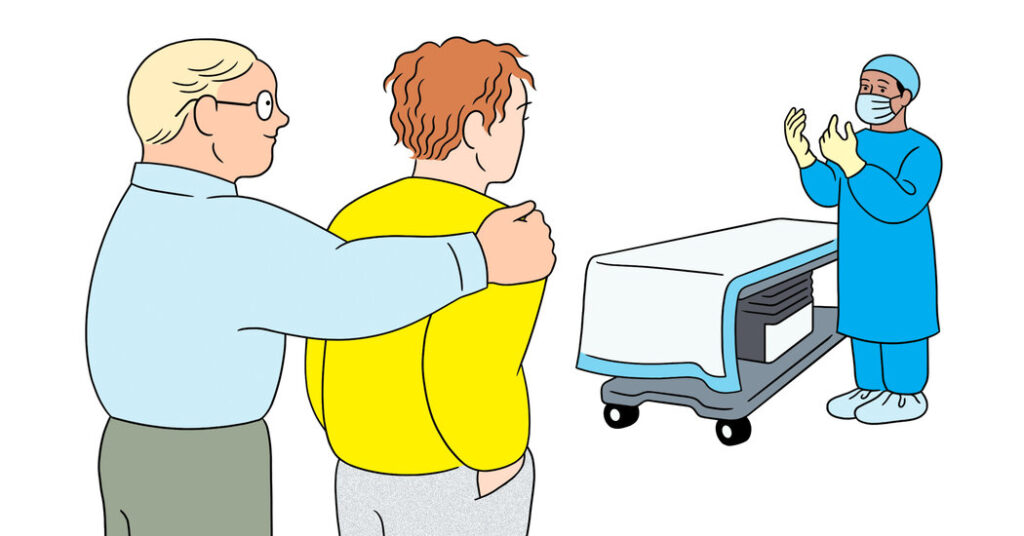
A 22-year-old in my family is being evaluated as a living kidney donor for a man he barely knows (a colleague of his stepfather’s). From what I can tell, the stepfather suggested him as the donor, and the process accelerated quickly from there.
This young person is kindhearted but somewhat vulnerable and eager to please. He has embraced this as a “selfless act,” but I worry that such framing, combined with strong family encouragement, may be substituting for a fully independent choice.
There’s been little discussion of the real costs — recovery, finances, long-term health — and I’m not convinced the transplant team sees the family dynamics behind this decision.
At the same time, his father, in poor health, has told him to “save” the kidney for him — another form of pressure pulling in the opposite direction.
I’m not close to him, and I don’t think he’ll advocate for himself. This feels less like a free choice and more like a young person being pulled by competing agendas.
Is there a responsible way to intervene? Or is this something I have to accept? — Name Withheld
From the Ethicist:
Transplant programs are supposed to assign an independent advocate (or advocate team) to a living donor, who must also undergo a psychosocial evaluation. The fact that this young man is being pressured by his stepfather to donate a kidney to the stepfather’s friend, while his father is urging him to “save” it for him, is very much the sort of thing that the advocate and the people doing the psychosocial evaluation should know about.
The circumstances you describe don’t mean he is incapable of consenting freely. Still, you’re not wrong to be concerned. Your role isn’t to argue for or against the donation. If you can speak with him, ask whether he has discussed these pressures with the advocate and evaluators. You can also make plain that he can stop the process at any point, and that he owes no one an explanation if he does.
A Bonus Question
Two months ago, my neighbor found a small dog running loose in our neighborhood. She knocked on doors and asked around, but no one recognized him. She couldn’t keep him, so I offered to foster him while we looked for the owner.
We posted everywhere we could think of: lost-pet Facebook groups, the county’s lost-pet system, Nextdoor, local shelters, the vet and even national lost-pet networks. The next day, I took him to the vet. He had no microchip, he was skinny and dehydrated and had small skin sores, but he was otherwise OK. I bought him food and started potty-training him. I told my kids not to get attached because surely someone would come for him.
After 30 days, when under local law lost animals become “abandoned property,” we started to consider adoption. At 45 days, we finally named him and began planning for his neuter.
Two months after he was found, someone messaged me on Facebook saying he was their dog and provided proof. From what I understand, the dog belonged to their daughter, who is away at college. Her parents lost him, didn’t search through any lost-pet channels because “they were new in town” and didn’t tell their daughter until recently. She is the one who found my Facebook post.
I was angry and heartbroken. We had become attached to this dog, my kids love him and I told them we had adopted him. I didn’t respond for a few days.
Now I’ve learned the owners live on the other side of our neighborhood, and I feel increasingly uncomfortable keeping him while knowing his former owners still want him back. I believe they lost their legal rights after 30 days. If he had gone through a shelter, they most likely wouldn’t be able to trace him after adoption. But ethically I’m torn. They seem distressed, and it may have been ignorance rather than malice.
I reached back out and said I was open to discussing it. What is the right thing to do? — Name Withheld
From the Ethicist:
These people messed up mightily. If they’d told their daughter at once, she would probably have found the dog within those 30 days. The episode is a good reminder that hiding something you’ve done wrong can make things even worse. But the dog’s real owner, the daughter, is not at fault for this. You might ask to speak to her directly, to discuss microchipping, fencing and how the dog will be kept safe in the future. Still, you don’t seem to have any doubts about what you’ve been told, nor any worries about the dog’s prospects for having a fine life at his old place. So whatever the legal situation, the right thing to do is return him to his home. There are always dogs that need families.
Readers Respond
The previous question was from a reader who wondered how to tell her partner that his dependence on chatbots was damaging their relationship. She wrote:
For the past year, my partner has used either ChatGPT or Claude to help him make almost every decision. … He talks to ChatGPT daily and feels it knows him better than he knows himself. He has discussed our arguments with it to understand them better. … He is sometimes on his computer for hours on end, and not really spending the quality time with me that I deserve. I respect using A.I. to save time figuring out how to roast a chicken or finding information you need. Still, one reason I love my partner is his sharp mind and critical thinking. Using A.I. for every decision is something I don’t understand. … Here’s my question: How do I go about telling my partner his reliance on A.I. is damaging our relationship? ChatGPT and Claude are so embedded in his life that I’m not sure how to approach the situation. — Name Withheld
In his response, the Ethicist noted:
There are lots of ways in which artificial intelligence, including the kind behind those chatbots, serves us well. … But one thing we surely don’t want to lose is a basic capacity for critical thinking. … You fell for someone who thought for himself; it’s understandable that watching him outsource that mind to a machine could dim his appeal. … There’s another risk in what you describe. By letting his conversations with the bot supplant actual conversations, your partner is degrading his relationships with real people. It sounds as if he may have lost sight of the fact that a large language model isn’t a person. … It’s understandable that you’re feeling crowded out. Be direct with him about how you feel. What’s clear is that he’s brought a third party to this two-person relationship, and it’s talking too much.
(Reread the full question and answer here.)
⬥
It’s important to be clear with yourself about what you want before you go into this discussion. Are you irritated by the botsplaining? (I love that term!) Are you missing your partner because the computer is now displacing your time with him? Are you seeing that he is making bad decisions because the chatbot is not considering things you know are important? Is the “desire to please” in the chatbot degrading his critical thinking? Each of these is a known challenge with modern technology. The solution, though, is the same in all cases: Come to an agreement about when your partner must put the technology down, like “no phones at mealtimes.” The decision should be made together. — Nick
⬥
Friends and family and colleagues are important, but when I want an answer to something, asking others generally is a waste of time. ChatGPT responds with an algorithmic response that covers points I would not have thought of, weighs pros and cons and teaches me more than I would ever have learned from the people around me. So it’s not that I’m trading time with a person for time with an A.I. bot; it’s about getting the answers I want from a source that “knows” things and doesn’t prattle on or guess. In short, I socialize and bond with people. I get information from A.I. and feel much more confident in the outcome. — Cari
⬥
Like any other addictive behavior, the overuse of A.I. fills a need for people who are overwhelmed with living in our complicated society. The Ethicist is so right in saying that we can’t lose our capacity for critical thinking; it’s one of the things that makes our life our own. He also points out that the letter-writer’s partner seems to value A.I.’s advice over theirs. This is a red flag for their relationship. Just like alcoholism, gambling and drug abuse, this growing dependence on A.I. will serve as a crutch for avoiding dealing with the real world. It is not the benign helpmate that it seems to be. — Meg
⬥
Although I agree that directly talking to your loved one about how their A.I. use is affecting the relationship could be helpful, it might not be enough. And a direct challenge could lead to defensiveness. I would try to gather more information first. Asking questions to find out why he is reliant on the technology could be helpful, so you can get to a place of empathy and understanding. Then I would take a more careful approach, using “I feel” statements, not accusatory “you are” statements. Keep the judgment to a minimum and focus on the impact: what is missing and what feels lost. — Star
⬥
Although I’m not in a relationship, one of the main things I really appreciate about speaking with A.I. when I’m going through a tough time is the way it makes me feel validated. It’s rare to find a person who can make you feel that way — not that they wouldn’t want to, but friends normally jump in and give advice quickly. If I were the letter writer, I might ask my partner what it is that he likes about the way A.I. makes him feel. I might also express that I miss having those conversations with him, and use the interaction as an opportunity to deepen the relationship. — Carolyn
The post My Family Member Is Being Pressured to Donate a Kidney. Should I Say Something? appeared first on New York Times.