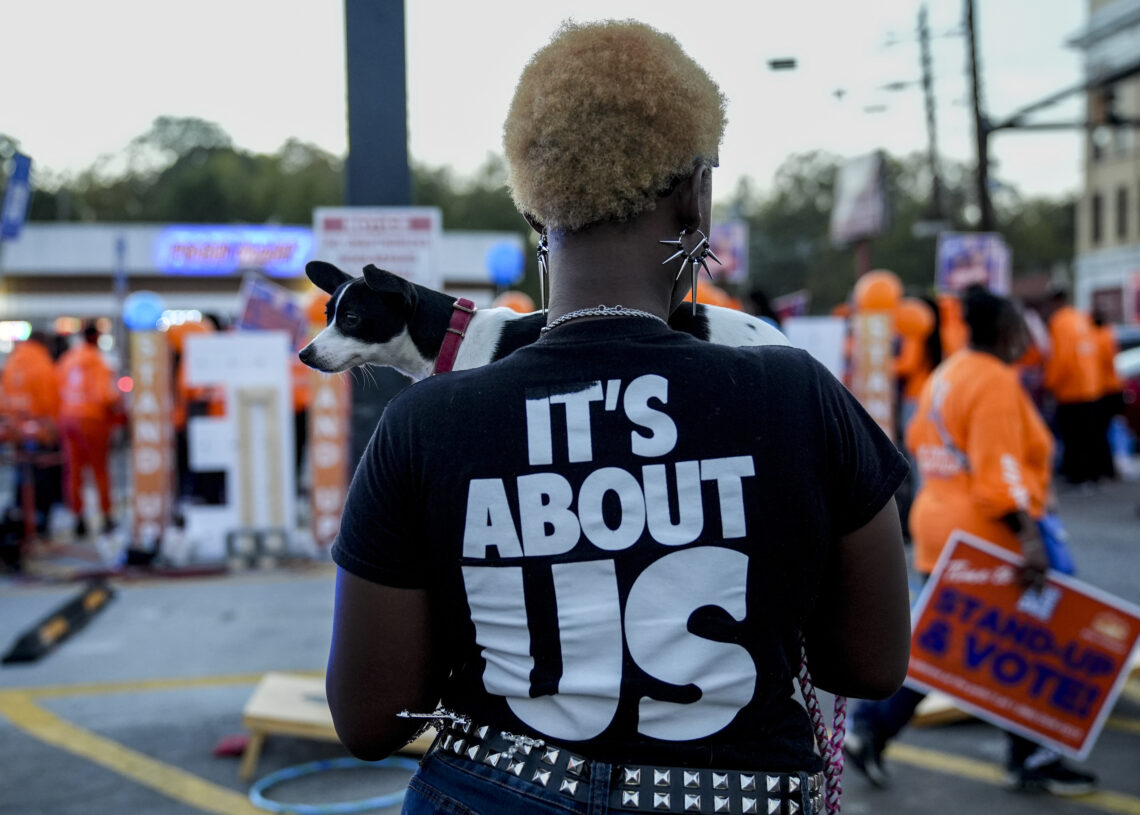
Transformations of American democracy are typically measured by constitutional amendments and federal legislation. But one of the most consequential occurred when Black Americans decided to vote with their feet. During the Great Migration between 1910 and 1970, 6 million of them left the South — where they effectively couldn’t vote for much of that time — for northern and Midwestern states, where they could. Since 1990, though, at least 2 million have returned, a reverse migration that’s reshaping the region’s politics and changing the calculus for the Democratic and Republican parties.
The original migrants were mostly rural laborers fleeing violence and disenfranchisement in search of better jobs and pay. Today’s reverse migrants are driven by economic opportunity in Southern metro areas, the lower cost of living, and connections to culture and extended family. These recent arrivals are typically younger, college-educated professionals with no firsthand knowledge of the Jim Crow South that their ancestors left several decades ago. And just as in the Great Migration, the new voters who arrived are shifting the balance of power in the states — and the backlash came shortly after they did.
Before the Great Migration began, more than 90 percent of Black Americans lived in the South. Disenfranchised after Reconstruction, by 1901, there were no longer any Black members of Congress. By the time the Voting Rights Act of 1965 was passed, 53 percent of the Black population remained. Political scientist Keneshia Grant found that northern parties and politicians took varying approaches to the new arrivals — from mobilizing Black voters and supporting policies they favored to suppressing their election participation and stoking racial anxieties. In voting by leaving, however, the newly enfranchised bloc elected Black congressmen in destination states such as Illinois and New York. Today, the reverse migration has increased the proportion of the Black population that lives in the South to nearly 60 percent. The two metro areas losing the most Black residents? New York and Chicago.
When this new migration is considered, the erosion of voting rights protections and the off-cycle scramble to redraw congressional maps across the South tell a more complete story. Through a purely partisan lens, these measures look like proactive attempts by Republican legislatures to gerrymander Democrats out of seats and bake in election advantages. But they can also be read as defensive: an effort to contain the growing political power of Black voters in some states. Whether these changes reflect explicit racial discrimination or hyper-partisan conflict, the effect now is the same as its historical precedent — Black voters are targeted by the state.
Atlanta is the epicenter of the reverse migration, and Georgia politics has taken notice. Between 1990 and 2020, the Black population of its metro area more than doubled and now exceeds 2 million. It’s the city most often cited by advocates who view reverse migration as a political strategy to increase Black electoral power in the South and influence national politics. Since then, President Donald Trump lost this Republican-controlled state in the 2020 election, and Democrats won both of its seats in the Senate. But this month, Georgia will convene a special legislative session to redraw its maps ahead of the 2028 election; the goal is to protect the Republican congressional advantage by containing the growing Black electorate.
Following the 2020 Census, a Brookings Institution analysis found that Texas, Florida and North Carolina were also top destinations for Black migrants. Texas Republicans, egged on by Trump, redistricted the state this year to pack Black voters into fewer districts in hopes of picking up five Republican seats. Similarly, Florida recently approved a new map, packing some districts with Black voters while splitting up others elsewhere to create four new Republican seats. North Carolina redrew its map, breaking up a district represented by a Black Democrat to make it reliably Republican, creating an 11-3 in-state advantage.
Gerrymandering is just the latest tactic. These states’ initial attempt at contesting the changing electoral dynamics was to implement restrictive voting laws. North Carolina’s effort was so egregious that federal judges struck down its provision, ruling that it targeted “African Americans with almost surgical precision.” Black migrants returning to the South, however, were readily organized and mobilized, helping to mitigate these laws’ anticipated effect of reducing turnout. Conversely, Black congressional Democrats are hoping that massive turnout in this year’s midterms will help save their seats. But recent Supreme Court rulings have paved the way for partisan gerrymandering to be a more effective tool to counter mobilization efforts, and Southern Republicans seem to be banking on the map’s math to keep power, no matter what shape the electorate takes.
Whether that calculus holds up over the long term remains an open question. Southern parties and politicians treat the Black electorate as if its politics and views are stuck in the Great Migration. Democrats behave as though the game is all about turnout, while Republicans treat Black constituents as voters to be diluted. But the Black people coming to the South are not the same as the ones who left. If the region’s leaders continue to apply a 20th-century playbook to 21st-century voters, they may find that in drawing up an advantage, they’ve painted themselves into a corner.
The post A great reverse migration is shifting the balance of power in the U.S. appeared first on Washington Post.