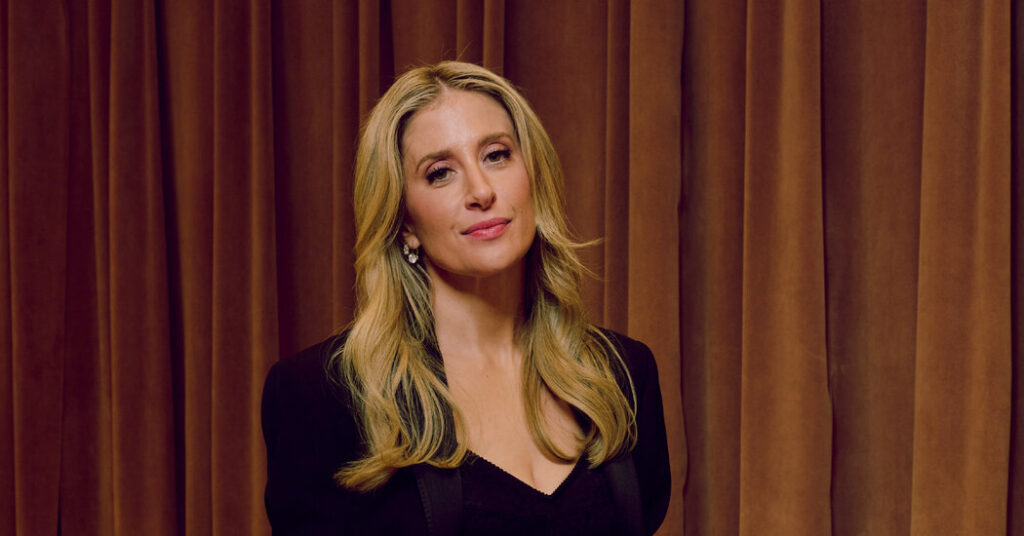
Caissie Levy was Broadway’s first Elsa, starring as the Queen of Arendelle in the stage adaptation of “Frozen.” She was a hippie in “Hair” and a potter in “Ghost.”
Since then, she’s played a lot of moms: a bedridden mother in an Off Broadway production of “The Bedwetter,” a bipolar mother in a London production of “Next to Normal,” a struggling stepmother in a Broadway revival of “Caroline, or Change” and a doomed mother in Broadway’s “Leopoldstadt.”
Now she’s playing a character known simply as Mother in a strong-selling and much-praised Broadway revival of “Ragtime,” a sweeping 1998 musical, based on an E.L. Doctorow novel, about the promises and perils of early 20th-century America. Mother is the matriarch of a wealthy suburban family, and over the course of the show — featuring music by Stephen Flaherty and lyrics by Lynn Ahrens — she evolves from dutiful wife to independent thinker.
The role is bringing Levy, 45, who was born and raised in Hamilton, Ontario, the most plaudits of her two-decade career. Last month she picked up her first Tony nomination for the role; now she is seen as the leading contender to win the prize at the awards ceremony on Sunday night.
In an interview at Lincoln Center Theater, the nonprofit organization producing “Ragtime,” Levy talked about her role, her career, the Tony Awards and motherhood. These are edited and condensed excerpts from the conversation.
You’ve been doing this a long time, with way more success than most, but this is your first Tony nomination. Does it matter to you, and if so, why?
It matters a lot. You don’t get into this line of work for awards. It’s such a tough life and it’s such a roller coaster. You get into it because you have to tell stories and you love playing roles. But to be recognized in this way is so much more meaningful than I even thought it would be. Of course I’ve dreamed of being nominated, and I’ve had many years when I thought it might happen and it didn’t. We [nominees] sign a little Tonys scrapbook, and I found myself writing “All Things in Time.” Everybody’s path is so different, and I guess right now it was my time. To look out and see the people I’ve worked with for 20 years, and people I’ve idolized and wanted to work with, shine some love back at me and say, “Keep at it, kid,” it makes me feel amazing.
“Ragtime” was not a hit the first time it ran on Broadway. Why do you think it is working now?
Every lyric and line of this shows feels like it was written yesterday. “Ragtime” is getting its due because we need it right now. There is plenty of injustice and despair, but there is also a glimmer of hope.
How would you describe your character?
She’s a modern woman in a very unmodern time. She’s doing the most radical things inside of her life story, making these really hard decisions in her own home, and causing this ripple effect of change in the world around her.
She changes over the course of the show. How do you convey that?
Mother is a slow burn. She’s very strait-laced at the top of the show, and by the end she’s barefoot by the beach, and her hair is down to symbolize the freedom she’s feeling. And vocally, to help show that progression, I save a lot of my chestier, beltier tones for the back end of the show. As she grows into the woman she’s becoming, she gets deeper and stronger, and that registers in her voice and her physicality.
You’ve been vocal about the importance of representation for Jewish actors. I wonder how you think about now playing a classic WASP?
I didn’t get to play a Jewish character until “Caroline, or Change,” and that and “Leopoldstadt” were such gifts because I was able to bring so much of my culture and my innate me-ness and upbringing to those roles. But I feel just as connected to this role. I feel Mother in my bones. I built her off my grandmothers and my mother.
You spent years helping to develop “The Lost Boys” musical, and planned to stay with “Ragtime” for a short period and then to join that show this season. You changed your mind. Why?
It was a very difficult time for my family at the start of the year. I have a 10-year-old son and a 5-year-old daughter, and my amazing husband. And as any working parent knows, in order to work at your best, something takes a hit in your family life. It’s a constant balancing act, trying to do what’s best for your kids and your family and to follow your own dreams and invest in your career. I want to be the kind of actor that shows people that you can do both — you can have the family and the career — but it’s not always going to be perfect and it’s not always going to happen exactly how you set out to do it.
And, so, yes, that decision was because of needs going on at home that I don’t feel the need to go into detail on, because it’s about my children, but it became very clear that there was no world in which I would be able to go into a new rehearsal process, a new tech process, a preview process, and open a new show at this moment in time. Once I was in previews and tech I wouldn’t see them at all because I would be [working] 12 hours a day. Thank God I had this incredible show and role to get to stay with. It has been a gift to see this experience through, but it’s tough. We make tough choices.
What would you change?
Every industry has tough stuff when it comes to raising kids. But that isn’t to say we shouldn’t actively try to improve ways to do it. We have an opportunity to examine the model, and play with it and be a little braver. I would love to see more role-sharing. I would love to see more alternates, with an opportunity to go on a little more often. It would keep a lot more artists in the game. So many amazing women have had to leave the business because they wanted to be mothers. What kind of work would they be doing?
Two of your biggest shows, “Ghost” and “Frozen,” weren’t financially successful. How do you think about those experiences?
They toughened me up, and taught me a lot. With each job, you learn so much and you grow up so much. You learn how to be part of a team, how to advocate for yourself, how to advocate for your character. “Ghost” was the first time I really felt like I was a leading lady on a show, and I was young, and I had a lot of pressure on my shoulders, but I loved it. Was the show perfect? No. Was there was so much to be proud of? Absolutely. And with “Frozen,” there was no hiding from how huge that job was. I was stepping into my power, and not shying away from the moment, and taking up space. That’s something I’m always navigating.
In London you starred in “Next to Normal” to great acclaim, but it seems like that production isn’t transferring to New York.
I promise I am not being coy when I say nobody wants that show to come to Broadway more than me, and there are no conversations about that right now. I’m immensely grateful that we have the live-capture, because I am so proud of our whole production and my work in it and I love that it’s accessible to people. It made me a better actor; it made me stronger in so many ways; it’s the hardest role I’ve ever played, and I would do it again in a heartbeat. But that is above my pay grade.
Given that, how are you thinking about the state of Broadway?
I see firsthand how hard it is to get new work produced on the scale that everyone dreams of. And of course it’s the thing that we all want to work on, because it represents the future. I don’t pretend to have the solution for how we do that now, with such a changing landscape for Broadway. But every day, people I interact with want to know what new fabulous story is being told — what’s next. We’re all craving that excitement of something new, and we have to figure out a way to nurture those stories and get them onstage.
Michael Paulson is the theater reporter for The Times.
The post It’s Hard Being a Mom on Broadway. Even for ‘Mother’ in ‘Ragtime.’ appeared first on New York Times.