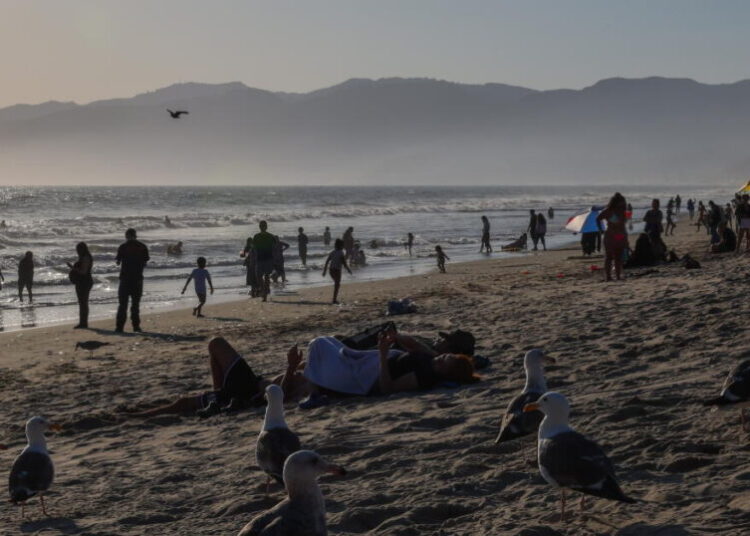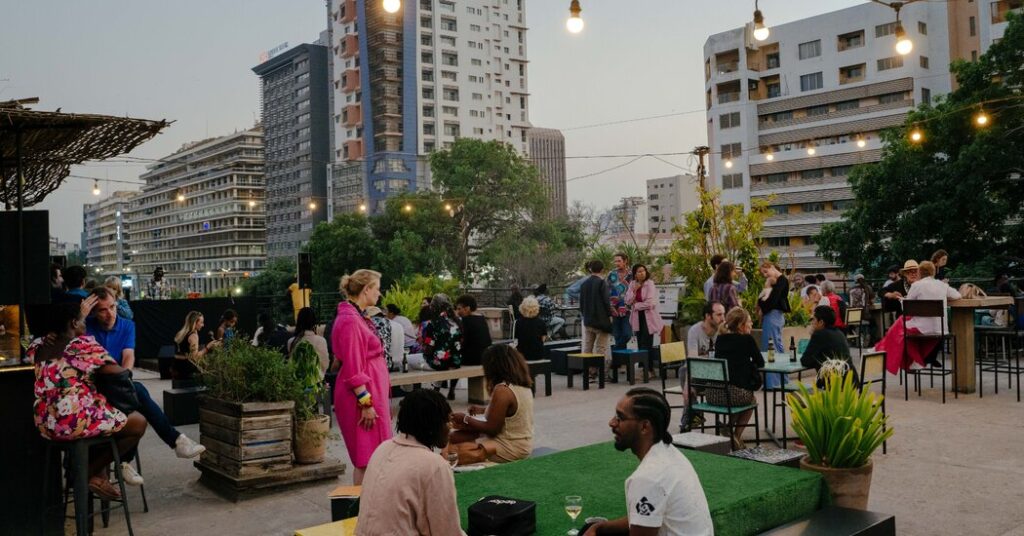
A couple of years ago at a dinner, I was sitting next to a Nigerian nonprofit executive who divides her time between Washington and Lagos. Exasperated by persistent stereotypes about Africa, she told me about Ghana’s edgy street-art scene, clubs in South Africa, fashion shows in Senegal and “Nollywood,” Nigeria’s booming film industry, which some years ago released a saucy television series about midlife crisis and menopause called “Fifty.”
It definitely made me want to visit some of these places. But Africa isn’t just attracting intrigued Europeans like me. Today, my colleague Saikou Jammeh writes about the rise of African travelers who increasingly see their own continent as “sophisticated and worth exploring.”
The new African tourism
By Saikou Jammeh
For most of my life, the dream travel destinations for young Africans with money lay outside the continent. Everyone with cash to spare wanted their social media to be filled with photos from the Champs-Élysées in Paris or Times Square in New York City.
That’s why I’ve been surprised by something I’ve noticed over the past few years. In the summer of 2024, I moved to Dakar, the capital of Senegal. And ever since, I’ve gotten a steady stream of texts from friends and acquaintances from other parts of Africa telling me they’re in town. For work? For a conference? Nope — on holiday.
It’s not just my circle of friends. Something is changing when it comes to travel and Africa.
The number of tourists visiting African countries grew by almost 8 percent last year — the fastest growth in the world, according to the United Nations World Tourism Organization. This surge isn’t being driven only by visitors from Europe or Asia. It’s being driven in large part, experts say, by a growing African middle class that is exploring the continent for the first time. And the most visible travelers — millennials and Gen Z-ers — are changing African ideas about leisure, travel and even Africa itself.
“Travel is increasingly seen as part of identity and everyday life, rather than a luxury,” said Jillian Blackbeard, chief executive of Africa’s Eden, a nonprofit that promotes African tourism. “African travelers are viewing their own continent as aspirational, sophisticated and worth exploring.”
New flights and no visas
Historically, the odds have been stacked against leisure travel here.
Most Africans still need visas to visit other African countries. Flights, too, are a challenge. Prices for flights within Africa are some of the highest in the world, and there are few direct ones. (I once had to travel via Doha, Qatar, on my way from Gambia to Namibia.)
But both issues have been improving in recent years.
Demand for air travel within Africa has been growing, and the more demand, the more airlines can put in place better routes. New airlines have sprung up across Africa; a journey from Accra, Ghana, to Johannesburg that once had to go through London or Dubai can now connect through, say, Addis Ababa, Ethiopia, said Omoniyi Kolade, the chief executive of SeerBit, a company that handles cross-border transactions in Africa.
And many countries, including Benin, Gambia, Kenya, Ghana and others, have scrapped visas for African passport holders in recent years. That shift, one travel influencer told me, has been a game changer.
In Lagos, Nigeria’s commercial capital, you can now spot advertisements for groups offering “stress-free weekend getaways” to neighboring Benin for around $150.
In Dakar, I often pass by the African Renaissance Monument, an enormous bronze statue not far from where I live. Whenever I do, I hear languages and accents from across the continent. I see young people posing for photographs and filming videos that will, presumably, earn a spot on their social media timelines that might have once gone to Times Square.
“Beautiful Africa for Africans”
The perception of leisure tourism as a largely Western pursuit is changing, Blackbeard of Africa’s Eden told me.
Across Africa, television commercials and billboards promoting tourism largely feature Western-looking faces. But the internet has given rise to an explosion of travel entrepreneurs and social media influencers who are driving educated, urban young people here to see Africa as a big and beautiful place that is worth their time.
Berthold Ackon, a Ghanaian travel influencer known online as Wode Maya, traveled to Zambia, in southern Africa, this spring. He was inspired by a trip the Ghanaian president took to Zambia in February, during which he wore a loose Ghanaian garment known as a fugu. The shirt set off a wave of baffled commentary on Zambian social media from people who weren’t sure what they were seeing.
“I think it came from a place of ignorance because young people really do not know about the cultures of other African countries,” Ackon told me.
Ackon, who has visited 39 African countries, wanted to show his two million followers, mostly young people in Africa, how “lovely” Zambia is. So he took a trip, showcasing the country’s scenic landscapes alongside visits to local markets and conversations with ordinary Zambians. In one video he posted, completely soaked at the edge of Victoria Falls, he said, “God indeed took his time to create beautiful Africa for Africans.”
Ackon had planned to visit Zambia for a week; he stayed for over a month.
TOP NEWS
Iran attacked Kuwait
One person was killed and dozens of others were injured at Kuwait’s international airport yesterday after Iran fired a barrage of missiles and drones at the country, Kuwait and the U.S. said. Tehran said the damage was caused by a U.S. defense system after it failed to intercept Iranian missiles.
Video verified by The New York Times showed smoke and flames inside a terminal, where a gaping hole had been ripped in the roof. The latest flurry of attacks started after the U.S. military said that it had conducted strikes on an Iranian military facility on Qeshm Island, off the coast of Iran. The death in Kuwait is the first reported fatality in a Gulf state since the U.S. and Iran agreed to a cease-fire in April. Follow our live updates.
In Washington, President Trump confirmed that he had called Prime Minister Benjamin Netanyahu “crazy” during a tense phone call on Monday and had used expletives to express his frustration with Israel’s military campaign in Lebanon.
OTHER NEWS
-
U.K. authorities urged calm after a night of violent protests over a murder case that has been seized upon by right-wing politicians.
-
Ukrainian drones struck St. Petersburg, Russia, during a high-profile economic conference.
-
E.U. officials unveiled a plan to reduce dependence on U.S. tech by building data centers and reviving the semiconductor industry.
-
Trump has proposed tariffs of at least 10 percent on 59 countries and the E.U. by invoking a novel legal provision.
-
A fire at a hotel in New Delhi killed at least 21 people and injured dozens more.
-
Every day at 9 a.m., Ukrainians observe a minute of silence to honor people killed during the war. My colleague Maria Varenikova presents the solemn moment in this video.
WHAT ELSE IS HAPPENING
-
Peabo Bryson, the soul singer known for the Disney hits “Beauty and the Beast” and “A Whole New World,” died at 75.
TOP OF THE WORLD
The most clicked link in your newsletter yesterday was about an audience member in Australia who filled in for a concert’s sick keyboardist.
SPORTS
French Open: Aryna Sabalenka, the world No. 1, was defeated by Diana Shnaider in a seismic upset. Follow our live updates of the quarterfinals.
World Cup: See where Zinedine Zidane’s head-butt ranks in our list of the 20 craziest moments in tournament history.
N.B.A.: Want courtside seats for the Knicks? It helps to be rich, famous and a die-hard fan.
CHART OF THE DAY
Japan is shrinking
Japan’s population has fallen by more than three million people over the past five years as it faces an accelerating demographic crisis — a harbinger of the headwinds many other countries could soon face. The shrinking population, caused by one of the world’s lowest birthrates, is already constraining economic growth, causing labor shortages and putting pressure on its health care system.
MORNING READ
Much has been said about Winston Churchill’s leadership in periods of both war and peace. Less time has been spent assessing the hundreds of artworks he painted.
That’s why a London museum has decided to put together a serious retrospective of his work. His paintings offer a glimpse into the inner life of one of the 20th century’s defining figures. See them here.
AROUND THE WORLD
A bone of contention
The tan street dogs known as caramelos, which roam Brazil by the millions, inspire just as much pride as football and samba. Once shunned and mistreated, they are celebrated in memes, cited in songs and honored with Carnival parade floats. Many see them as embodying Brazilians’ own mixed heritage and adaptability.
But the authorities in Mexico recently labeled the tawny dogs a Mexican treasure, declaring them a native breed much like the Chihuahua. Angered Brazilians say a national icon is being stolen from them.
“How can they say the caramelo is not Brazilian?” said one woman in Rio de Janeiro, the owner of a bouncy, toffee-colored rescue called Madâ. “It’s the face of Brazil.” Read more about the dispute over dogs.
RECOMMENDATIONS
Hold the protein: There are health risks from eating too much.
Rent: An artist built a coyote-shaped house in the New Mexican desert. You enter through its mouth.
Consider: What’s your friend group’s financial culture, and how does it shape your spending habits?
Celebrate: You can party like a Swede with our guide to Midsummer.
RECIPE
This spicy, tangy vegan take on chile paneer is inspired by Indo-Chinese cuisine, which emerged when Chinese immigrants in Kolkata, India, adapted their cooking style to suit local palates. The tofu is dusted in cornstarch before being pan-fried to lock in moisture, creating a crispy exterior that holds on to the sauce.
WHERE IS THIS?
Where is this street?
TIME TO PLAY
Here are today’s Spelling Bee, Mini Crossword, Wordle and Sudoku. Find all our games here.
That’s it for today. See you tomorrow! — Katrin
Saikou Jammeh was our guest writer today.
We welcome your feedback. Send us your suggestions at [email protected].
Katrin Bennhold is the host of The World, the flagship global newsletter of The New York Times.
The post Africans Exploring Africa appeared first on New York Times.