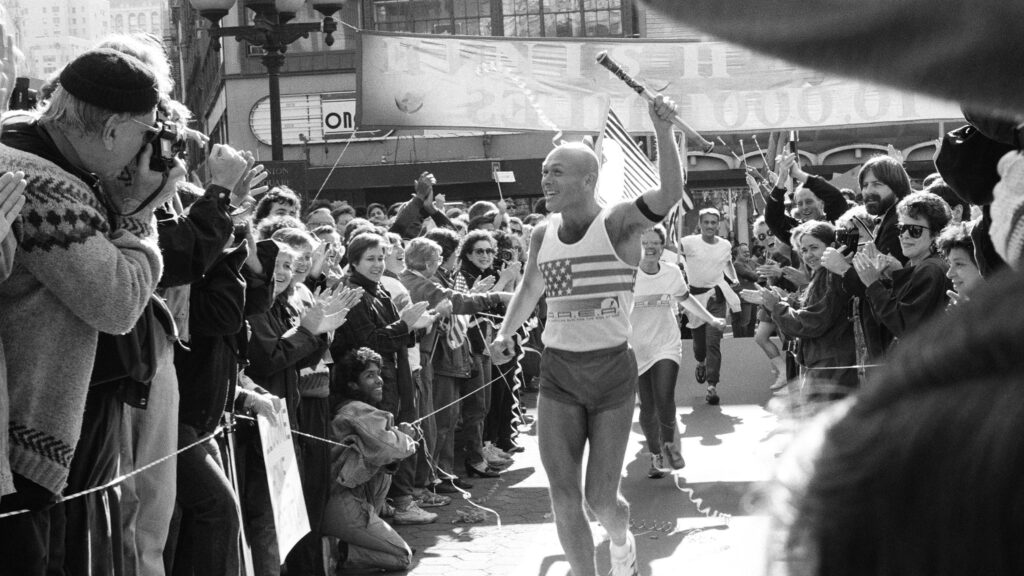
In the early 1980s, as AIDS began its terrifying spread through New York’s gay community, Brent Nicholson Earle was an actor and house manager finally living openly in the city he adored. One morning, after a long night out dancing at The Saint, record executive and nightclub boss Mel Cheren stopped Earle with a challenge that would change his life.
“If all you’re doing is taking,” Cheren said, “you’re not really part of us. You have to give something back. And your community is in trouble. Figure out what you can do to help.”
Earle watched helplessly as friends fell ill. Then he came up with an idea so improbable it bordered on absurd; he would run the perimeter of the continental United States—9,000 miles, roughly 20 miles a day—to raise awareness for AIDS. He called his journey A.R.E.A.—The American Run for the End of AIDS—and, against all logic, he completed it.
At the time, the AIDS epidemic was shrouded in fear, misinformation, and political silence. Many Americans viewed AIDS as someone else’s problem, confined to gay neighborhoods in cities like New York and San Francisco. Earle challenged the country to look directly at the crisis and at the people being abandoned by it.
Nearly four decades later, as cuts to HIV prevention and treatment programs threaten to unravel years of progress, Earle’s story remains a testament to the power of courageous action.
Born in 1951, Earle grew up in Lockport, New York, traveling into Manhattan as a teenager to immerse himself in theater and the freedom of gay New York. He visited the Stonewall Inn before it became synonymous with resistance, and happened to be bar-hopping nearby on the night police raids erupted into the 1969 uprising.
“I saw the mob forming,” he recalled. “Garbage cans being thrown. I wanted to join the fight, but my friends pulled me away.”
By the late 1970s, Earle had built a happy life in New York, co-creating plays with composer Peter Link and studying under the famed acting teacher Uta Hagen. He embraced long-term relationships over fleeting flings and built a tight-knit group of friends.
Then came 1981. The New York Times published a small article about a “rare cancer” affecting homosexual men in New York and California. Within months, it was clear that something terrifying was spreading. No one knew exactly how it was transmitted or who was at risk. Fear replaced hugs, caution replaced kisses, and paranoia seeped into even the most vibrant corners of the city.
By 1984, the epidemic was no longer abstract. “I was drowning in grief,” Earle said. “My friends were sick. My friends were dying. And no one seemed to care. I wanted to respond in a positive way.”
A 5k benefit run seemed small, but it was a start. He raised $500 for Gay Men’s Health Crisis. Then the idea of running the perimeter of the U.S. took shape. Earle wasn’t a doctor, a policymaker, or a seasoned activist. He’d never considered himself particularly athletic. He was a 35-year-old theater-lover with no sponsors. But he believed that if Americans encountered a man literally running through their towns to talk about AIDS, the epidemic might transform from being distant or abstract to something human, urgent, and impossible to ignore.
Earle’s 70-year old mother, Marion, a retired schoolteacher, volunteered immediately to help. Her role was to drive ahead to set pace, then behind to shield him from traffic. A Winnebago trailed with a small team organizing press stops, public meetings, and fundraisers.
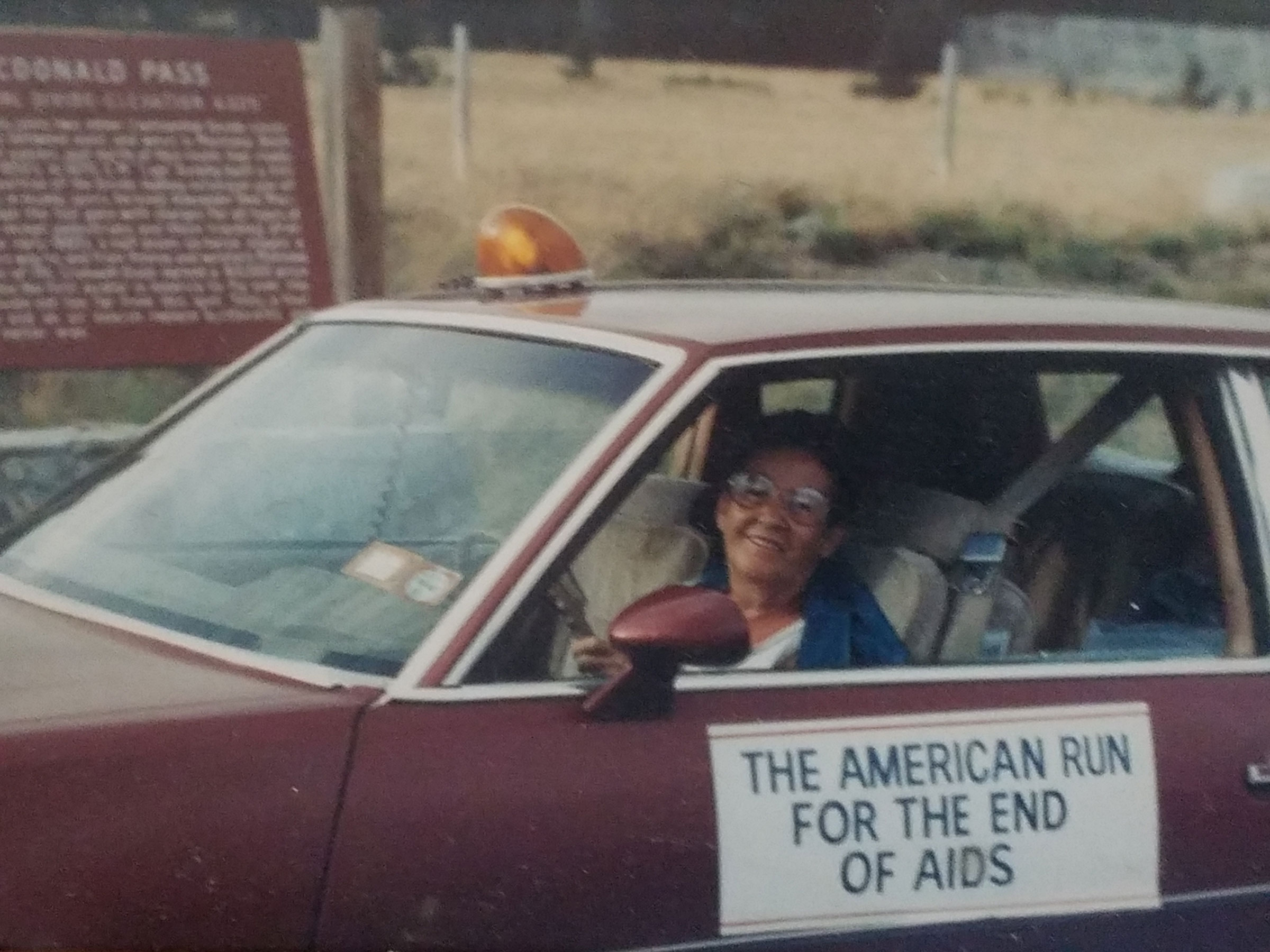
Marion and Earle and two teammates set out in March 1986 with others joining and departing at different stages to assist the journey. They headed first to New England before continuing west.
Immediately, they felt the financial pinch. Gas and food cost more than they’d budgeted, and shoes wore out fast. Donations came in fits and starts, often through sales of A.R.E.A. T-shirts and buttons. Still, Earle believed the details would work themselves out.
Long stretches were solitary. He ran with a Walkman, listening to mixtapes of Dan Fogelberg and Mr. Mister’s “Kyrie.” As a devoted student of Christian Science since the age of 21, he made prayer part of every step. The physical toll arrived quickly in the form of shin splints, stress fractures, blistered feet, and relentless mosquitoes. Snow, rain, heat, and snakes were constant companions.
The social climate was no kinder. In 1986, AIDS was still widely misunderstood. Powerful religious leaders described the epidemic as divine punishment. The White House had only addressed the crisis the year prior, offering a brief mention in response to a reporter’s probing question. Stigma and fear provoked hostility. Marion’s pace car with flashing lights and A.R.E.A. banners made them visible targets, provoking the very fear Earle was trying to confront. Drivers screamed slurs. Bottles flew from car windows. Once, someone leveled a shotgun at them. Cars intentionally swerved close to spook him, sending him into the gravel more than once.
Most would have quit. Earle did not.
Along the route at potlucks and receptions in churches, bars, schools, and living rooms, Brent spoke and listened. He met the sick, the fearful, the closeted, the skeptical, and the curious. His mother’s presence proved to be a true superpower during these cross-country stops. Marion embraced homosexual sons abandoned by their families, approached hardened parents with gentle persistence, and planted seeds of acceptance where there had only been fear.
“The real work of the run wasn’t the running,” Earle said. “It was the outreach, telling people, ‘You may think AIDS isn’t part of your community, but it’s coming.’ And there was symbolism in the run itself: for people dying back home to know they had champions. To know someone cared.”
By the time Earle completed the roughly 9,000-mile circuit in Oct. 1987, nearly two years after he began, he had become a national symbol of AIDS activism. Hundreds of supporters joined him for the final stretch into Manhattan, where crowds gathered in Times Square and Union Square to celebrate his return.
The next day, Earle ran the New York City Marathon to carry the message that although the A.R.E.A. run was finished, the race against AIDS was not.
As the epidemic continued to accelerate, Earle threw himself into the newly formed ACT UP, the AIDS Coalition to Unleash Power, demanding urgent government action to develop treatments. In 1989, he was arrested during a notorious demonstration at St. Patrick’s Cathedral.
“It was absolutely freezing that day. I’d never been so happy to get locked up,” he joked. From 1988 through the early 2000s, he was arrested 12 times for his activism.
Then came his own diagnosis. After testing negative in 1987 and 1988, Earle tested positive in 1989.
“I was horrified,” he said. “But I wasn’t surprised.”
The virus came from a long-term partner he loved deeply, a man who would later die of the disease.
Treatment options were grim. He began an AZT cocktail, enduring nausea, fatigue, and toxicity. Meanwhile, hospital visits and funerals of friends blurred together. In 1991 alone, Earle lost 42 friends to AIDS. Around the same time, he lost his mother, the woman who had spent thousands of miles protecting him on the road.
“She was so proud of me,” he said. “We had a true partnership.”
In the years that followed, advocacy became the organizing principle of his life. He continued combining endurance athletics with AIDS awareness campaigns, raising visibility for people living with HIV long after many Americans stopped paying attention.
Today, for those with access to treatment, HIV is no longer the near-certain death sentence it once was. Over 40 million people worldwide live with HIV, and advances in HIV prevention, particularly PrEP, have reshaped the landscape. Yet the epidemic is far from over. In 2024 alone, an estimated 630,000 people worldwide died of AIDS-related illnesses, while 1.3 million more were newly infected.
Cuts to U.S.-funded programs like PEPFAR—the backbone of global HIV treatment infrastructure—have already disrupted care. UNAIDS has warned that the funding losses could drive 6 million new infections and 4 million preventable deaths by 2029. These numbers reflect not just a persistent epidemic, but a worsening one. Progress that once seemed irreversible is now unraveling.
On Dec. 1, 2025, for the first time since World AIDS Day was established in 1988, the U.S. State Department refused to recognize it officially. Earle lived through a time when government indifference allowed a virus to devastate an entire generation. That history makes today’s retrenchment feel chillingly familiar.
“We fought so hard to get here,” he said. “You don’t want to see that ground lost.”
At 75 years old, Earle still carries the belief that first sent him running across the country decades ago. Change does not require authority or certainty, only the willingness to take a single step.
The post The Long Run Against AIDS appeared first on TIME.