NAIROBI — Kenya’s High Court on Tuesday extended its order to halt a Trump administration plan to establish a field hospital for Americans exposed to or infected with Ebola.
The facility, which was constructed by the U.S. military — with Kenyan government approval — on an air base on the outskirts of Nanyuki, a town in central Kenya, had been set to open on Friday but was blocked by an initial court decision.
The makeshift hospital is intended to isolate Americans exposed to Ebola, a viral hemorrhagic fever following an outbreak in the Democratic Republic of Congo.
The court on Tuesday issued new orders extending its previous restrictions for seven days and directing the Kenyan government to disclose details about its negotiations and agreements with the United States, including hazard assessments related to the facility.
A final court ruling is expected after that period, but in the meantime it is unclear what, if any, backup arrangement President Donald Trump’s administration might develop to help Americans exposed to Ebola.
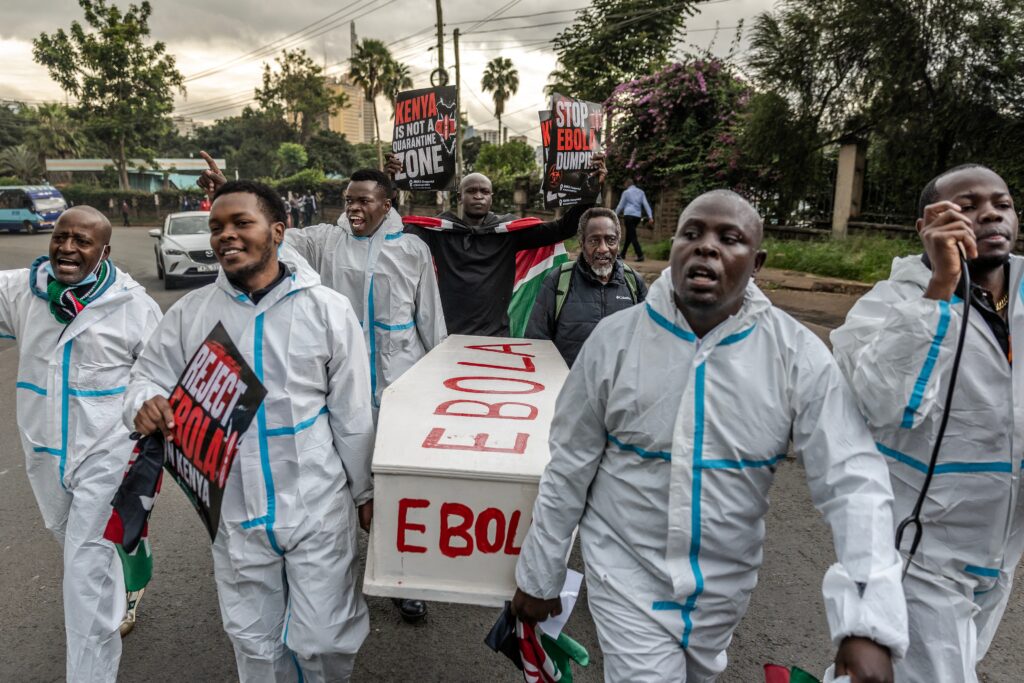
The plan to open a dedicated Ebola quarantine and treatment center for Americans sparked outrage in Kenya, and the Katiba Institute, a constitutional rights advocacy group, filed a lawsuit to challenge it.
The field hospital was to be staffed by officers from the U.S. Public Health Service. In Kenya, there have been no reported cases of Ebola from the outbreak in Congo, and critics of the U.S. plan said it would bring the disease into the country and put local residents at risk.
The plan drew added attention to the Trump administration’s apparent reluctance to allow Americans at risk or infected with the disease to return home.
In its lawsuit, the Katiba Institute complained of a lack of transparency surrounding the agreement.
“The only information that we had came from sort of unnamed U.S. government sources rather than in our own government,” Nora Mbagathi, the institute’s executive director, told The Washington Post. “These orders maintain that nothing should go ahead.”
Mbagathi said that the plans to establish the facility violated Kenya’s constitution.
“Proactive disclosure, relevant impact assessments, relevant contingency plans —that all needs not only to be undertaken but also made public and shared with the public, so that we’re able to really scrutinize that agreement,” Mbagathi said.
In its orders, the court said the documents should be released within seven days.
Authorities say suspected Ebola cases have surged past 1,000, and there are nearly 250 suspected deaths. Countries neighboring Congo have rushed to increase surveillance on its borders and airports. So far, Uganda has reported one Ebola death and nine confirmed cases.
Kenyan President William Ruto on Monday defended the plan for the field hospital, saying that Trump had requested the government’s support to host the facility at the Laikipia air base.
“I gave the okay because it was an agreement and a partnership with friends who have walked with Kenya for 30, 40 years,” Ruto told journalists on Monday night. “The American government has supported us. They have deployed huge resources in Kenya to work with us on HIV/AIDS, to work with us on other diseases. They worked with us on Ebola.”
Ruto said there are 23 other health facilities across Kenya that are no different from the one being put up by the Americans.
“These facilities are meant to make sure that there is proper screening,” Ruto said. “And if there is any positive identification of people who have Ebola, then immediately they are isolated, they are treated, so that we avoid any spread of the disease.”
Kenya has said that it is maintaining surveillance at its borders to prevent the disease from entering the country.
Residents of Nanyuki protested the planned facility on Monday, with hundreds gathering in the streets.
Duncan Simiyu, 28, said that what started as a peaceful protest turned violent when police fired tear gas and live ammunition at the protesters. Simiyu said one person who was shot in the leg had died and that angry protesters stormed the Nanyuki court, tearing down its perimeter fence and damaging property inside.
“When we started the protest going to the site of the facility, we were met by the military who said they had heard us and asked us to go back and that we should present our petition,” he said. “But when going back to town, we met the police who started firing tear gas and even live bullets.”
“We are already dealing with malaria and hunger in parts of the country,” Simiyu said. “We don’t have the same capacity like the U.S. to deal with such a disease.” He added: “If they want to help the Democratic Republic of Congo, they should go inside Congo and set up a structure there.”
On Tuesday, residents told The Post that heavy security had been deployed around Nanyuki.
Mbagathi, of the Katiba Institute, called on Kenyan and U.S. officials to respect the court decision. “The Kenyan government is the one that has the responsibility toward its people,” she said.
The post Kenyan court extends order blocking U.S. hospital for American Ebola patients appeared first on Washington Post.