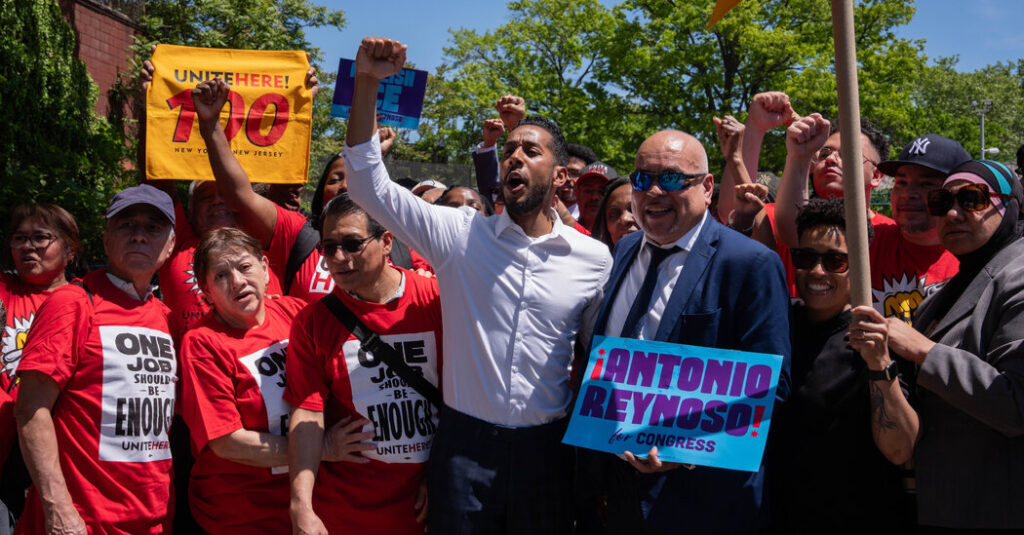
Sitting in the cool of a Williamsburg cafe one recent morning, Antonio Reynoso looked pained as he tried to make sense of how a progressive like him ended up at war with Mayor Zohran Mamdani over a prized New York City House seat.
Mr. Reynoso, the Brooklyn borough president, has been a loyal ally of the mayor and, in another time, might have expected his support. But when a longtime congresswoman’s surprise retirement opened the seat, Mr. Mamdani saw an opportunity, too, and backed a little-known state assemblywoman who would advance his brand of democratic socialism.
There were attempts to deconflict. Mr. Mamdani offered to discuss “other opportunities” for him, Mr. Reynoso said, but the candidate would not budge. Mr. Reynoso, in turn, suggested that Mr. Mamdani reconsider his support for the assemblywoman, Claire Valdez.
“He didn’t want to have that conversation,” Mr. Reynoso recalled. “So we ended it there.”
Six months later, the disagreement has transformed what could have been a sleepy race for a solidly Democratic seat into a hard-fought primary that is driving a wedge through the heart of Mr. Mamdani’s coalition and offering up a preview of a new kind of struggle.
Where most other city races have followed a familiar pattern, pitting a united left against the moderate establishment, the primary in New York’s 7th District has turned the left against the lefter.
And on the ground in the Brooklyn and Queens neighborhoods that make up the district, the contest is stirring up uncomfortable questions about race, class and rapid gentrification that the left rarely wants to acknowledge.
On one side is Mr. Reynoso, 43, the Brooklyn-born son of working-class Dominican immigrants, who has helped build the city’s progressive movement for 15 years. Lined up with him are many of the players who, until very recently, were its arbiters: Black and Latino politicians, major labor unions and the Working Families Party.
On the other is Ms. Valdez, 36, a Latina and Native American from Texas who moved to the area alongside other young, college-educated newcomers and concluded that progressives were not thinking boldly enough. She has the backing of Mr. Mamdani and the Democratic Socialists of America, who were emboldened by last year’s mayoral result.
(City Councilwoman Julie Won and Vichal Kumar, a public defender, are also running, but have gained less traction.)
“This is the new battle line in New York City and urban politics,” said Michael Lange, a writer with ties to both factions who coined the term “Commie Corridor” to describe the district’s overwhelmingly young and left-leaning electorate.
He added: “There are going to be plenty of neighborhoods and districts where the past establishment has receded, and the frontier is now socialists versus progressives.”
The policy distinctions in the race can be difficult to discern. Both candidates support abolishing ICE, want to raise taxes on the rich and cite the crushing costs of housing as their top priority.
But the tribal politics are hard to miss.
Representative Nydia Velázquez, the Puerto Rican trailblazer surrendering the seat after spending three decades as a kind of godmother to the city’s left, has openly chafed at Mr. Mamdani’s involvement in the race.
“I’m not going to allow D.S.A. to define who is progressive and who is not,” she said recently after campaigning with Mr. Reynoso, her preferred candidate. “Because the fact that they are here, I paved the way for that.”
Gustavo Gordillo, one of the organization’s top New York leaders, said he agreed with the congresswoman about her influence — but that the world had changed.
“There were different approaches to left politics on the ballot last election, and it was the democratic socialist approach that won,” he said.
Polling has been scant, but it suggests a close race. Mr. Reynoso’s name recognition, record and endorsements would historically have given him the upper hand. But both sides agree that Mr. Mamdani’s popularity may be more than enough for Ms. Valdez to overcome her short tenure (she has served in the Assembly since last year).
Mr. Mamdani, for his part, did not comment on Mr. Reynoso’s candidacy but said in a statement that he supported Ms. Valdez because she had the “courage to do what’s right even when it isn’t easy.”
“We need to fundamentally change who has power in this country,” he said, “and Claire will spend every day working to do exactly that.”
The contest is playing out against a backdrop of demographic changes that have transformed the area over the last quarter century from an immigrant-heavy enclave into an internationally recognized symbol of gentrification.
The district, which runs from Downtown Brooklyn to Queens, stretching to Astoria in the north and Woodhaven in the east, is still about a third Latino, according to census data, and is home to working- and middle-class neighborhoods and public housing.
Yet in the decades since developers first began putting up luxury apartment towers along the postindustrial waterfronts of Williamsburg and Long Island City, an influx of new residents has driven the average age down and already liberal politics further left.
In last year’s mayoral primary, Mr. Mamdani won 75 percent of the vote there. Today, the district boasts nearly 3,000 dues-paying D.S.A. members, more than elsewhere in the city.
Both leading candidates insist they are campaigning across the demographic divide. But strategies detailed in so-called red boxes on their campaign websites, where candidates give instructions to outside super PACs, suggest distinct bases.
In her instructions, Ms. Valdez listed ZIP codes where the groups should spend, starting with Williamsburg, Greenpoint and Ridgewood, areas that are now home to large pools of college-educated white voters. Mr. Reynoso, by contrast, put up instructions asking for outside groups to target voters over 35 and all voters of color.
As she campaigns, Ms. Valdez displays few qualms about her identification with the area’s newer residents. She moved to the city in 2015 to pursue a “career in the arts,” she said. Instead, she found rising rents and diminishing opportunities, even for those with degrees and cultural capital.
“I don’t think it takes very long to see how hard it is to live in this city,” she said in an interview at a Long Island City diner.
Ms. Valdez does not dispute that Mr. Mamdani’s involvement has galvanized support for her campaign. But she argues that voters want her more ideologically committed politics.
An outspoken critic of Israel’s war in Gaza, Ms. Valdez has criticized Mr. Reynoso for not describing the conflict as a genocide until last year. Where he has advocated reforms within existing systems, she wants to shrink the private sector and drastically ramp up the federal government’s role in building housing.
The district, she said, “is one of the most progressive, if not the most progressive,” in the country.
“The person who leads it should be someone who’s going to stand up for justice, who’s going to have real moral courage and conviction,” she said. “I didn’t see that from the borough president until he started running for Congress.”
The assemblywoman and her allies have also knocked Mr. Reynoso for accepting tens of thousands of dollars in campaign contributions from people connected to the real estate industry.
“It is the real estate industry that is most responsible for turning New York City into a playground for the rich,” Mr. Gordillo said. “It’s the most basic litmus test to show you are behind working people.”
Mr. Reynoso’s campaign pushed back, pointing out that it had taken donations from smaller industry players, not corporate landlords or developers.
Mr. Reynoso is trying to use his experience to try to distinguish himself. He highlights his role as a founder of the New Kings Democrats, which helped uproot the more moderate Brooklyn political machine, and the fact that he personally defeated Vito Lopez, its boss, in a 2013 City Council race.
Long before the renaissance of democratic socialism, Mr. Reynoso forged coalitions to pass laws in the Council that removed ICE from Rikers Island and forced police officers to identify themselves when searching people.
“The thing we have said to Antonio is you can’t cede the left lane to Claire and the D.S.A.,” said Jasmine Gripper, the director of the Working Families Party in New York. “You have the receipts to back it up when someone else just has rhetoric.”
On the campaign trail, Mr. Reynoso has also emphasized his local ties. At a recent stop in Los Sures, the Latino neighborhood in South Williamsburg where he is from, Mr. Reynoso danced to Bomba music with Ms. Velázquez and discussed policy for Puerto Rico.
“It’s a cultural thing,” said Rob Solano, the executive director of Churches United for Fair Housing Action, an advocacy group. “It’s understanding the smell of adobo in the room.”
But in the interview, Mr. Reynoso acknowledged that getting that message to newer residents had been difficult.
“I don’t want to make this about Zohran, but it’s hard not to,” he said. “A lot of these folks are getting involved in politics for the first time now. I think it’s 50 percent of the voting population have been here less than 10 years. They don’t know how hard we fought.”
The pattern was reflected in interviews with voters and canvassers.
Outside a grocery store in Sunnyside, an immigrant-heavy neighborhood in Queens, Consuelo Ramirez, 75, said she had always voted for Ms. Velázquez and would take her recommendation.
“Even though I like the mayor — I like him a lot — I trust Velázquez’s choice,” Ms. Ramirez, a retiree originally from Colombia, said in Spanish, adding, “I know Reynoso will do a lot for the community.”
Ms. Ramirez said she had never heard of Ms. Valdez.
Across town in Bushwick, a group of Valdez supporters, many of them D.S.A. members, gathered on a sweltering evening in May to knock on doors.
Their leader offered advice for how to discuss Mr. Reynoso if his name came up. But one of the volunteers, Nate Lamm, seemed to discount the possibility after canvassing in Bushwick, Greenpoint and Williamsburg.
“To be honest with you, I haven’t encountered a single living, breathing Antonio Reynoso supporter,” said Mr. Lamm, 25, “and I’ve knocked like hundreds of doors.”
Miles G. Cohen contributed reporting.
Nicholas Fandos is a Times reporter covering New York politics and government.
The post The Congressional Primary Tearing the Mamdani Coalition in Two appeared first on New York Times.