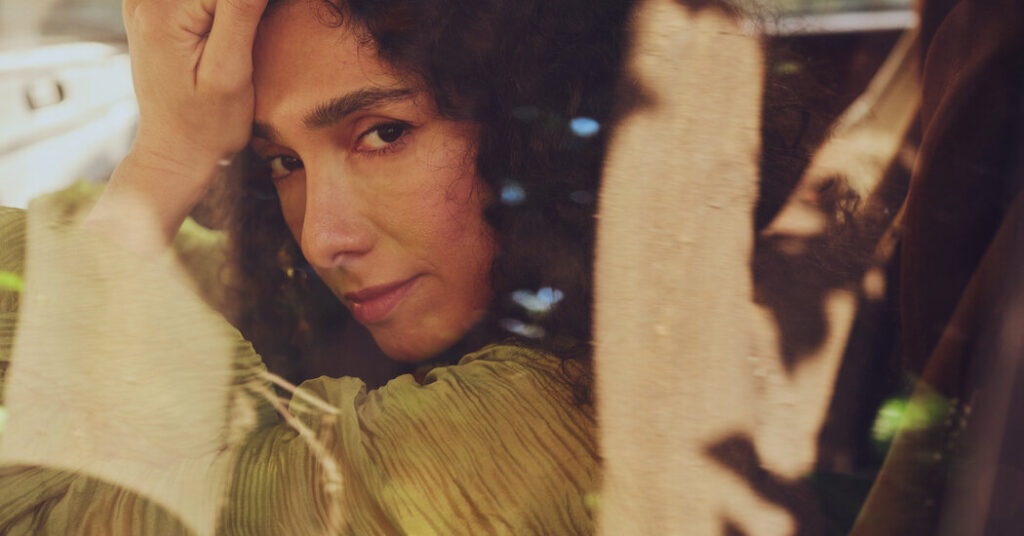
The last time that Azniv Korkejian, the clarion-voiced singer-songwriter who records as Bedouine, returned from a visit to Saudi Arabia, she was filled with an overwhelming sadness she couldn’t quite explain.
Korkejian knew the trip, in 2019, would be nostalgic. She had spent the first decade of her life living in Saudi Arabia, but since her parents were then preparing to retire to their ancestral homeland of Armenia, she wondered how often, if ever, she would be returning to this first country she considered home.
Still, when she got back to Los Angeles, where she now lives, the depth of her despair surprised her. “I just came back so sad,” Korkejian said over lunch at a Lebanese restaurant in Manhattan one afternoon in early May. She wore a marigold sun dress dotted with a burgundy flower print, and around her neck hung a locket housing pictures of her mother and grandmother when they were young.
“I was like, ‘I owe it to myself to confront this feeling,’” she said. And so she did what she often does when she experiences an emotion she wants to better understand: She wrote a song.
That particular composition became “On My Own,” the melancholic but warmly enveloping opening track on her forthcoming album “Neon Summer Skin,” which will be released on Friday. “Woke up with a heavy heart, cradled it like it was a baby,” Korkejian sings, accompanying her own opalescent voice with an appropriately soothing progression of piano chords. “I wrote it and I was like, ‘I think I really like this,’ but I couldn’t play it without crying,” she said. She took that as a sign that she was on the right track.
The musician Norah Jones, in a phone interview, described Korkejian’s voice as being “like a warm balm.” When Jones invited Korkejian to perform some of her songs on a 2021 episode of her podcast “Norah Jones Is Playing Along” — Jones sang backup — she was impressed by both the idiosyncrasy of Korkejian’s chord progressions and the unique timbre of her singing.
“It’s just so nice to hear a voice that’s not trying to prove anything to you and is at ease with itself,” Jones said.
Robin Pecknold, whose indie-folk group Fleet Foxes toured with Bedouine in 2017, agreed. “There’s a confidence and an assuredness in the way she sings,” Pecknold said in a phone interview.
“The thing I admire most — and struggle with the most, when I’m trying to write my own songs — is wanting something to feel classic without sounding pastiche,” he added. “Somehow, more than most musicians I know, she is able to find that balance and make it her own.”
Indeed, an uncanny sense of time-travel pervades Bedouine’s music. (Her chosen moniker is an Anglicized version of an Arabic word for a nomadic tribe.) Her style of singing and composition conjure, quite vividly, the American folk revival of the 1960s and the early ’70s golden age of easy-listening pop, when the AM dial belonged to acts like the Carpenters and Carole King.
“Neon Summer Skin” finds Korkejian sifting through her memories and creating a highly personalized vision of her past. “I have a weird relationship to home, which is a lot of what this record is about,” she said at lunch, having just ordered a vegetarian spread that included grilled halloumi, baba ganouj and Rakakat bi Jebne, an appetizer she describes as being like “Lebanese mozzarella sticks.” (She insists that we save room for knafeh, a savory-sweet Middle Eastern dessert that she loves.)
As a writer, Korkejian is inspired by Leonard Cohen, particularly in terms of efficiency. “I think of it as nutrition — like how one lentil has the most protein or iron,” she said. “What word is packed with the most meaning?”
Throughout “Neon Summer Skin,” Korkejian emanates a kind of benevolent poise even as her songs consider heavy and even harrowing aspects of her family history. Korkejian wrote “Canopies,” a stirring acoustic ballad, from the perspective of her grandmother, who placed her 7-year-old daughter — Korkejian’s mother — in a Lebanese orphanage that had housed victims of the Armenian genocide, to protect her from an abusive family member. “Waves, waves, fold over, and send her scent to me,” Korkejian sings, imagining a mother yearning for her child across the Mediterranean.
The following track, “Deghma Cheega,” is a light, bossa nova-inspired tune, sung in Armenian, that Korkejian describes as being about how immigrants are “expected to be resilient and not reactive,” bearing their struggles with a smile so they are not perceived as threatening. “A lot of immigrants, they are in countries that they don’t want to be in, that they don’t feel wanted in, and they still just have to carry on,” she said, thinking in particular of a cousin, now living in Austria, who fled Syria on a dinghy during the civil war.
“My experience as an immigrant is a best-case scenario,” Korkejian said. “I’m so lucky to have shelter, food, comforts. But I’m still struggling with longing for my family and us being really split up.”
Still, she said, one benefit of writing this album is the way it has made her feel more connected to her “ancestors who had, thankfully, really strong survival skills.”
Korkejian was born in Aleppo, Syria, in 1985; her family moved to Riyadh, Saudi Arabia, soon after. She has memories, from after the 1991 Persian Gulf war broke out, of going to school with a gas mask and her family sleeping on mattresses they had dragged into a hallway, to get away from the glass windows. “We had chips and board games, and I remember so distinctly eating my chips and thinking, ‘What a fun sleepover,’” she said. “I don’t know if that’s just being a kid, or the way my parents shielded me. But I was taken care of in that way, in a place where there were a lot of dangerous things happening.”
In Riyadh, Korkejian and her brothers attended an American-run school, where she was exposed to a blend of Middle Eastern and Western culture. “Lisa Simpson was my first role model,” she laughed.
When Korkejian was 10, her family “won” the green card lottery and moved to the United States. They spent a year outside of Boston before relocating to suburban Houston. In college, she felt a desire to explore America, so she transferred frequently and, as she put it, “used education as a way to travel.”
Eventually she settled in Los Angeles, where she found work as a dialogue editor. She lived and worked in a studio apartment that overlooked a busy thoroughfare. “It was so romantic,” she recalled. “I’d look out on Sunset Boulevard, play my guitar, watch people come and go.”
Songs casually began to form this way. At the time, she was enchanted by “Colour Green,” a belatedly released collection of recordings that the German folk singer Sibylle Baier had made at home on a reel-to-reel tape machine in the early 1970s. Korkejian considered documenting her songs in a similar fashion, so she reached out to an acquaintance, a musician and producer named Gus Seyffert, “who I wasn’t very familiar with at the time, but I knew enough to know he was the tape guy.”
She ended up playing him one of the songs she’d written, a gorgeous folk song about contented self-sufficiency called “Solitary Daughter.”
“It really blew my socks off,” Seyffert recalled, in a phone interview. “It was so effortless, and she played it so perfectly, that I was just like, ‘Well, jeez, if you can just do that again, we have mics set up.’” That recording would make Bedouine’s self-titled debut, released in 2017.
“It was so magical and so serendipitous,” Korkejian said. “It felt understood that we would continue to do this.” Over the next year or so, whenever they both had spare time, Korkejian would bring a new song over to Seyffert’s place. Eventually, she used those recordings to get a deal with the Virginia-based indie label Spacebomb. Over time, the pair became close friends, and then, as Seyffert puts it, “started looking at each other funny.”
With some trepidation about what it would mean for their creative collaboration — which had been working so smoothly — they became romantically involved. They eventually married and now have a 2-year-old daughter.
“I’ve learned so much from him,” Korkejian said. “And I think I’ve gained his trust as a producer, too, where we are actually having an equal exchange.”
One of the most moving songs on “Neon Summer Skin” is the title track, which Korkejian has said is about the “luxury of safety, to the degree that you don’t have to consider your own safety.” The first two verses vividly describe a young Korkejian coming out of a swimming pool in Saudi Arabia, after having spent an afternoon blissfully unaware of the dangers of the wider world. In the final verse, she envisions, in her dulcet lullaby of a voice, tucking in her “sleepy daughter, never thinking once of her safety.” Her reassuring timbre, as usual, gives the listener the visceral feeling of being swaddled.
Korkejian’s daughter had not yet been born when she wrote that lyric, but she imagined it as a kind of wish for the future. “I wrote it about that idea of being between families — the way I was taken care of and hoping to take care of someone else that way,” she said. “How I want my kid to enjoy their childhood and never think about their safety while I’m there to protect them. For their biggest concern to be being pulled out of the pool because it’s getting dark.”
Lindsay Zoladz is a pop music critic for The Times and writes the music newsletter The Amplifier.
The post A Voice Like a Warm Balm, With Songs That Travel Through Time appeared first on New York Times.