These days, the best thing about being mayor of Washington, D.C., is the nice title. The overwhelmingly Democratic city is in an economic contraction, triggered by the Trump administration’s purges of the federal workforce, and is facing a deep budget deficit of $1.1 billion. The metro area lost 1.7 percent of its jobs last year, the worst showing in the country. Meanwhile, a hostile president and Republican-led Congress are able—and eager—to overrule laws, yank away funds, and deploy troops in the city at whim. Perhaps that is why Muriel Bowser, who has held the job since 2015, announced in November that she would not run again. The bitter contest to succeed her has so far replicated the central ideological struggle within the Democratic Party—between a defiantly left-wing politics and the sedate institutionalism it disdains. The Democratic staffer class who will power the party in the coming years will make up a disproportionate share of the June 16 primary’s voters.
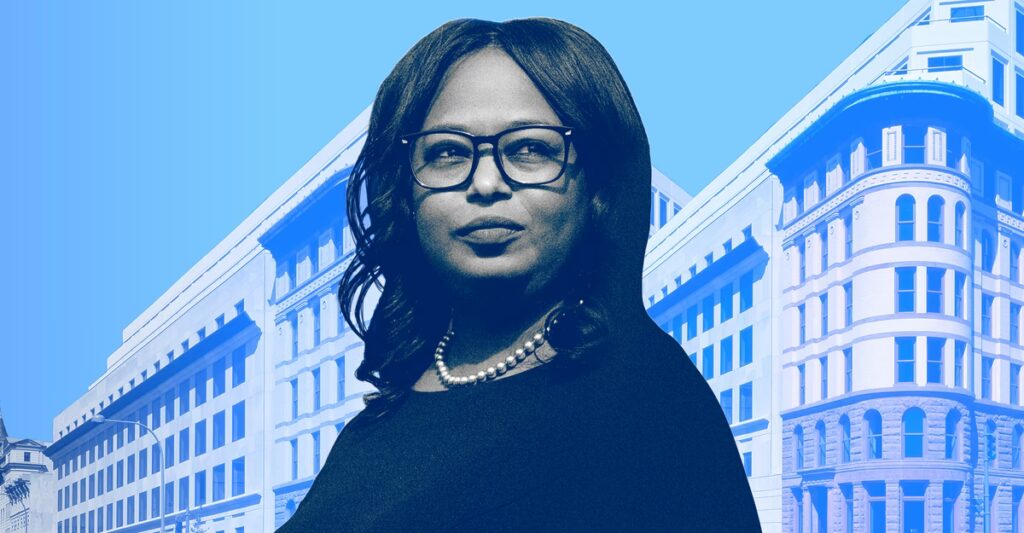
The front-runner is Janeese Lewis George, a democratic socialist on the D.C. city council. She is promising greater resistance to Donald Trump, especially his deployment of ICE agents and National Guard members in the city. She is also proposing state-sponsored plenitude. “I follow the socialist tradition shaped by Dr. King, who said there must be a better distribution of wealth within this country,” Lewis George told me. “And that’s why there’s nothing radical about fighting for universal child care or housing that puts people over profit.” Both her rhetoric and her proposals show a deep skepticism that the private sector can sufficiently provide essential goods and services.
Just behind her in a recent poll is Kenyan McDuffie, a mild-mannered lawyer who served, without much fanfare, on the city council from 2012 until January. “I’m not overcommitting on what we can deliver,” he told me. “What we have to do is be honest with Washingtonians, that D.C. has both a revenue problem and a spending problem.” That McDuffie is close—despite his low-key affect and late entry in the race—speaks more to apprehension about Lewis George than to the persuasiveness of his campaign. Another motivation for McDuffie supporters is the fear that, if Lewis George is elected, Trump would intensify his retaliation, which has already harmed the economy and left thousands of National Guard members idling on its streets at a cost to U.S. taxpayers of more than $1.6 million a day.
[Michael Powell: Where Mamdani has refused to moderate]
Polling conducted by City Cast DC shows that Lewis George is the preferred candidate of affluent, college-educated, Gen Z and Millennial white voters who have newly moved into the city, but that McDuffie leads among longer-term residents, Black voters, and older white people. Victory for Lewis George would be the latest in a string of triumphs for proudly socialist politicians, including, most notably, New York City Mayor Zohran Mamdani. Others predict that her victory would only accelerate the city’s decline. “The District is functionally in a localized recession right now,” Adam Fofana of the DMV New Liberals, a local centrist group that has endorsed McDuffie, told me. “That’s a very real constraint on the resources available, either from the federal government or within the District.”
Lewis George has made two eye-catching promises in her campaign. First: to provide universal child care that caps family expenses at 7 percent of household income. The costs of doing so would be considerable. Even at current child-care prices of about $27,000 a year, meeting the commitment would likely cost hundreds of millions of dollars annually. But Lewis George has also committed to increasing the wages of child-care workers to the same scale as those of unionized teachers, which would considerably raise the total cost. When I asked her how the city could afford those schemes while already facing a serious deficit, she said, “I’m not naive about the fact that we are going to be facing some financial hard times.” She said that D.C. can raise revenue through a new tax on lobbying and consulting firms owned by people who live outside the city. Advocates say this could raise up to $500 million per year—assuming the untested tax does not prompt businesses to relocate to Maryland and Virginia.
Her second pledge is to build 72,000 homes in five years. While Lewis George is pledging to liberalize zoning laws and reduce permitting times—a nod to the yes-in-my-backyard urbanism that has gained force among wonky D.C. Democrats—her pledge would be extraordinarily difficult for private developers to deliver amid the deep recession that the D.C. housing market is in. House prices peaked in May 2021. Since then, they have fallen 26 percent in inflation-adjusted terms, making investments in new-home construction less likely to pay off.
“A couple of years from now, we’re looking at almost no housing production going forward,” Emilia Calma, the director of housing studies at the D.C. Policy Center, told me. Calma attributed the problem to high interest rates, high rates of rent nonpayment, and an extremely slow eviction process. D.C. has also just come off an incredible construction boom: From 2019 to 2026, the District added 45,000 new homes. As a result, real rental prices dropped by nearly 11 percent (even as rents rose across the country). Already discouraged developers will not exactly be lured back by the new tenant protections and expanded rent-stabilization laws that Lewis George is proposing.
Instead, the most important developer would be the local government. “The private market cannot do it alone, so as mayor, D.C. is also going to step up and build mixed-income housing,” Lewis George told me. In place of ordinary development would be “Dignified Homes DC”—government-owned “mixed-income housing with stable rents” to “prioritize residents over profit.” Policy experts would call it public housing or social housing. Lewis George’s faction of the new urban left does not oppose home construction; rather, it aims to achieve it on the government’s terms.
On this issue and others, McDuffie has pitched himself as the moderate alternative. “There is no way anybody is going to build 72,000 units of housing in Washington, D.C., particularly when her goal is to build social housing, which is an experiment and is untested,” he said. (He has instead pitched building 12,000 new homes. He has also promised to preserve 20,000 below-market-rate units whose rent restrictions are scheduled to expire soon.) He would like to reinstate wage subsidies for child-care workers but not commit to universal child care.
Perhaps most decisively for the race, he has pitched himself as tougher on crime than Lewis George, who, ahead of her first council election, in 2020, called for defunding the police. In a questionnaire that she filled out for the Democratic Socialists of America that year, she agreed to support “efforts to demilitarize and disarm our police departments.” But in the same year, McDuffie also said, “We need to redirect funding away from the police department to other government agencies.” Both are now eschewing those past statements and campaigning on hiring more police officers. And both candidates, when I asked them about whether they had flip-flopped on the issue, pivoted to talking about their past work as prosecutors.
Still, there are clear differences: Lewis George was the sole vote against a strict emergency crime bill in 2023, passed amid a homicide spike. Unlike McDuffie, she opposes a nighttime curfew on teenagers—imposed after several episodes of violent “teen takeovers” of public spaces that have resulted in brawls, robberies, and gunfights. And when I asked Lewis George whether she would commit to not defunding, demilitarizing, or disarming the police as mayor, she answered: “That’s a nuanced question.” By that, she meant she wanted other agencies to deal with mental-health crises and traffic enforcement, “so that officers actually get to do the job we need them to do.” This stance is arguably responsive to her core constituency of white liberals, who are much more supportive of such efforts than Black voters are.
[Charles Fain Lehman: Trump is right that D.C. has a serious crime problem]
This will be the first mayoral election in D.C. that gets decided through ranked-choice voting. That system might be empowering to McDuffie, who, polling suggests, narrowly trails Lewis George overall but is the second choice for more voters. The ranked-choice system has also tempted outside candidates to try their lot. “The principal opponents I have in this race are career legislators,” Rini Sampath, a young government contractor who entered this race in a fit of frustration over city management, told me. “My fear is that either of these guys—regardless of what their promises are—are going to get in office and not have the chops to execute.” Sampath’s campaign promise is to not make any grand promises and to instead fix basic city management. Gary Goodweather, a longtime real-estate developer polling at about 7 percent, lobs a similar critique at the front-runners, who, he says, do not know how to build. “They’ve never done it. I spent my career doing it,” he told me. Whereas Sampath is minimalist about her pledges, Goodweather is maximalist. Among other proposals, he wants to make transit use free for D.C. residents, set up a small modular nuclear reactor, and “convert office buildings into indoor vertical farms.”
The schism of D.C. Democrats between socialists and institutionalists is a familiar battle across the country—between those who believe that the government can solve most social problems and those who favor cautious approaches. Lewis George’s performance will gauge the activist left’s strength within national Democratic policy circles. But the prize for the winner is perhaps the least appealing of all those contests. Whoever prevails in the mayoral primary will likely inherit a city stuck in a Trump-induced contraction with budgets that Congress can unilaterally overwrite and a police force that the president can federalize. Trump enjoys squeezing those who are subject to his discretion—trading partners, military allies, universities, domestic businesses, and, in his most immediate vicinity, the District of Columbia. Lewis George and McDuffie are staging a contest for the future of the Democratic Party. Trump will do his utmost to remind them of their painful and powerless present.
The post Is Socialism the Answer to D.C.’s Woes? appeared first on The Atlantic.