Early this year, Lebanon’s leaders seemed to be edging toward one of their most elusive goals: disarming Hezbollah, the powerful Iran-backed militia that has long operated as a state within a state.
That effort — tentative and incremental from the start — has now stalled.
After more than a year of largely holding its fire, despite Israeli strikes from across the border, Hezbollah re-emerged as a major combatant. In March, after the United States and Israel began the war with Iran, Hezbollah began cross-border attacks on Israel in solidarity with its patron, and it has killed several Israeli soldiers.
Now, Lebanon is trapped in a familiar position. Israel has intensified its military campaign against Hezbollah, making the group even less likely to disarm. And Lebanon’s government, wary of Hezbollah’s enduring strength and haunted by memories of civil war, has recoiled from the idea of forcibly seizing its arsenal, despite Western pressure to do so.
On Monday, the Israeli government announced plans to bombard the southern outskirts of Beirut, and Hezbollah claimed new attacks against Israeli soldiers and communities — reflecting how a cease-fire declared by the Trump administration in April increasingly exists only on paper.
With hundreds of thousands displaced by the fighting and Israel occupying parts of southern Lebanon, many Lebanese worry that any strife between the government and Hezbollah would deepen the country’s turmoil and reopen old wounds.
“Any coercive or confrontational process from the army will be complicated because it would require a nonconsensual decision, which is very much against the grain of Lebanese politics,” said Heiko Wimmen, the project director for Lebanon at the International Crisis Group, a research organization.
Another obstacle is Iran itself.
Though battered by two wars with Israel and the United States in less than a year, Iran’s authoritarian clerical rulers remain firmly in charge. Analysts say Hezbollah is unlikely to relinquish its weapons unless Iran’s regional influence and ability to project power are meaningfully curtailed by the war.
“Lebanon will have to wait for change in Tehran before it can turn a page regarding Hezbollah’s defiance of the Lebanese national interest,” said Lina Khatib, a visiting scholar with the Harvard Kennedy School’s Middle East Initiative.
A Window Briefly Opened
A series of Middle East wars that began with the Hamas-led Oct. 7, 2023, attack on Israel left Iran’s regional allies — including Hezbollah, the most powerful — all weakened.
Over the past three years, Israel and Hezbollah have fought two wars. When a U.S.-backed cease-fire in late 2024 paused the first one, Western and Middle Eastern governments, including Lebanon’s, saw a rare opening to pursue, finally, a disarmament of Hezbollah.
The truce agreement envisioned that the group would gradually surrender its weapons — particularly south of the Litani River, near Israel — in exchange for an end to Israeli military operations in Lebanon.
The idea seemed to gain momentum after a new president and prime minister took office in Lebanon in early 2025, pledging to prioritize Hezbollah’s disarmament. Last August, Prime Minister Nawaf Salam’s cabinet directed the military to draft a plan for dismantling Hezbollah’s arsenal by the end of the year.
As the cabinet was reviewing that plan in September, ministers aligned with Hezbollah walked out, echoing the group’s often-made claim that disarming it would leave Lebanon vulnerable to Israel.
Still, the process moved ahead.
Israeli and Lebanese officials regularly held talks at a U.N. base in southern Lebanon, facilitated by the United States, to discuss progress on disarmament. In October, U.S. Central Command said the Lebanese military had removed nearly 10,000 rockets and about 400 missiles from the south over the preceding year. In January, the army said it had completed the first phase of clearing Hezbollah’s weapons from the area between the Litani and the Israeli border. Israel called it “an encouraging beginning” but “far from sufficient.”
An Opportunity Derailed
All of that progress came to a stop on Feb. 28, when Israel and the United States attacked Iran.
Within days, Hezbollah fired on Israel in response, demonstrating that it still had a substantial arsenal of rockets and antitank missiles. Its fighters seemed increasingly agile, attacking Israeli troops with new explosive drones that were harder to intercept.
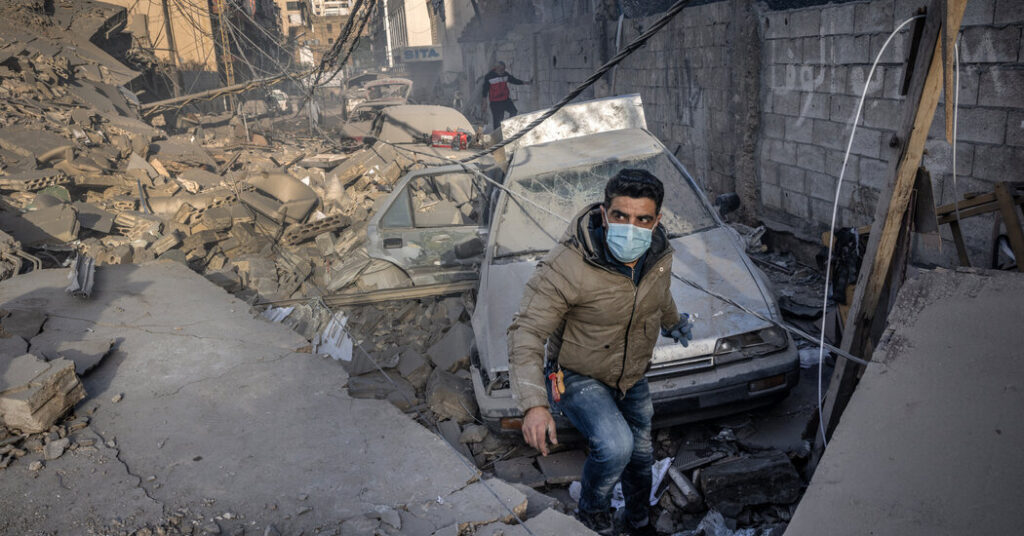
Israel responded with an offensive that has devastated southern Lebanon, killed civilians and brought Lebanese territory under its control. But it has done little to weaken the resolve of Hezbollah, which insists it will not surrender its weapons.
“The Israelis were surprised. The Americans were surprised. And the whole world was surprised by the resistance’s capabilities,” a Hezbollah spokesman, Hajj Youssef al-Zein, told reporters in May.
The standoff has left Lebanon’s government in a bind. It barred Hezbollah in March from engaging in military activity, an order that proved toothless, and now faces mounting pressure to rein it in more effectively.
Memories of Civil War
Founded in 1982, Hezbollah has cast itself as Lebanon’s foremost defender against Israel, entrenching itself along the southern border.
Its leaders have long argued that its weapons are essential to defending the country and preserving the political influence of Shiite Muslims, one of Lebanon’s three main religious groups and the bedrock of Hezbollah’s support.
Over time, Hezbollah emerged as Lebanon’s dominant political and military force, widely seen as stronger than the country’s own armed forces. But many Lebanese people have come to resent being pulled into one ruinous war after another by the group.
“Hezbollah has been monopolizing the political voice of the Shiite community and is packaging criticism of the militia in sectarian terms,” Ms. Khatib said. “This makes it difficult for the Lebanese state to confront Hezbollah even after the Lebanese government ruled that Hezbollah’s military actions are illegal,” she added.
Before the current war began, Lebanon’s military had been reluctant to raid private homes and other buildings in the south where it suspected that Hezbollah weapons were hidden, according to Israeli leaders and a U.N. official who spoke on the condition of anonymity to discuss sensitive matters.
Experts say that such raids could raise tensions by evoking memories of Lebanon’s traumatic 15-year civil war.
Mr. Salam, the prime minister, has repeatedly pointed to the Taif Accords of 1989, which ended the war and called for the country’s many militias to be disarmed. “So we are over 30 years late” on disarming groups like Hezbollah, he said in a recent interview.
Another obstacle to disarmament is Lebanon’s hope of tying it to Israeli withdrawal from the south.
“The Lebanese government, if they are actually going to take real steps, they are going to want to be able to demonstrate something to the population, that they are getting something in return,” said David Schenker, a former senior State Department official.
‘A Moment of Truth’
Hezbollah’s disarmament is at the center of the U.S.-mediated talks between Israel and Lebanon — a rare diplomatic process that both Hezbollah and Iran have denounced.
Arab and Western officials, along with regional analysts, have floated various plans. These include proposals for an independent international commission, modeled on the reconciliation process in Northern Ireland, to oversee full disarmament.
In April, Secretary of State Marco Rubio said the United States was working to get “vetted units” within the Lebanese Army to target Hezbollah “so Israel doesn’t have to do it.” Others have suggested using foreign funding as leverage to push Lebanon’s government to pursue disarmament.
Taking on Hezbollah would seem to require a major overhaul of the Lebanese military, which lacks sufficient personnel, equipment and training, and it is unclear who would pay for that. Gulf states that might back such a project have been strained by the regional war, and Lebanon has not made fiscal reforms that would be required to gain access to international financial assistance.
In May, the United States imposed sanctions on nine people — including members of the Lebanese military and intelligence services — accusing them, among other things, of impeding Hezbollah’s disarmament.
“Lebanon is facing a moment of truth,” said Mr. Wimmen of International Crisis Group. “Whether it will defer or delay resolving the question of disarmament, or how it will deal with it, will define what’s to come next for the country.”
Hwaida Saad contributed reporting from Beirut.
Abdi Latif Dahir is a Middle East correspondent for The Times, covering Lebanon and Syria. He is based in Beirut.
The post How Lebanon’s Best Chance to Disarm Hezbollah Failed appeared first on New York Times.