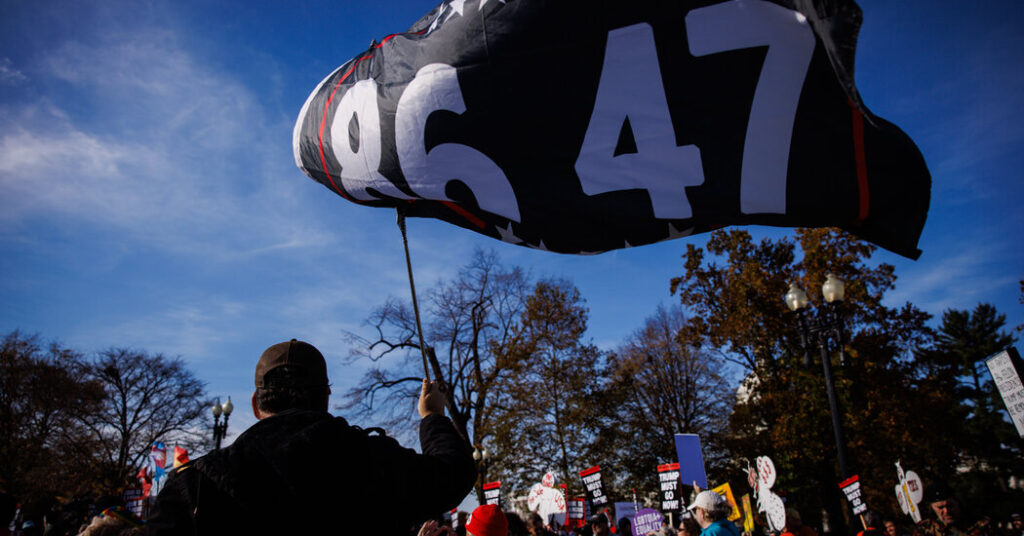
A federal judge in Washington ruled on Monday that protesters criticizing President Trump near the Capitol could not be forced to take down a flag reading “8647,” finding no indication that the message could be taken as a true threat against the president’s life.
Judge Randolph D. Moss wrote that despite efforts by police to compel the group, an advocacy organization called Accountability Now USA, to remove the flag and other signage over the course of several months, he concluded it was clear that the flag and its message were protected speech. The dispute in some ways mirrored the criminal case against James Comey, the former F.B.I. director, who was indicted on a charge of making a threat against the president over a photograph posted to Instagram that depicted seashells on a beach arranged into the same numbers.
Beginning with Mr. Comey’s indictment in April, the Trump administration has claimed that the phrase “86” — common in restaurant parlance — could be interpreted as a death threat. The other number, “47,” is a reference to Mr. Trump, the nation’s 47th president.
Todd Blanche, the acting attorney general, said in May that others without Mr. Comey’s reach and profile would not be similarly investigated for posting or displaying the phrase.
Turning to the Merriam-Webster dictionary, Judge Moss wrote the phrase “86” originated in “1930s soda-counter slang,” meaning to “throw out,” and had evolved through the twentieth century to mean “to refuse to serve a customer” or “to get rid of.” He noted that the dictionary included language that it did not endorse any definition with violent connotations “due to its relative recency and sparseness of use.”
The activist group received a permit from the Park Service in April to set up near the George Meade Statue outside the Federal District Court in Washington, within walking distance of the Capitol and the National Mall. According to court filings, the group has maintained a 24-hour demonstration in the spot, calling for Mr. Trump’s impeachment, and it intends to renew the permit when it expires in August.
But after it set up the encampment, the group reported several contentious encounters with law enforcement, including officials with the Secret Service and National Park Service, who insisted they take down signs, hinting they might face arrest if they did not.
A National Park Service official contacted the group in April, writing that signs alluding to president’s ties with Jeffrey Epstein were “deemed unprotected obscenity” by the agency, and needed to be removed. In particular, the National Park Service sought the removal of a sign that said Mr. Trump’s supporters “love child rapists,” an apparent allusion to criticism over the Justice Department for missing files in its release of documents related to Mr. Epstein’s sex trafficking investigation.
Mr. Trump has maintained he severed ties years before Mr. Epstein’s involvement in federal crimes, and has denied any wrongdoing.
The group did not take down the sign. But once it put up the “8647” flag, in court filings members said they faced further scrutiny, including a visit by Secret Service agents asking if the flag was meant as a threat. According to filings, a volunteer with the group told the agents “I want Trump to live forever and rot in jail where he belongs,” after which the agents left.
But in May, a group of National Park Police officers arrived and demanded the flag be taken down, informing the group that flying it again would violate their permit to protest on federal land.
The Trump administration had argued to Judge Moss that there was a “strong governmental and public interest” in investigating any possible threat against the president, even ones that turn out to be frivolous. It said the Secret Service had investigated more than 1,300 instances of individuals using “86-47,” though predominantly in posts online.
Judge Moss wrote that within the context of the demonstration, which focused on impeachment and “removal” of Mr. Trump from office, outside a courthouse, the message could not be seen as a credible threat. He barred the Interior Department and Kevin Greiss, the superintendent of the National Mall, from interfering with the group’s demonstration for two weeks.
“Under these circumstances, it is difficult to fathom how the N.P.S. (or the Secret Service) could have concluded that a reasonable observer would view the flag as a true threat,” Judge Moss wrote. “The term ‘86’ is used far more often to mean ‘throw out’ than ‘kill,’ and it appeared at a demonstration that was focused, of all things, on the constitutional impeachment and ‘removal’ of the president.”
Zach Montague is a Times reporter covering the federal courts, including the legal disputes over the Trump administration’s agenda.
The post Demonstrators Cannot Be Forced to Take Down ‘86-47’ Flag, Judge Rules appeared first on New York Times.