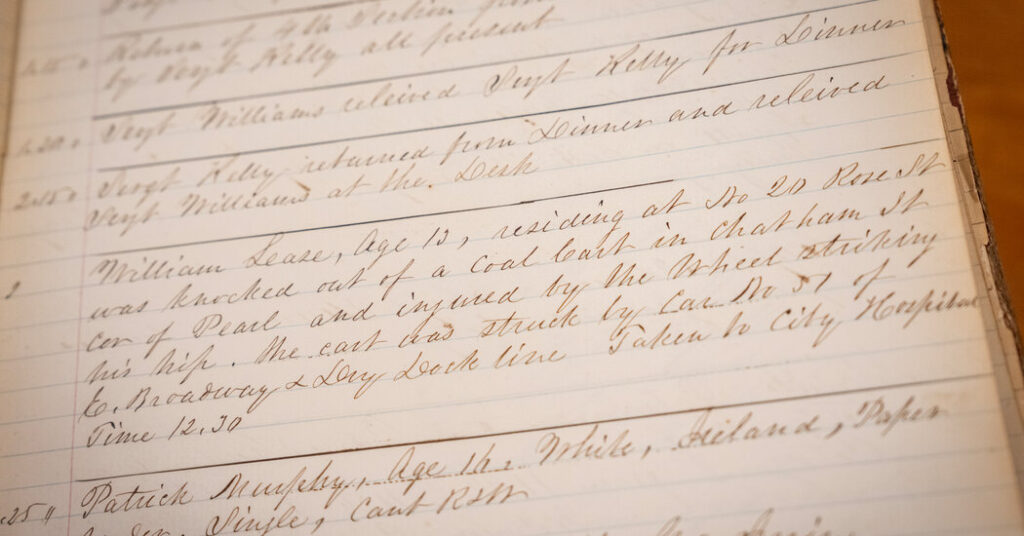
On Aug. 29, 1866, a horse-drawn coal cart was clopping along at East Broadway and Chatham Square when a trolley car on the Dry Dock railway line rammed into it, knocking off its 13-year-old passenger and rolling over his leg.
It was the start of a busy afternoon for the patrolmen at Manhattan’s 19th Precinct. At 4 p.m., two girls found a lost toddler wandering along Cherry Street. That evening, John Connell, a 33-year-old shoemaker of Roosevelt Street, was charged with assault and battery.
Those events and millions more have been recorded in police command logs — hard-bound ledgers with daily, handwritten entries that chronicle the city’s history through the work of its beat cops. Notes about mundane tasks like roll calls and prison cell checks were, at times, interrupted by pivotal moments: The lead-up to the Civil War draft riots in 1863; the assassination of John Lennon at The Dakota in 1980; the terrorist attacks on Sept. 11, 2001.
Tens of thousands of logs have piled up like silt on bookshelves and atop filing cabinets throughout New York City’s 78 precincts, which still use ledgers nearly identical to the one from 1866. Now this way of record-keeping, one that has spanned three centuries, is ending.
The New York Police Department plans to roll out a digital data-input system that will show which officers are on duty, a list of completed tasks and information on detainees, including when they were arrested and whether they arrived sick or injured. It expects to release a pilot in several precincts by September.
Most vital records like crime and arrest reports have been digitized for years, and the department was a pioneer in using computers to analyze trends. Still, it hung on to using ledgers until Jessica S. Tisch, the police commissioner and a technocrat, prioritized a shift away from pen and paper.
The new system “will give leadership a clear, real-time picture of what’s happening across their precincts,” Ms. Tisch said in February during her remarks at a New York City Police Foundation event in Midtown. “There is no reason a department of this caliber should still be using 19th-century technology.”
The old logs will remain on shelves, in storage rooms or wherever they are scattered across the city. That includes the ledger from 1866, one of three acquired by the New York Public Library.
On a recent afternoon, at the library’s flagship building on Fifth Avenue, Detective Arthur Tsui and Sgt. Patrick Lindie, who were curious about the logs, leafed through their yellowed pages. As they scanned the entries, they noticed one name inscribed again and again: Capt. Galen T. Porter.
A brief (online) search revealed that the captain was a senior commander of the Metropolitan Police, the city law enforcement agency that predated the Police Department. On July 13, 1863, Captain Porter ordered his officers to quell a mob of club-toting Irish laborers protesting the Civil War draft. The laborers believed that, while they were on the front lines, their jobs would be taken by Black men, most of whom were ineligible for citizenship and therefore could not be drafted. The melee led to three days of deadly rioting, largely considered the worst civil disturbance in the city’s history.
Downtown, at the Ninth Precinct in the East Village, was another old ledger. This one, however, traveled across the country.
About eight years ago, Police Officer Michael Ranieri was at his desk when the phone rang. The caller said he was a lawyer in California. He told Officer Ranieri that he had been rummaging through his late father’s belongings when he stumbled upon a thick brown book.
The lawyer said an address inside was for the Ninth Precinct.
“I said, ‘Send it, I’ll take a look,’ not thinking of what importance it might have,” said Officer Ranieri.
When the book arrived, Officer Ranieri flipped through pages filled with elegant, slanted handwriting. “Then I noticed the date,” he said.
The ledger was a command log written in 1898, the year the five boroughs consolidated into a single metropolis.
The lawyer, it turned out, was the son of a late-19th-century Manhattan prosecutor who must have kept it as evidence during a court proceeding, and, for some reason, never returned it to the police.
The ledger now sits in a glass case in the precinct waiting area so that visitors can see it. Inside are details that officers would write in a log book today: a person reported missing; the time and place of an arrest, the names of officers on sick leave and those who were reporting for duty.
“My favorite part about looking through it is how much things change, but how, in many ways, everything stays the same,” he said.
Two miles away, at the Information Technology Bureau in the Police Department headquarters, Sgt. Hubert Chrostowski was at his desk testing the new digital system. He pointed to the computer monitor in front of him, which displayed a blue screen divided into sections with details about which officers were on patrol, who was in custody, and what tasks must be completed.
The portal would have been useful when he was working as a desk sergeant in the 44th Precinct, Sergeant Chrostowski said, who joined the bureau in September. “I was actually writing in the command log just a few months ago,” he said. “Now to know that an entry that used to take me some time is now reduced to a few clicks is phenomenal.”
Still, some police officers say, the old command logs forge a link between the modern cop to the patrolmen of the past in a way that cannot be accomplished by a computerized system.
A ledger from August 1928 describes how Capt. James B. Nestor sold “perishable abandoned property” — several eggplants — for 50 cents to a Brooklyn man named John Christiano. Another dated June 1, 1998, says that Scott Weiland, once the lead singer of the Stone Temple Pilots who later died from an accidental overdose, was arrested on the Lower East Side for carrying 10 glassine bags of heroin. It notes that the incident was “possibly newsworthy.”
A log from Sept. 11, 2001, says that Police Officers Ramon Suarez and Mark J. Ellis of Transit District Four never returned for duty. An entry dated May 5, 2011, documents then President Barack Obama’s visit to the 10th Precinct. He signed the book and wrote the words, “God Bless!”
Most entries in the log books are not so momentous. The stiff phrasing of one entry from April 11, 1863, made Sergeant Lindie laugh out loud when he read it at the library.
“At 2 o’clock this morning, an attempt was made by thieves to enter the grocery store, corner of 73rd and 3rd Avenue, by cutting a hole in the window glass with a diamond,” the entry said. “The proprietor, hearing the noise, disturbed them and they fled without accomplishing their objective.”
Chelsia Rose Marcius is a criminal justice reporter for The Times, covering the New York Police Department.
The post A Long History of Handwritten Police Logs Comes to an End appeared first on New York Times.