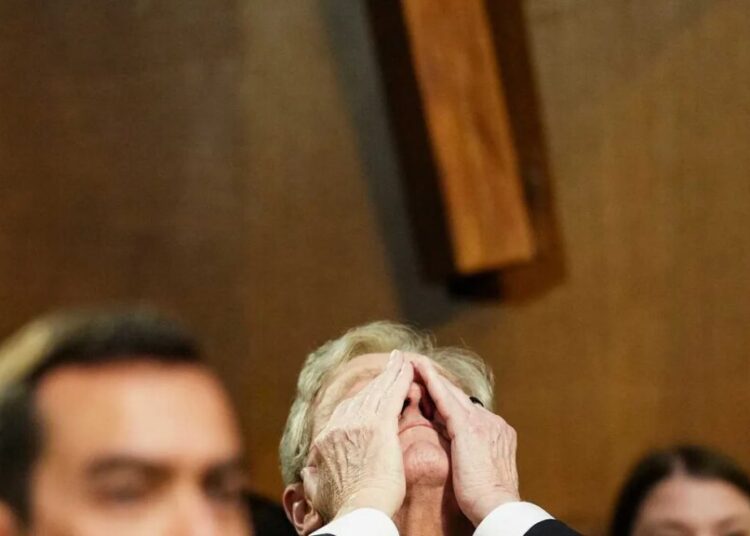
This week, the YOLO Republican caucus takes center stage — YOLO, of course, standing for “you only live once.” On “The Opinions,” the Times contributor Robert Siegel argues that senators like Thom Tillis and Bill Cassidy, freed from certain electoral pressures, can now vote in accordance with their principles rather than whatever President Trump dictates.
He is joined by the Times contributor E.J. Dionne Jr. and the Bulwark editor Mona Charen to discuss the caucus’s newest member, John Cornyn, who was recently defeated in Texas, and what Cornyn’s loss signals about MAGA’s grip on the Republican Party.
Below is a transcript of an episode of “The Opinions.” We recommend listening to it in its original form for the full effect. You can do so using the player above or on the NYTimes app, Apple, Spotify, Amazon Music, YouTube, iHeartRadio or wherever you get your podcasts.
The transcript has been lightly edited for length and clarity.
Robert Siegel: Hi. I’m Robert Siegel, in conversation about politics with, as always, New York Times Opinion contributor E.J. Dionne Jr.
E.J. Dionne Jr.: Always fun to be with you.
Siegel: And returning this week is Mona Charen, policy editor of The Bulwark and host of “The Mona Charen Show.” Welcome back. It’s good to see you.
Mona Charen: I’m delighted.
Dionne: Great to have you here.
Siegel: And when it comes to politics, we are not short of material this week.
The biggest news was the Texas primary — above all, John Cornyn’s defeat in the Republican runoff, for what would have been Cornyn’s fifth term in the U.S. Senate. He was beaten by an opponent with enough political baggage to weigh down a battalion of Red Caps, but the Texas attorney general Ken Paxton had Donald Trump’s backing, and that proved even weightier.
E.J., what are the lessons there for Republicans in the Texas primary results?
Dionne: Well, I think the first is a lesson they should’ve learned long ago, which is that Donald Trump’s loyalty only goes one way. John Cornyn went out of his way to be supportive of Trump. He even had a picture of Trump’s book “The Art of the Deal” that he was holding, and it did him no good.
I think, by the way, that Trump saw Paxton was going to win and jumped on the bandwagon at the end. But, in any event, Cornyn got killed. But I think there’s a larger message for the Republican Party, which is: Yes, this party is MAGA-fied now. For something I’m writing, I’ve been looking at this great series of Economist/YouGov polls, and they followed this closely.
In September 2022, only 38 percent of Republicans identified as MAGA Republicans. As of May, the proportion had risen to 62 percent, so this party is MAGA-fied. But in the electorate as a whole, the only people becoming MAGA are Republicans, so that Americans who call themselves MAGA rose from only 11 percent to 19 percent. So, MAGA’s a really small percentage, and what I would call the MAGA gap between the Republicans and the rest of the country has gone from 27 percent to 43 percent.
And one of the places you’re seeing this is in sharp turnout declines in the Republican primary. In the first round of the Texas race, there were more people who voted in the Democratic primary than in the Republican primary.
Siegel: Two hundred thousand more.
Dionne: Yeah. And then, in this runoff, the total turnout was 1.4 million. Donald Trump got 6.4 million votes in Texas in 2024. This is a dispirited party, and the part that’s dispirited is the non-MAGA part, and I think this is a real problem going forward for the Republicans.
Siegel: Mona?
Charen: Yeah, it’s really interesting, in those numbers, that if you look at Paxton’s performance in the initial round and then look at how he did in the runoff, it’s almost the exact same number, which means those MAGA people are going to be there no matter what, even in this kind of environment.
The primary also shows us that this is unlike political parties in the past — political parties in the past, where you had an unpopular president, which is the key to how things are going to go in a midterm. The president would understand that his party needed to put some distance, needed to show some independence from him in order to hold on to their seats in a rough year. Not in this party. In this party, Trump has managed to spray his musk over every single candidate, so that they cannot escape it.
Dionne: I’m shuddering at that thought, by the way.
Charen: And they have no choice. They are going to be victims of Trump’s unpopularity, and he’s leaving them really hanging out there. Well, we knew this, but he never had any interest in Republican success, except insofar as it enhances Trump’s power. So he’s not concerned about Republicans who might have been — like, Cornyn would have been a better general election candidate. This is universally acknowledged. He doesn’t care about that. He wants the party to be 100 percent MAGA and loyal to him.
Dionne: And you know what’s interesting about that? I’m not in the habit of comparing Newt Gingrich favorably to others, but when you go back to Newt Gingrich as speaker, he understood that his majority was built, in part, by Republicans who were way more progressive than any Republican out there now. People like Chris Shays in Connecticut, Jim Leach in Iowa. And Republicans then understood that if you lost all these seats, you wouldn’t have a majority. Now, in a much more conservative party, they’re willing to throw over the side very conservative people who just aren’t loyal enough to Trump. That’s so dangerous.
Charen: That is exactly right. By the way, they call those people in those swing districts “majority makers.” And that is something that both parties used to understand. I also have some questions about whether Democrats sometimes put purity tests, and don’t think about matching their candidates to the districts, but that’s maybe a topic for another day.
Dionne: I think it’s less of a problem now. There are some districts where there’ll be primaries, but mostly, from what I can tell, they’ve been pretty good at matching the right ——
Charen: I’m worried about the Michigan Senate race.
Siegel: Let’s talk about the lessons of Texas for Democrats. I mean, is one lesson for the Democrats: Your opponents are suicidal; do not get in the way. Mona?
Charen: Right. Never interrupt your enemy when he’s in the process of destroying himself. Yes, sure. That is one lesson. But, look, the Democratic primary was interesting because there you did have voters, I think, looking ahead and being kind of smart and saying: Do we want Jasmine Crockett, who’s a little more polarizing? Even though they may not have been that different ideologically. Just stylistically, she was much more appealing to the progressive side of the Democratic Party. And they went with James Talarico, who has more crossover appeal. And so that was, I think, smart, and looking at the future. Look, is it the first time in 25, 30 years that they might possibly win a Senate seat in the state of Texas? And it’s very important that Democrats use this opportunity by remembering that they can’t win just with the Democrats. They need those independents desperately.
Dionne: And, you know, I think something interesting is going on in the Democratic Party with Talarico. Also, I would say, somebody like Jon Ossoff in Georgia. Greg Sargent, in The New Republic, had a really interesting line, where he said: “Trump and Trumpism are wrecking our common life at a very profound moral and spiritual level.” And yes, they’re going after some of Talarico’s theological statements from the past, but Talarico is putting not simply people’s interests at the heart of the campaign, although he talks about those. I mean, you always talk about people’s interests in a campaign. But it is really a moral critique.
Obviously, Paxton gives him a lot of room for that; so does Trump. But it’s a moral critique for how the economy works. And we’re not going to say much about it today, but I think you see — in the response to Pope Leo’s encyclical on A.I.— a real longing for something that’s not just political, not just economic, but a kind of moral view of how we are behaving toward each other and in our economic life. And Talarico really nails that home in just about every speech he gives.
Charen: Yep, and he’s shown some graciousness toward opponents, which is a desperately needed tone in American politics, so that’s hopeful, too.
Dionne: No, it was ironic, because he was ready to rip up Cornyn as an establishment Republican, but instead, when Cornyn lost, he said that we both appreciate public service. Just a nice little tweak at his opponent.
Siegel: Well, John Cornyn is a member of the Senate Republican leadership team, but having lost his re-election bid, he’s now eligible to join the Louisiana Republican senator Bill Cassidy, who lost his primary in the — it’s not quite a caucus, but the YOLO Republicans. “YOLO” stands for “You only live once.” The idea is that you’ve been loyal to Donald Trump in nearly everything, but now that you’ve been defeated by a MAGA-backed opponent, you’re a lame duck. You can actually vote in accordance with your real principles, assuming you can remember what those were. Mona, can the YOLO Republicans actually influence events now that their spines are out of storage?
Charen: I like that. So, the numbers are very close, right? So you would need more than two or three Republicans to really affect things in the Senate in particular. And it has been the case that Republicans — even after they have lost their races, even after they’ve announced their retirements — have proven less courageous than one might hope. But ——
Siegel: You could still become ambassador to Liechtenstein.
Charen: I guess.
Dionne: Pretty little place.
Charen: I mean, there has been a burst of frankness that’s come out of this — what you call the YOLO caucus — which includes Thom Tillis, who is not running again.
Siegel: From North Carolina.
Charen: From North Carolina. It includes Mitch McConnell, it includes several others, and they are making some pretty forthright statements. Thom Tillis, for example, said — regarding this slush fund that Trump proposes — he said, “I call it a payout pot for punks.” Now, that is the kind of language we haven’t heard. You’ve even had people like Senator Mitch McConnell saying: “So the nation’s top law enforcement official is asking for a slush fund to pay people who assault cops? Utterly stupid, morally wrong — take your pick.” Those are the kind of words you did not hear from most Republicans for the past 10 years. I’m not sure there’s going to be a legislative impact, but what we are getting now, with these newly freed YOLO Republicans, is insight into what they have been saying behind the scenes all this time. And any dose of honesty is healthy.
Dionne: You know, I think there are two issues here: One, to go where Mona left off, it is clear that there is more dissidence publicly now than there was even a month ago. I think his endorsement of Paxton and turning his back on Cornyn actually played a role in this, because Cornyn was very popular among his colleagues. He almost became the leader ——
Charen: And he raised a ton of money for them.
Dionne: Yeah. And so I think a lot of them took that badly. And so they become dissident. This slush fund is a step, or five steps or 100 steps, way too far, even for them. The war itself is starting to split Republicans, with some of the most hawkish Republicans, like Roger Wicker from Mississippi, who’s not known as somebody who’s going to run out there and attack Trump, making a very strong statement about the possibility of — he didn’t use the word “sellout,” but it was along those lines.
So you are seeing this dissidence. The magic number is three plus one. The question is, if these YOLOs vote together — YOLOs, a new term, I use it respectfully — if the three of them vote together, you know that puts a lot of pressure on is Susan Collins and Lisa Murkowski. Susan Collins of Maine, who’s up for re-election, and Lisa Murkowski of Alaska. Because they have been publicly dissident, but they could cast “no” votes up to now that had no actual effect on what was happening in the Senate. If these three vote no, then the Collins and Murkowski votes become very significant, because they are, in another sense — to pick up your earlier term — majority makers. They get them to 51. Now, I’m still skeptical that John Cornyn, who’s a party loyalist deep all the way down, is going to break as much as I think Cassidy and Tillis might, but we’ll see.
Charen: John Cornyn reminds me of that great novel “Darkness at Noon,” where this Communist is arrested by Joseph Stalin on trumped-up charges, and he knows he’s innocent, but after a while, he just comes to embrace that if the party has arrested him, he must be wrong. He must have done something to deserve it. And I had that vibe from Cornyn a little bit. Here he has been defeated by somebody that he himself described as a moral abomination, which Paxton is. We haven’t gone into that. We could.
Dionne: But it would take the whole segment.
Charen: Exactly. So, he’s beaten by this guy with the help of the leader of his party, and he says: I always, you know, support the Republican ticket, and I plan to this time. I mean, it was really kind of pathetic.
Dionne: Yeah. I mean, he spent tens of millions of dollars saying what a morally flawed — to put it gently — person, going after his divorce. I mean, those were really remarkable ads.
Charen: He was impeached by his own party, Paxton, in Texas.
Siegel: Is it overly cynical to say that a lot of Republicans have done well, by there being this constant buzz that behind closed doors, when they’re not on television, when they’re speaking off the record, they’re expressing the same condemnation of Donald Trump that you — the center Republican, maybe even Democrat — are feeling? A lot of Republicans have managed to imply that they do share this critical view of Trump. They’re just not saying it in public, which we may fault them for, but in a way, it’s a survival strategy.
Charen: It is, but those people, I think, are more morally culpable than the true believers, because they’re so dishonest, right? I mean, the true believers at least are saying what they think. And Marjorie Taylor Greene believes what she believes, crazy things. But the others, who kept silent — the Mitch McConnells of the world, who in private are so critical but in public not, although that’s now changing — I think that’s actually worse.
Siegel: OK. Well, onto familiar territory in these conversations. Part of the backdrop of this political season is, of course, the war with Iran, which marked a break with two Donald Trump campaign promises. First, given the blockades in the Strait of Hormuz, gas prices at the pump have gone up instead of down. And while going on three months may not count as a forever war, the U.S. is finding it very hard to exit from this war without at least appearing to concede the Islamic republic’s right to rule in Iran.
Mona, how do you think voters are going to perceive the war and its relation to the election in the midterms?
Charen: I promise I’m getting to the war, but I have to introduce it by saying: Have you all seen this structure that they are now building on the White House lawn? It’s this enormous scaffolding for a big M.M.A. dome, where they’re going to have this thing in honor of Trump’s birthday or whatever. OK. So it occurred to me ——
Dionne: I can’t wait for this.
Charen: So Trump, like a good dictator, is trying to present his people with bread and circuses. So he’s got the circus. It’s right there on the White House lawn. The bread, though, he has not produced, and that’s going to be critical. Now, regarding the Iran war, it not only violates, Robert, his promises that he would not get involved in foreign wars, but it undercuts his image as, I am the strongman. When I say something, it happens. Nobody can gainsay me. Nobody can stand in my way, both domestically and internationally. I know how to throw my weight around, and watch me. And what voters have seen is that this supposed strongman has marched himself straight into a box canyon in Iran. He is unwilling to send ground troops, because that would be catastrophically unpopular, to actually topple the regime, and so he has to deal with the regime. Yet they have been able to withstand all the pain of repeated bombings.
And, on the other hand, they have discovered all kinds of leverage that he did not anticipate — because he’s not very bright — that they would close the Strait of Hormuz, and that the instability and the high prices would bounce back on the American public, who — having not been prepared at all for this war and having had no buy-in to this war — are saying, “You’re imposing costs on us without ever having asked our approval.”
And now he appears to be walking into a situation where he’s going to have to accept a humiliating climb down and some sort of deal that they will attempt to package as a victory, but everybody can see that it really is an American defeat.
Siegel: E.J.?
Dionne: My head is still swimming that you actually landed that intricate M.M.A. fight metaphor. I salute you for that. I’ve been thinking of variations on Donald Rumsfeld’s line — all through this war. In my version, you go to war with the president you have, not the president you wish you had. And Mona and I were talking before — Mona’s pretty hawkish in her views on foreign policy, it’s fair to say.
And yet she’s taken some grief because she didn’t have faith in this war, where others said, “Oh, great things are going to happen from this. We’ll topple the regime in Iran.” But all those expectations depended on a long-term strategy, and I think they were foolish from the beginning, and they weren’t going to happen.
But let’s assume you believed in them. You also had to believe that Donald Trump knew what he was doing in the war. The fact that he never felt an obligation to make a case to the American people for why he was doing this; the fact that the rationales at the beginning changed day to day and hour to hour; and the fact that he just never gave a sense that he thought this was anything more difficult than throwing out the government in Venezuela, which he didn’t actually do. He just has a new ally. It’s still the old regime.
Siegel: He has tried to describe this already as a new regime.
Dionne: He keeps trying to say that. No, that’s exactly right. And so, in the end, I think he’s going to face attacks from both ends — that the hawks are unhappy because they see him selling out, and more dovish people say, “We told you in the first place that this war was a terrible, dumb idea.”
And so I think that really reduces support for this war to, basically, the most Trump-loyal people in the electorate and almost nobody else, including non-MAGA Republicans.
Charen: Yeah, I remember, E.J., but going back to the 2016 race, when Trump used to always say, about various problems that have plagued the country, “It’s so easy,” he would say. That was one of his favorite go-to lines: “It’s so easy,” solving these problems. All you need is will, and I bring lots of that. Right? And that, I think, is part of the problem here. He genuinely believed that if previous presidents had not, you know, made war against Iran, it wasn’t because they balanced the risks and benefits and said, “You know what? Not really going to work out very well.” No, it was because they lacked his iron will, and what he’s discovering is that things aren’t so easy and will is not enough.
Dionne: And he keeps attacking Barack Obama’s — or as he insists on saying, Barack Hussein Obama’s — deal with the Iranians, the Joint Comprehensive Plan of Action, that he ripped up at the beginning. And if you look at what people are talking about, this deal may not even be nearly as strong as the J.C.P.O.A., or it will, if he’s lucky, be very close to that deal that Obama made.
And there’s no evidence that he can get there. And by the way, there’s no evidence that he has the degree of expertise negotiating this deal that Obama brought. That was a long, intricate process. The energy secretary was there. I mean, they were very careful.
Charen: Two more points to add to what you’re saying: One, the J.C.P.O.A. cost zero American lives. This outing has already cost more than a dozen. And two, the other thing that has happened is we have expended all of these munitions, so it’s been a tremendous economic loss for us, which we are going to have trouble making up. And finally, he has let the world know that Iran has another weapon that it didn’t really know if it had before, namely the ability to close the strait. So, on every level, this is far worse than the J.C.P.O.A.
Siegel: I would take us back earlier than the presidents we’ve just heard about. E.J., you and I shared the experience of being in Wiesbaden in January 1981, for the return of the Iranian hostages. Covering their return. The Iranians waited until Ronald Reagan had been sworn into office before they released those hostages. The point was Jimmy Carter should be humiliated by not being able to bring them out. The Iranians are big league when it comes to humiliating American presidents, and they’re doing a pretty good job on Trump right now, I’d say.
Dionne: When German Chancellor Friedrich Merz said that Trump was being humiliated — he used that word in these negotiations — Trump pulled 5,000 troops out of Germany. Again, just a totally personal foreign policy rooted in nothing.
Charen: Peak. Yes.
Siegel: Well, just so that we shouldn’t leave you thinking only about the Strait of Hormuz, or the YOLOs, for that matter, we always end these conversations with some joy that we’ve experienced in recent days. E.J., why don’t you go first?
Dionne: So, when our kids were young, I used to praise them for having excellent taste in the parents of their friends, because we met some of the best people that we know because they had kids and we had kids of the same age. And my whole Memorial Day weekend was made possible by the good taste our kids had in the parents of their friends.
It began at a naming ceremony. It’s a Jewish tradition. And I actually got to say the prayer. They invited me. I put on my shawl. I’m a Catholic kid from Fall River, but I put on my shawl, and I love the end of the prayer. It was a prayer for peace, appropriately enough at this moment. “Let justice and righteousness flow down like a mighty stream. Let God’s peace fill the Earth as the waters fill the sea. Amen.” And it was such a moving experience. And then we headed out to our friends in West Virginia, and I discovered that, as my wife put it to our kids, I was a pool shark. I actually kind of knew how to play this game, and that was a great joy, all made possible, thank you to our kids.
Charen: Aw. I got chills, actually, when you were describing that ceremony. That’s lovely.
Siegel: And Mona, some joy you’ve experienced.
Charen: So, I also am hitting on the kid theme, but it is that I have recently become a grandmother. My husband and I are grandparents for the first time.
Dionne: Congrats.
Charen: Thank you. It is such sheer joy. So there are many things in life that bring us satisfaction and pleasure, but there’s nothing like just being in the company of this little 8-month-old, and when he smiles, the whole world lights up.
And I just want to say, to those people who are young and who are thinking that maybe kids aren’t worth it, or kids are too much trouble, the greatest thing that I ever did was become a mother. I mean, it was the most gratifying — not the easiest, but the most gratifying thing I’ve ever done. And then the reward is if you raise your kids, you get the sheer joy of grandchildren.
Dionne: You know that great old line, what do grandparents and grandchildren have in common? And the answer is a common enemy.
Charen: Yes.
Siegel: Well, I’ll just mention, one source of joy for me this past week was going back to listen to some tracks from a record that I bought back in college, and that really changed my tastes and introduced me to a whole new world.
And in those days it was an album called “Work!” Or you can find it online as “Sonny Rollins/Thelonious Monk.” I loved this album so much, I must have played it 100 times. And I went and bought every Thelonious Monk album and every Sonny Rollins album that I could find. Sonny Rollins left us, died, at age 95. There’s a track he plays with Monk, their version of “I Want to Be Happy,” which is about two men, who had some pretty difficult times, being happy in their lives, and resorted to some chemical happiness along the way. And it’s just a brilliant take on an old standard. And I listened to it over and over and over again, and got joy from it every time.
Dionne: Music like that is such a blessing, and I salute your taste in jazz.
Siegel: OK. Well, E.J. Dionne and Mona Charen, thank you both very much for this conversation.
Dionne: Great to be with you.
Charen: Pleasure.
Siegel: Take care.
Thoughts? Email us at [email protected].
This episode of “The Opinions” was produced by Jillian Weinberger. It was edited by Kaari Piktin. Mixing by Isaac Jones. Video editing by Ben Wright. The postproduction manager is Mike Puretz. Original music by Carole Sabouraud and Pat McCusker. Fact-checking by Mary Marge Locker. Audience strategy by Shannon Busta and Kristina Samulewski. The director of Opinion Video is Jonah M. Kessel. The deputy director of Opinion Shows is Alison Bruzek. The director of Opinion Shows is Annie-Rose Strasser.
The Times is committed to publishing a diversity of letters to the editor. We’d like to hear what you think about this or any of our articles. Here are some tips. And here’s our email: [email protected].
Follow the New York Times Opinion section on Facebook, Instagram, TikTok, Bluesky, WhatsApp and Threads.
The post Sorry, Republicans, Trump Doesn’t Love You Back appeared first on New York Times.