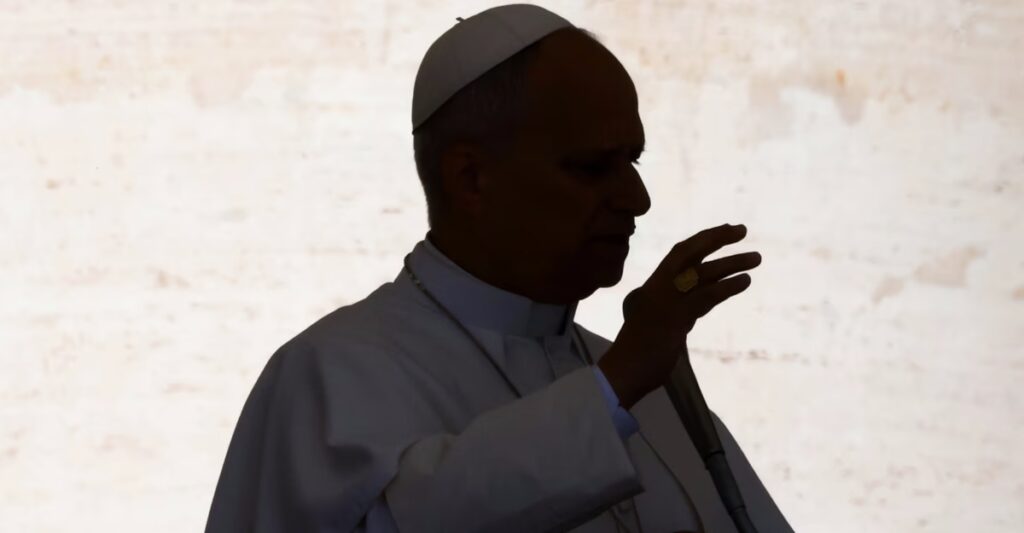
Magnifica Humanitas, Pope Leo XIV’s new encyclical “on safeguarding the human person in the time of artificial intelligence,” has received widespread praise. This isn’t surprising. A popular and learned world leader with a significant degree of moral authority is pointing out the dangers of a deeply unpopular technology created by deeply unpopular people.
The laudatory coverage of the encyclical is justified, but it has obscured perhaps Leo’s most important insight. Magnifica Humanitas (“Magnificent Humanity”) is not only—or even mostly—about AI itself. And the pope is challenging much more than Big Tech.
To be sure, Leo devotes considerable space to addressing the technology and its purveyors. In one of the document’s most-quoted passages, he declares that AI “must be disarmed” and prevented “from dominating humanity.” Elsewhere, he argues for the need “to establish adequate regulatory tools capable of upholding justice and curbing the distorting effects of technological power” on human relationships, working conditions, public discourse, international affairs, and much else. Given AI’s “energy-intensive infrastructure,” the pope warns, “it is essential to develop more sustainable technological solutions that reduce environmental impact and help protect our common home.” He also points to the impunity bestowed on AI developers by the extraordinary resources they have at their disposal.
[Elizabeth Bruenig: The pope grasps the limits of AI]
But Leo doesn’t stop there. “Technology promises emancipation” for the stable and secure, he writes, which in turn “produces new forms of global subordination” for those in precarious situations. No doubt, many encyclical readers fall, like me, into the first group. He’s implicating us, too.
“Nothing in the world of AI is immaterial or magical,” Leo challenges us to keep in mind. “Every seemingly immediate and flawless response is the result of a long chain of mediation, involving vast networks of natural resources, energy infrastructure and, above all, people.” These include people “working under demanding conditions for minimal wages,” Leo writes. “In some regions of the world, children and adolescents work in dangerous conditions, crushing the materials from which rare earth elements are extracted. The bodies of these people are scarred, injured and worn down so that computational flow may continue uninterruptedly.”
Leo rightly calls this a form of slavery—and the ones who benefit from it include much of his audience. We are the ones who demand and expect endless, frictionless data so that we can be more efficient and adept at work and school, more entertained and eased at home, more liberated from the slow, hard effort of reading and understanding. And instead of reckoning with our own complicity, we blame AI and Big Tech. Now, thanks to Magnifica Humanitas, we can selectively quote an authority no less than the pope to heighten that blame even more.
AI hasn’t created this situation. Rather, it has dramatically accelerated a preexisting one in which human affairs were already governed by paradigms that place the ultimate good in technology, economics, and unconstrained individualism. “We live at a time of significant spiritual and cultural blindness,” Leo writes, thanks in part to “a disconcerting loss of historical memory.” Warmongers prolong conflict “as a source of power and income,” while “globalization has provoked fundamentalist, identity-based and nationalistic reactions.”
Humanity, not technology, is responsible for this polycrisis. Accordingly, Leo says that we’re responsible for remedying it. This will require building “a civilization of love” based on “the sum total of small and steadfast acts of fidelity that serve as a bulwark against dehumanization,” the pope writes. He grounds this account in biblical precedents, invoking the humble, gradual, communal rebuilding of Jerusalem recounted in the Book of Nehemiah, contrasting it with the story of the proud, striving, failed effort to build the Tower of Babel. Throughout the encyclical, and especially near its conclusion, he also invokes Christianity’s core proposition, which accounts for the title of the encyclical.
Humanity is magnificent, Leo says, because God made us in his own likeness; because a first-century Jewish teenage girl from Nazareth gave birth to the son of God; because this indwelling of the eternal divine in mortal human form endows humanity itself with the highest possible meaning, purpose, and value.
[Read: The pope doubles down on the beautiful struggle]
To nonbelievers, the Jesus-and-Mary stuff may be unconvincing, even a little ridiculous. But Leo proposes that the incarnation is the firmest possible ground for the conviction that “no computational system, however sophisticated, can create a heart that gives itself, or a conscience that discerns good from evil.”
Leo has offered an answer to the signal question of the digital age. This question isn’t what to do about AI—that’s secondary. The question is: What does it mean, what does it take, to be human? You don’t need to agree with the pope about why humanity is more magnificent than AI, but his encyclical reveals what’s happening now that fewer and fewer people believe that it is.
The post Pope Leo Is Challenging Much More Than Big Tech appeared first on The Atlantic.